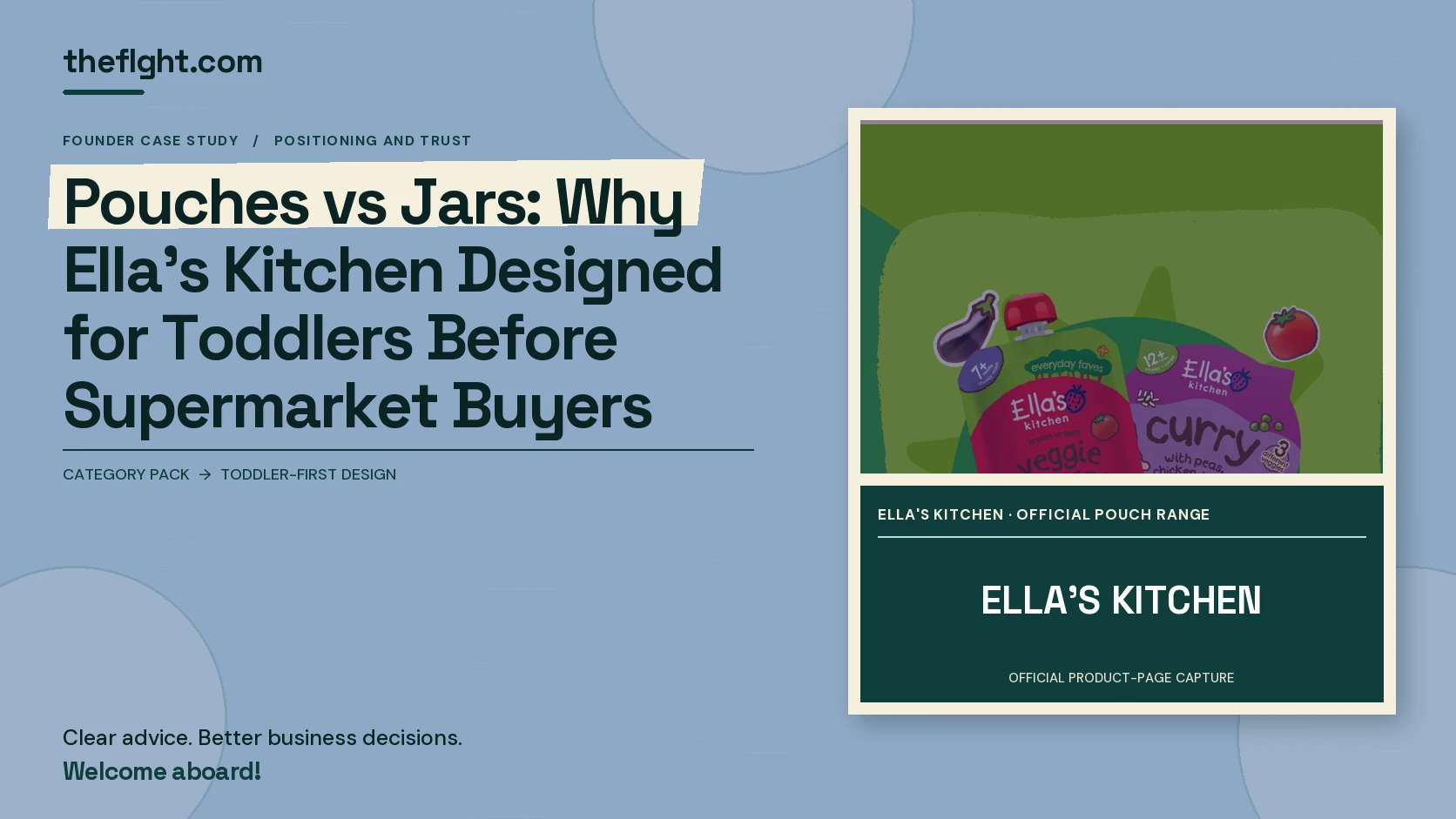
Pouches vs Jars: Why Ella's Kitchen Designed for Toddlers Before Supermarket Buyers
Short answer: Choose distinctive packaging only when it improves a specific customer job and still survives production, shelf, compliance and cash tests. Compare the formats through observed use, paid purchase, delivered unit cost, minimum order, damage, filling capability and retailer acceptance. Packaging is a defensible difference when customers use or choose the product differently because of it; colour and novelty alone rarely justify a large first order.
New brands often design for a buyer's range review or an online thumbnail. The person consuming, carrying, opening or storing the product may face a different problem.
Packaging can resolve that problem and make the brand recognisable at the same time. It can also lock scarce cash into printed material before demand is known.
Use the Packaging Difference Proof Stack
The Packaging Difference Proof Stack has five layers. A format must pass from customer use through cash exposure before it deserves scale.
| Layer | Question | Evidence | |---|---|---| | Use | Does the pack make the product easier or better to use? | Observed task completion and failure | | Choice | Will buyers select it at the intended price? | Paid comparison against alternatives | | Product protection | Does it preserve safety and quality? | Qualified technical testing | | Channel fit | Can it be filled, shipped, shelved and sold? | Supplier and retailer trial | | Cash | Can the business fund minimums and lead time? | Downside working-capital case |
My position is that packaging should be treated as product design, not decoration, when it changes how the customer experiences the offer. That also means it deserves the same testing discipline as the product inside.
What Ella's Kitchen changed
Paul Lindley built Ella's Kitchen around young children rather than accepting the conventional baby-food category cues. In a founder interview about the launch, he describes creating a colourful, tactile pouch that children could hold and that was convenient for parents. He had encountered the squeezable format in France, according to an Elite Business profile.
The commercial commitment was substantial. Lindley says he began with about £20,000, then remortgaged his home to raise £200,000 after Sainsbury's agreed a six-month trial across more than 300 stores. The brand launched there in January 2006 with two products. In his own later account of the decision, he describes the risks on both sides: a new supplier, new brand, new packaging format and no track record in baby food.
These figures are founder-reported and do not establish that the pouch alone caused later growth. The useful evidence is the sequence: design around the user's experience, secure a bounded retailer test, then confront the stock and cash required to supply it.
Start with the customer's physical job
Observe the product being opened, held, dispensed, consumed, stored and discarded in its real setting. Record where people spill, pause, ask for help or abandon the task. Parents may value one-handed use and portability; the child may respond to touch, colour or independent handling; the retailer needs a stable item that survives distribution and communicates clearly.
Write the job without mentioning the proposed format. “Feed a toddler while travelling with little mess” is a job. “Use a pouch” is a predetermined answer.
Compare at least two realistic formats with the same product and brand information. If testers know which design you prefer, politeness can distort feedback. Measure time, waste, errors and actual choice rather than asking which looks innovative.
Some users may dislike the distinctive format for equally valid reasons, including storage, recycling, portion control or difficulty seeing the contents. Your decision should specify the segment and occasion the packaging serves, not claim universal superiority.
Test product protection before brand appeal
Food packaging has to protect the product through filling, transport, storage and intended use. Material compatibility, seals, migration, contamination, shelf life, temperature and tamper evidence require appropriate technical assessment. Child-focused products also demand particular care around caps, choking risks, claims and instructions.
Requirements vary by product and market. In the UK, food business registration, labelling, allergens, packaging materials, weights, nutrition and advertising rules may apply. Use qualified food-safety, packaging, legal and regulatory professionals rather than relying on a converter's marketing claim.
A prototype made by hand can demonstrate grip but cannot prove an industrial seal or shelf life. Separate user tests from technical validation and require both to pass.
Cost the complete packed unit
Ask suppliers for more than the price of an empty pack. Include design adaptation, printing plates or cylinders, minimum order, freight, storage, filling-line changes, slower throughput, quality checks, waste and obsolete printed stock.
| Cost area | Jar or standard format may offer | Custom pouch or novel format may impose | |---|---|---| | Empty pack | Established supply and lower minimums | Higher minimums or specialist material | | Filling | Familiar local capability | New equipment, setup or contract partner | | Freight | Heavier and breakable | Lighter but potentially less rigid | | Shelf | Familiar category presentation | Strong distinction but uncertain merchandising | | Cash | Easier short runs | Printed stock paid before demand is known |
Calculate packaging obsolescence separately. A recipe, legal line, barcode or claim can change while thousands of printed units remain. Use labels or shorter digital print runs during proof stages where technically and legally appropriate, even if the per-unit cost is higher.
Worked example: Little Harbour Meals
Little Harbour Meals is comparing a glass jar with a shaped spouted pouch for a chilled toddler meal. A permitted customer-use test indicates that parents complete feeding 25% faster with the pouch and report fewer spills. A paid pop-up test sells 96 of 140 offered pouches and 63 of 140 jars at the same £2.40 retail price.
The pouch nevertheless carries greater commitment:
| Item | Jar | Pouch | |---|---:|---:| | Minimum order | 5,000 | 25,000 | | Empty pack and closure | £0.29 | £0.43 | | Filling and setup per unit | £0.24 | £0.31 | | Freight and expected damage per unit | £0.18 | £0.09 | | Printed setup cost | £900 | £4,800 |
For the minimum run, jar packaging cash is 5,000 x (£0.29 + £0.24 + £0.18) + £900 = £4,450. Pouch packaging cash is 25,000 x (£0.43 + £0.31 + £0.09) + £4,800 = £25,550.
The pouch saves 9p per unit on freight and damage but costs £21,100 more at the first minimum. Suppose the complete pouch product leaves 62p contribution when sold wholesale. The business must sell £25,550 divided by £0.62 = 41,210 units to recover packaging cash alone, more than the first 25,000-unit run because the contribution also funds ingredients and other costs outside this simplified comparison.
Little Harbour should not place the full custom order from a 280-unit sales test. It negotiates a 3,000-unit plain-pouch pilot with compliant labels at a higher unit cost, then seeks retailer sell-through and repeat-purchase evidence. Distinctive use has passed; scaled cash has not.
These figures are illustrative. Food and packaging decisions require product-specific professional advice.
Prove the difference survives the shelf
A pack can perform well at home and fail in the channel. Test how it stands, hangs, faces forward, fits cases, scans and survives replenishment. Ask the retailer where it will be placed and which dimensions, barcodes, case quantities and shelf-life rules apply.
Run a bounded number of stores for a fixed period. Track units delivered, units sold at full price, markdowns, waste, returns and repeat orders. Compare with the category alternative where the retailer permits it. A high first-week sale caused by prominent launch placement may not continue after the display changes.
Direct sales need a channel test too. Pack real orders, send them through the intended carrier and measure leakage, damage and customer service. Lightweight packaging can reduce freight while increasing the need for protective outer packaging, erasing the apparent saving.
Make the packaging decision in 30 days
In week one, observe at least ten target users completing the real task with two plausible formats. Record actions, not adjectives. During week two, obtain qualified technical requirements and written supplier quotes covering minimums, setup, filling and lead time.
In week three, sell a compliant short run at the intended price through one relevant channel. Measure selection, successful use and repeat intent. In week four, calculate the downside cash exposure if only half the first run sells before a change is required. Approve the distinctive format only when all five proof layers pass.
Related guides
Frequently asked questions
Is distinctive packaging worth paying more for?
Yes when it improves a valued customer outcome or meaningfully increases paid choice enough to recover the extra complete cost. Compare contribution, not the empty-pack price. Include filling, freight, damage, storage, waste, retailer deductions and obsolete stock. Then test whether the advantage persists after novelty. A 12p packaging premium can be rational if it supports a higher price, lower damage or more repeat purchases. It is wasteful if customers merely call it attractive. Set the improvement and payback threshold before commissioning a large printed run.
How many customers should test a new package?
Start with 10 to 20 observed users to uncover physical failures, then run a larger paid comparison appropriate to the purchase frequency and risk. There is no universal sample that proves a market. A low-risk local product may justify another short run after dozens of purchases, while a national food launch needs technical validation and stronger channel evidence. Ensure testers represent the actual user and buyer, who may be different people. Continue until repeated problems stabilise and paid behaviour, not stated preference, supports the next financial commitment.
Should I show the packaging to supermarket buyers before testing consumers?
Speak to buyers early about dimensions, shelf life, case size, merchandising, compliance and category fit, but do not let one buyer replace customer evidence. Retailers can identify operational reasons a format will fail. Consumers reveal whether it improves use and earns purchase. Present prototypes honestly and distinguish technical assumptions from validated performance. A buyer's interest may be conditional and is not a purchase order. Before investing in minimum quantities, obtain written requirements, a defined trial route and enough working capital to supply it.
Can I copy a packaging format used in another country?
You can investigate the format, but do not assume designs, closures, materials, intellectual property, labelling or compliance transfer across markets. Check patents, registered designs, trademarks and supplier rights with qualified advisers. Food-contact and recycling requirements can also differ. A format seen abroad may require different filling equipment or lack local recycling infrastructure. More importantly, test the customer job in your market. Ella's Kitchen's founder reportedly encountered pouch packaging in France, but the business still had to build its own product, brand and UK retail case.
What if the minimum packaging order is too large?
Do not let the supplier's minimum define your evidence requirement. Ask about plain stock with compliant labels, digital printing, a shared production run, a smaller converter or a contract packer with suitable equipment. The per-unit cost may be higher, but total cash and obsolescence risk can be far lower. Compare the extra short-run cost with the potential write-off on unused custom packs. If no compliant small route exists, secure stronger paid orders or retailer commitments before production. Never compromise safety or mandatory information to reduce the minimum.
How should I test child-focused packaging safely?
Use qualified specialists and an ethics-conscious protocol appropriate to the child's age and the product. A parent or responsible adult should control participation, and the test must not expose children to unapproved food, loose parts, choking hazards or misleading claims. Observe only after technical risks have been assessed. Laws and standards vary by market and product, so obtain food-safety, product-safety, data and legal advice. Parent approval is not a substitute for compliance. Early testing can focus on adult handling and controlled observation before any child uses the pack.
What if customers prefer the pack but retailers reject it?
Identify the exact channel failure. The issue may be case size, shelf stability, hanging, scan reliability, leakage, margin or category rules rather than customer demand. Test direct sales, specialist retail or a modified secondary pack if those routes preserve the customer benefit and produce viable economics. Do not assume retailer resistance is irrational, but do not redesign solely to fit one account without checking alternatives. A format can be right for a different channel. Cost every route and verify that production minimums and working capital remain affordable.
Comments (0)