How Long Should You Keep Developing Before Launch? Lucky Saint's Six-Brewery Search
Short answer: Keep developing while each cycle tests a named failure cause, moves a measurable customer outcome and leaves enough cash for one launch plus one correction. As a working rule, stop when the product meets a pre-declared minimum standard across two repeatable production runs, not when the founder calls it perfect. If three consecutive cycles fail the same measure without a new technical explanation, change the specification, partner or business rather than funding another hopeful attempt.
A deadline can force useful focus. It can also send an unacceptable product into market and turn customers into unpaid quality inspectors.
The opposite error is just as costly. “One more version” becomes an identity, while runway disappears and no buyer is asked to pay. Development needs evidence gates and a stop clock.
Use the Development Runway Stop Clock
The Development Runway Stop Clock connects technical learning to cash remaining. Every cycle must buy one defined piece of evidence and preserve enough runway for the next authorised stage.
| Clock point | Question | Evidence to continue | Stop or change signal | |---|---|---|---| | Specification | What must the product do? | Measurable minimum and target | Success remains subjective | | Failure diagnosis | Why did the last version miss? | Named cause supported by test data | Team changes several variables blindly | | Repeatability | Can the partner reproduce it? | Two qualifying runs | One lucky sample only | | Buyer proof | Will target customers pay? | Controlled paid or trade test | Compliments without purchase | | Launch readiness | Can you make, deliver and support it? | Costed capacity and quality plan | Product works only under founder supervision | | Runway | What remains after the next cycle? | Launch and correction cash protected | Development consumes survival cash |
My position is that calendar time is the wrong primary limit. Six disciplined iterations over two years can be rational; six undiagnosed versions in eight weeks can be waste. Limit the number and cost of unresolved failure cycles, then protect a hard launch reserve.
What Lucky Saint's two years established
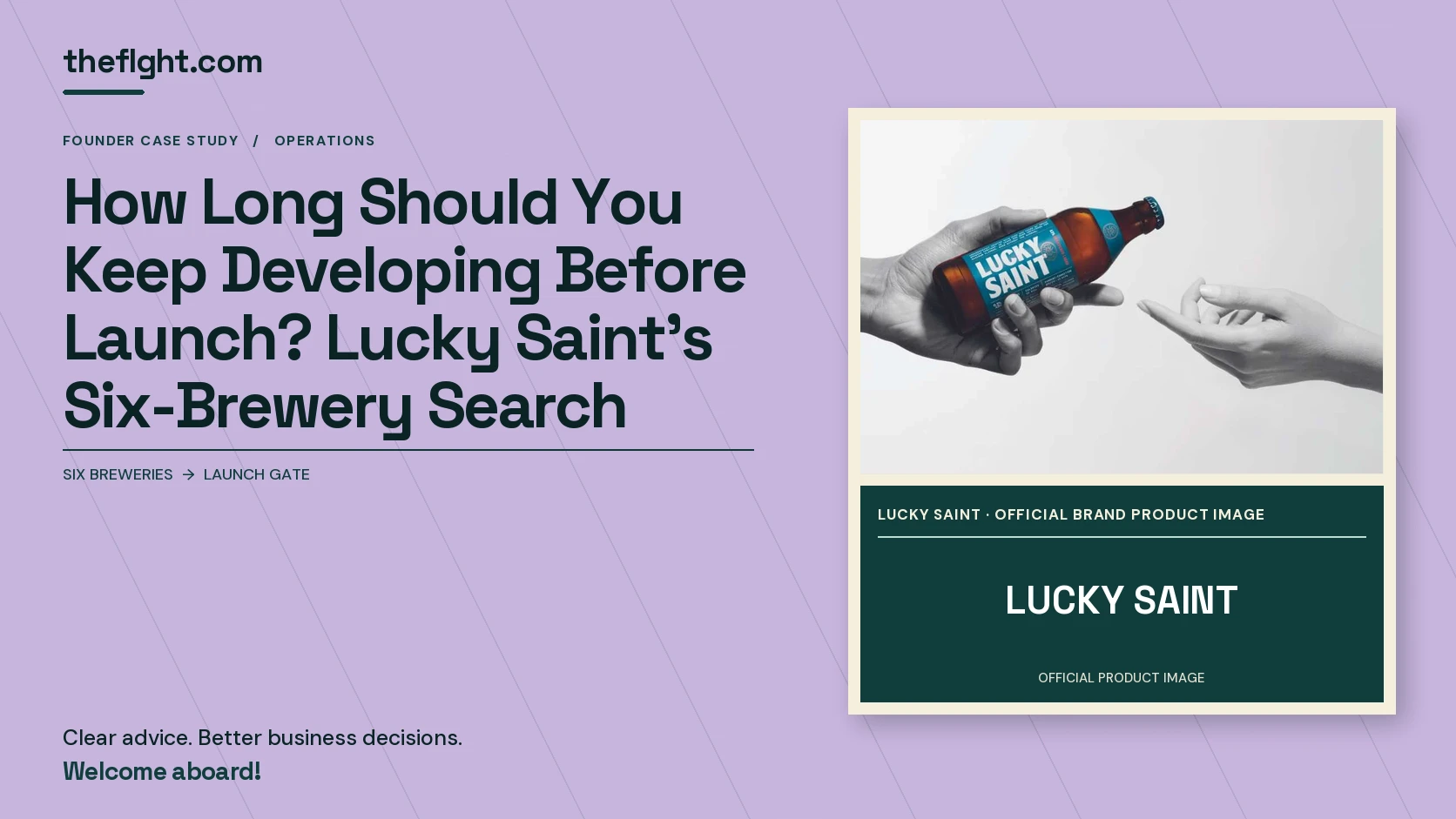
Lucky Saint founder Luke Boase set out to make an alcohol-free lager that delivered the experience he felt existing products lacked. Lucky Saint's company account says he spent two years working with six breweries before finding the right production match in Bavaria.
A Retail Bulletin interview adds that the work covered three countries and nearly 60,000 litres of brewing before the recipe was reached. Boase told Club Soda that he pursued a classic pilsner-style lager and that arriving in Germany was a turning point. The MBS Group's founder interview says only one brewery he found had the required technology and identifies Honest Burgers as an influential first account.
Those volume and timing figures are founder or company reports, not a cost ledger. They do not prove every litre was avoidable waste or that another drinks business should wait two years. They show that partner capability was part of the product, and that launch readiness depended on finding a repeatable process rather than choosing an arbitrary date.
Define minimum, target and unacceptable performance
Translate “good enough” into measures before the next sample. For a drink, that may include taste scores from the defined buyer, stability, alcohol level, fill consistency, shelf life and delivered unit cost. For furniture, it may include load, assembly time, finish, defect rate and packed dimensions.
Use three levels:
- Minimum: the product cannot launch below this level.
- Target: the commercial result you want to reach.
- Unacceptable: a failure that ends the batch or partner trial.
Do not average away a safety or compliance failure. A pleasing flavour does not compensate for unlawful labelling. Product, alcohol, food-safety, packaging and marketing requirements vary by market. Use accredited testing and qualified regulatory advice where needed.
Customer measures also need a threshold. Ask target buyers to compare coded samples, then include an intended price and buying context. Preference for a free sample is weaker evidence than a buyer placing a conditional order after seeing cost, minimum quantity and lead time.
Diagnose one failure before funding the next
After each run, write the failed measure and most likely cause. Change the smallest set of variables needed to test it. If recipe, equipment, process time, packaging and supplier all change together, improvement cannot be attributed and the next failure teaches little.
Keep a version record covering input specification, process, result, cost and decision. This is an operating record, not a public story. It prevents the team repeating abandoned ideas when staff or partners change.
Partner failure and product failure are different. A recipe may work in a development kitchen but fail on a particular production line. Before changing the product, ask whether the partner can control temperature, timing, ingredient handling, tolerances and packaging at the required scale.
The article on [how to check a supplier before paying a deposit](/operations/check-a-supplier-before-paying-a-deposit/) explains the wider commercial checks. Technical enthusiasm should not bypass solvency, capacity and contract review.
Protect the launch reserve
Divide available cash into development, launch and correction pots. Development funds approved test cycles. Launch cash covers the first commercial run, compliant packaging, freight, selling and working capital. Correction cash covers a contained recall, repack, delayed retailer payment or second run.
Do not spend the launch reserve because the next prototype feels close. A finished product without cash to produce or distribute it is not ready.
At each clock review, calculate:
cycles remaining = uncommitted development cash divided by full cost of one learning cycle
Use the full cost, including founder time, travel, testing, write-offs and partner charges. If only one cycle remains, its success condition and fallback must be explicit before approval.
Worked example: North Pier Soda
North Pier Soda has £74,000 available to develop and launch a low-sugar botanical drink. It protects £32,000 for the first commercial run and £12,000 for launch corrections, leaving £30,000 for development.
One brewery trial costs:
| Cost | Amount | |---|---:| | Ingredients and production slot | £4,600 | | Laboratory and shelf test | £1,350 | | Packaging samples and freight | £950 | | Founder time and travel | £1,100 | | Full cycle cost | £8,000 |
The budget permits £30,000 divided by £8,000 = 3.75, so only three complete cycles can be authorised while preserving £6,000 development cash.
Cycle one scores 61 out of 100 in a blind buyer test against a minimum of 72 and shows inconsistent carbonation. The brewery identifies a filling-pressure problem. Cycle two reaches 74, but only 84% of bottles fall within the declared fill and carbonation tolerance, below the 97% minimum. Cycle three at the same partner reaches 89% with no new technical explanation.
The stop rule activates: three cycles are used and the same repeatability gate still fails. North Pier does not release the £44,000 protected launch and correction cash for a fourth hopeful batch. It spends the remaining £6,000 on a small technical-transfer trial with a different qualified producer. If that partner cannot meet the tolerance, the company changes the format or stops.
The interesting result is that the recipe passed the taste gate in cycle two. Launch remained wrong because production repeatability, not flavour, was the binding constraint.
These figures are illustrative. Use accredited, sector-appropriate tests and your actual tax and production costs.
Use paid buyer proof without pretending it is launch
Once minimum product and compliance gates pass, offer a bounded commercial test to a small number of target buyers. State the production status, delivery date and refund terms accurately. Do not take money for a product you cannot lawfully supply.
For a hospitality product, test repeat orders from a few appropriate venues. Record rate of sale, reorder timing, wastage, serving problems and payment. A respected first account can supply credibility, but one friendly buyer does not prove national demand.
Keep the batch small enough that a failure can be corrected without threatening the business. Price it at the intended economics. A subsidised pilot can reveal use, but it cannot establish that the finished unit works commercially.
Decide the next cycle within 10 working days
On days one and two, define minimum, target and unacceptable results. By day four, reconcile remaining cash into development, launch and correction pots. Review every previous version by day six and identify the unresolved cause.
Ask the partner for a written cycle plan, price, inputs, measurement and delivery date. Approve the run only if it tests that cause and leaves the protected reserves intact. Within two working days of results, choose one of four actions: repeat for confirmation, correct one variable, change partner or stop. Never approve “try again” as an action without a diagnosis.
Related guides
Frequently asked questions
How many prototypes should I make before launch?
As many as required to pass your minimum standard repeatedly, within a fixed learning budget. There is no responsible universal number. A simple non-regulated accessory may need a few versions, while food, electronics or medical products can require extensive testing and approval. Count complete learning cycles rather than cosmetic versions. Each cycle should test a named failure and produce a decision. Stop when the product passes across at least two repeatable runs or when the authorised budget, technical route or market case fails. Sector safety and compliance requirements always override a founder's preferred prototype count.
Does two years of development mean the idea is taking too long?
Not by itself. Time is justified when it resolves difficult, valuable uncertainty and the business can finance the period. Two years is wasteful when successive versions repeat the same failure without diagnosis or buyer evidence. Track cost, technical movement and runway at every cycle. Compare the likely advantage with the opportunity cost of waiting. Lucky Saint's reported search involved a demanding production capability and several breweries; that does not make two years a benchmark. Set your own stop rules before sunk cost makes another year feel inevitable.
When should I change manufacturing partner?
Change when the partner cannot meet an agreed critical measure across the permitted correction cycles, lacks required capability or capacity, hides process information, or creates unacceptable commercial risk. First confirm that your own specification is complete and achievable. A supplier cannot reproduce a target that moves after every sample. Request root-cause evidence and a dated corrective plan, then test it once where risk permits. Protect tooling, formulas, data and approvals through written agreements. Supplier termination and transfer can affect intellectual property, deposits and compliance, so obtain qualified advice.
Should I launch a minimum viable product for food or drink?
Only if “minimum” still means safe, lawful, stable and true to the promise customers are buying. You can reduce flavours, pack sizes, channels and production volume. You cannot treat consumers as a test for unresolved safety, allergens, shelf life or labelling. Use controlled sensory and trade tests before general sale, with qualified technical oversight. The viable product must also be repeatable at its selling cost. A perfect brand campaign around an inconsistent drink is not a minimum viable product. It is a preventable trust failure.
How do I know whether testers are being polite?
Use blinded comparisons, individual scoring before group discussion and a purchasing consequence. Recruit target users who do not depend on pleasing you. Ask them to choose between coded products, state what they currently buy and decide at the intended price. Hospitality or retail buyers can place a small conditional order. Friends' adjectives are weak evidence. Repeat buying and comparable preference are stronger. Keep the same protocol between versions so movement is meaningful. If only the founder can explain why the product is better, it is not yet communicating through the experience itself.
What if the best product is too expensive to make?
Treat cost as a failed specification, not a problem for later. Break the unit into ingredients, conversion, pack, freight, wastage and channel margin, then identify the cost driver. Test whether customers will pay the required price before degrading the feature they value most. A smaller pack, narrower channel or different process may preserve the promise. If no price and configuration leave adequate contribution, stop or change the proposition. Do not launch at a knowingly unsustainable margin in the hope that unspecified future scale will rescue it.
How much cash should remain at launch?
Enough for the first commercial run, all delivery and selling costs, normal operating commitments and at least one defined correction scenario. The amount depends on lead times, payment terms, batch minimums and recall exposure. Build a dated cash forecast rather than using a percentage alone. Ring-fence tax and customer deposits according to their obligations. If the final development cycle consumes money required to supply confirmed launch orders, you are not ready. Food, alcohol and product-liability risks merit qualified financial, legal and technical advice.
Comments (0)