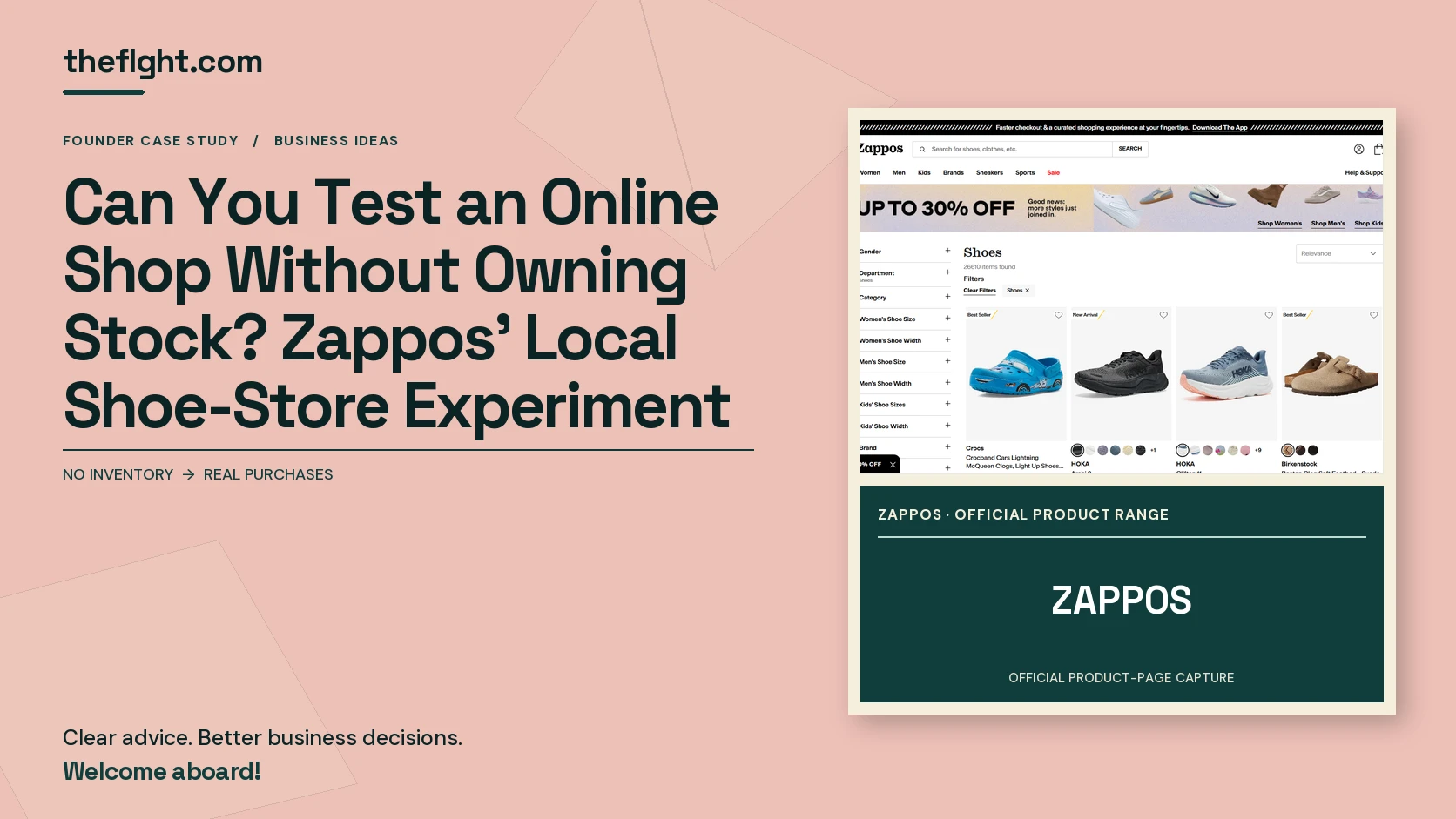
Can You Test an Online Shop Without Owning Stock? Zappos' Local Shoe-Store Experiment
Short answer: Yes. List a narrow range you can lawfully source one unit at a time, take normal payment, buy each item only after an order and fulfil it manually for 20 to 30 orders. Use the test to prove paid demand, product choice, availability and delivery behaviour. Do not treat its deliberately poor margin as the future business model, and do not buy stock until supplier pricing makes the same orders profitable.
Founders often “test” an online shop with a survey, a waiting list or social engagement. Those methods can test attention. They do not prove that someone will choose a product, accept the price, enter payment details and tolerate the delivery promise.
Owning stock too early creates the opposite problem. You can lose thousands of pounds before learning whether the buyer exists. A manual, stockless test sits between those extremes, but only if the customer transaction is real.
Zappos tested the purchase before building the stock operation
Nick Swinmurn founded the business that became Zappos in 1999. In a later interview with Fortune, he described asking a local shoe shop for permission to photograph its products. He put those images online and, when a customer ordered, bought the pair from the shop at full retail price.
Tony Hsieh later described the same process in a How I Built This interview transcript. The transactions did not make money, but they tested whether people would actually buy shoes online at a time when online payment itself created anxiety.
The important feature was not that the website looked minimal. It was that the front of the transaction was genuine. The customer selected a real shoe and paid. The manual sourcing happened behind the promise.
This experiment did not prove that a stocked shoe retailer would have attractive returns, supplier terms or fulfilment costs. It proved a more basic uncertainty: some customers would buy footwear online. That evidence justified tackling the next risks.
My view is that a loss-making test is acceptable only when the loss buys evidence that cannot be obtained more cheaply. It must have an order cap and an end date. “We lose money because we are validating” becomes an excuse if you cannot state what the next model changes.
Use the Stockless Demand Proof
The Stockless Demand Proof separates six questions that founders often collapse into “people bought”.
| Test | Evidence to record | What it does not prove | |---|---|---| | Choice | Product and variant selected at the stated price | Broad demand for a whole category | | Payment | Cleared normal-price order | Repeat purchase or future retention | | Availability | Item found after the order | Reliable wholesale supply | | Fulfilment | Item delivered within the promise | Scaled warehouse performance | | Return | Refund reason, condition and cost | Mature return rate from larger volume | | Stocked economics | Quoted wholesale cost and operating cost | Actual margin until supplier terms are secured |
Pass the stages in order. A paid order that you cancel because the shop has sold the item is still evidence of demand, but also evidence that your sourcing promise is unreliable. Record both.
Set thresholds before launch. For example: 25 fulfilled normal-price orders, at least 80% sourced on the first attempt, at least 90% dispatched within the stated window, and a credible wholesale quote producing positive contribution after expected returns. These are working thresholds, not universal benchmarks.
Choose a range narrow enough to fulfil manually
Start with one buyer, one product problem and 20 to 50 listings. A vast catalogue creates false choice and makes availability impossible to control. You need enough variation to observe what customers choose, but not so much that every order teaches a different lesson.
Get the shop or supplier's permission before photographing products, using descriptions or relying on access to stock. Do not imply a supply arrangement that does not exist. Check each item's availability at least daily during the test and remove anything you can no longer source.
Products should be legal to resell, safely deliverable and verifiable. Avoid regulated, age-restricted, hazardous, perishable or safety-critical products unless you already understand and can meet the obligations. Counterfeit risk alone can make an informal source unsuitable.
The test should preserve the part you are trying to learn. If delivery speed is central to the proposition, a two-week manual delay invalidates the result. If curation is the promise, a limited range is acceptable because it expresses the intended service.
Take a real payment without deceiving the buyer
The customer must receive an accurate description, price, delivery date, return terms and seller identity. You do not need to advertise your internal sourcing method, but you cannot promise stock you know is uncertain or claim dispatch has occurred when it has not.
Keep the order cap within the cash you can lose. Each sale may require you to buy at retail before payment clears, pay delivery twice after a return and refund the full customer amount. Ring-fence that exposure.
Consumer rights, product safety, taxes, distance-selling information and return requirements vary by country and product. UK sellers should verify current obligations for online sales, and any material decision needs qualified local legal and tax advice. A test order is still a real sale.
Worked example: TrailStep tests specialist walking shoes
TrailStep is a hypothetical UK online shop for wide-fit walking shoes. The founder obtains permission from two independent retailers to photograph 36 models and check availability. The site states a five-working-day dispatch promise and takes normal payment. The founder caps the test at 30 orders.
During four weeks, TrailStep receives 30 orders at an average selling price of £102. Two pairs are unavailable and refunded. Twenty-eight are bought from the retailers for an average of £84 and delivered.
| Item | Arithmetic | Amount | |---|---:|---:| | Revenue on 28 fulfilled orders | 28 x £102 | £2,856 | | Retail purchase cost | 28 x £84 | £2,352 | | Outbound delivery | 28 x £6.20 | £173.60 | | Payment fees | 28 x £2.34 | £65.52 | | Four returns, collection and second delivery | 4 x £11.50 | £46.00 | | Test contribution before founder time | £2,856 - £2,352 - £173.60 - £65.52 - £46 | £218.88 |
The test appears slightly positive only because returned shoes can be taken back under the retailers' agreed arrangement. It produces £7.82 before founder time per fulfilled order. That cannot fund customer support, photography and overhead.
A distributor then quotes £58 per pair for an opening order of 60 units. At the same price and other variable costs, expected contribution becomes £33.46 per non-returned order before the cost of holding unsold sizes. If 60 pairs cost £3,480 and only 36 sell in the first cycle, £1,392 remains tied up in 24 pairs.
The result is useful but incomplete. TrailStep has evidence of online payment, a 7% unavailability rate and four returns from 28 deliveries. It should negotiate a small mixed-size order or repeatable replenishment before buying 60 units. Demand passed. Stock risk has not.
Do not confuse manual sourcing with dropshipping
In this test, you own the customer promise and personally verify each purchase. A dropshipping arrangement delegates fulfilment to a supplier and creates different risks: inventory feeds, packaging, delivery control, cross-border duty and return handling.
Either model can be legitimate. They answer different questions. Manual retail buying is an intentionally temporary way to observe the entire order. Supplier fulfilment may test whether a continuing low-stock model can operate.
Do not hide weak economics behind the absence of inventory. Calculate contribution as though your labour were eventually paid. If the only path to profit assumes a wholesale price no supplier has offered, you have not yet found a business.
Decide what the test must prove
A successful test should lead to one specific next commitment: a small wholesale order, a supplier account, a narrower category or a stop decision. It should not automatically trigger a broad catalogue and warehouse lease.
Look for concentration. Which five products generated most purchases? Which sizes caused cancellations? Did buyers arrive because of category expertise, price or convenience? A narrow demand pattern often supports a smaller, safer first order than the founder expected.
Ask the first customers why they chose you only after recording what they actually bought. Stated motives are useful context. Paid selection remains the stronger evidence.
Run a 30-order test in five weeks
Week one: define one buyer and range, obtain written permissions, verify your legal obligations and cost the maximum loss. Week two: publish accurate listings and test payment, confirmation, sourcing, delivery and refund flows yourself.
Weeks three and four: fulfil up to 30 normal-price orders. Record unavailable items, time per order, dispatch, contacts, returns and reasons. Do not substitute products without consent.
Week five: obtain written wholesale prices and minimum orders for the concentrated demand. Model a downside in which only 60% of stock sells during the first cycle. Buy stock only if the downside preserves cash and the delivered contribution can pay for the work.
Related guides
Frequently asked questions
Is it legal to list products I do not own yet?
It can be, but you must have a lawful, realistic way to supply them and give customers accurate information. Permission to use photographs and descriptions, product authenticity, safety, availability claims, delivery dates, cancellations and returns all matter. Taking money for goods you cannot reasonably fulfil can create consumer and payment-provider problems. Requirements differ by jurisdiction and product category. Before launching, check current local rules and obtain qualified legal advice where the exposure is material. A “test” label does not remove your obligations as the seller.
How many products should I list in the test?
List enough to represent the buying decision but few enough to verify availability every day. For many specialist shops, 20 to 50 products across the most important variants is a useful starting range, not a universal rule. A buyer seeking one replacement part may need only ten credible options. Fashion footwear may require sizes and colours that multiply complexity. If you cannot explain what each additional listing helps you learn, leave it out. Catalogue size should serve the hypothesis, not imitate an established retailer.
What if I lose money on every test order?
Accept the loss only when it is capped and purchases answer an expensive uncertainty. Calculate the maximum loss before opening orders, including retail purchase, payment fees, delivery, returns and refunds. A £12 loss on 25 orders is a £300 research cost. An uncapped loss on hundreds of orders is a broken business model. Stop after the planned cohort, use the evidence to secure wholesale economics, then retest contribution. If no plausible supplier terms can make a proven order profitable, demand alone is not enough.
Can I use pre-orders instead of buying after each sale?
Yes, when the customer clearly understands the item is a pre-order and the delivery timing is credible. Pre-orders test willingness to wait as well as willingness to pay, which may not represent a normal stocked shop. They also create fulfilment, refund and cash obligations before you have the goods. Keep receipts reserved for the promised order rather than treating them as free working capital. Consumer and tax treatment varies by jurisdiction, so verify local requirements and payment-provider terms before taking material sums.
Should I refund an order when the local shop is out of stock?
Yes, unless the customer freely accepts an accurate alternative or revised date. Do not source a different size, version or condition and assume it is equivalent. Record the cancellation as two pieces of evidence: the customer wanted the item, and your supply method failed. A high unavailability rate means the manual test is damaging trust and no longer produces clean demand evidence. Pause the listing, improve availability checks or secure supplier access before taking more customer orders for that product.
When should I place the first wholesale order?
Place it when normal-price orders concentrate around specific products, a supplier has confirmed price and availability, and a downside sell-through case does not threaten essential cash. Include delivery, duty, storage, damage, returns and slow variants in landed cost. Do not order merely because the minimum quantity provides an attractive unit price. Model the cash left if 40% remains unsold after the first planned cycle. If that remainder prevents tax, payroll or essential replenishment, negotiate a smaller order or keep testing.
Comments (0)