License Your Product or Build the Brand? Why Trunki Took Control After Its Licensee Failed
Short answer: License when a capable partner can reach the market faster and your contract protects the rights, quality, reporting and return of control that matter. Build the brand yourself when customer learning, product quality and category creation are the core advantage, and you can finance stock, compliance and distribution. Before signing, model the downside in which the licensee sells little or fails, because a royalty percentage is irrelevant if your product is positioned badly and your rights are trapped.
Licensing is often described as the low-risk route. It reduces manufacturing exposure, but it replaces that exposure with dependence on another company's priorities, competence and solvency.
Running the brand gives you control. It also gives you every bill. The correct choice depends on where the value must be learned and protected.
Use the License-or-Control Rights Matrix
The License-or-Control Rights Matrix compares the two routes across six assets. Score each from one to five for strategic importance, then ask which route gives you enforceable control over the highest-scoring assets.
| Asset | Licensing can provide | Owning the brand can provide | Contract question | |---|---|---|---| | Market access | Established sales channels | Direct choice of channels | What launch and sales duties are binding? | | Product quality | Partner's production system | Direct specifications and inspection | Who approves changes and failures? | | Customer learning | Periodic reports | Direct complaints, use and repeat data | What data must be shared? | | Brand position | Partner's portfolio and sales choices | Consistent price, message and range | What uses require approval? | | Cash | Low production funding | Higher unit margin after investment | What costs precede any royalty? | | Recovery | Termination and rights reversion | Supplier replacement under your control | What happens on breach or insolvency? |
My view is that first-time product founders overvalue the royalty rate and undervalue customer learning. If the category is unfamiliar and the offer still needs positioning, handing the market interface to a licensee can prevent you learning why buyers accept or reject it.
What Trunki's first licence changed
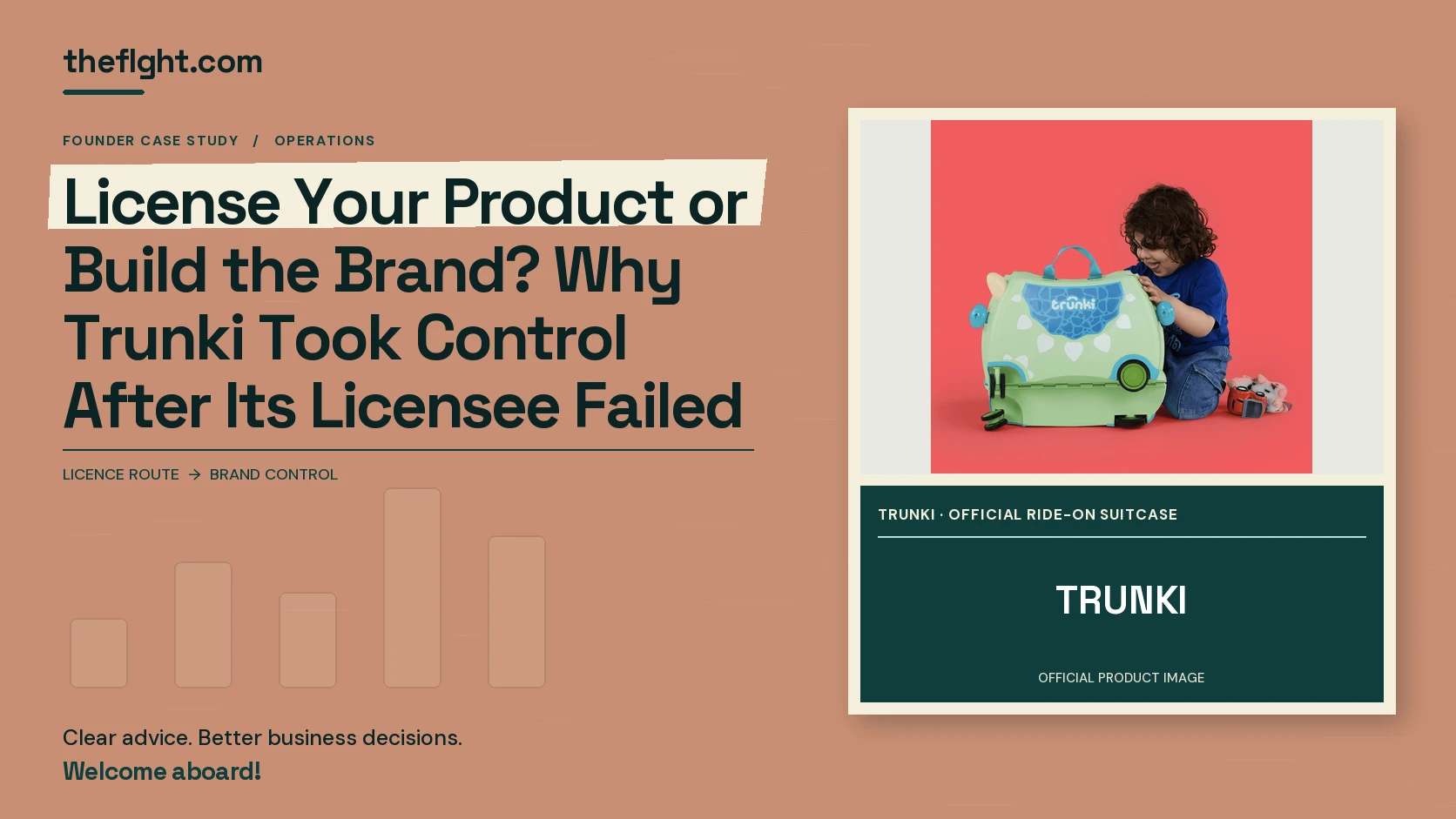
Rob Law developed the ride-on children's suitcase that became Trunki and initially planned to license it rather than build an operating company. In a detailed founder interview, Law says his entire £4,000 Prince's Trust loan paid the legal fees for the licensing contract.
The arrangement lasted around three years before the licensee went into liquidation. Law says the toy company had positioned the product as a cheap toy rather than the lifestyle and travel brand he believed it should become. He then decided to bring Trunki to market himself. A later Sage interview with Law confirms the sequence: manufacturers initially rejected the concept, the eventual licensee performed poorly and failed, and Law took control.
His problems did not end with ownership. The first trading year included a Chinese factory failure, product-quality trouble and restrictions on cabin luggage, as Law recounts in another interview on Trunki's early hurdles. Ownership created the ability to respond, not an absence of risk.
Decide where the irreplaceable learning sits
If the invention is technically complete, buyers understand the category and a partner already reaches them, licensing can be efficient. The licensee contributes production, purchasing, compliance, distribution and working capital while you receive royalties.
If the product creates a new category, you still need rapid answers about use, price, packaging and channel. Those answers often arrive through retailers, reviews, returns and customer service. A quarterly royalty statement cannot replace direct learning if it reports only units and net sales.
Write the five decisions you expect to make during the first two years. Examples include changing the strap, altering the age claim, moving from toy shops to luggage stores or adding a related product. Then identify who would control each decision under the proposed licence. If the licensee can refuse the changes that make the product work, the low-capital route may be strategically expensive.
Test the partner rather than admiring its size
Assess the exact team, factories, channels and budget assigned to your product. A large company with hundreds of products can be a weaker licensee than a focused operator because your launch is immaterial to its results.
Request evidence of comparable launches, retailer orders, quality systems, complaint handling and royalty reporting. Speak to other licensors. Ask what happened to the products that missed forecast, not only the successes.
Minimum sales commitments need dates and consequences. “Commercially reasonable efforts” may be difficult to enforce without defined activity. Agree territories, channels, product scope, exclusivity, sublicensing, audit rights, approvals, insurance, product liability and ownership of improvements with an experienced intellectual-property lawyer.
Intellectual-property, product-safety and insolvency rules vary by country. A licence does not transfer every legal responsibility automatically. Obtain qualified advice in each material market.
Compare cash at the same sales volume
Model royalties and own-brand contribution using the same units and time period. Include every cost needed before the first royalty or sale.
For licensing, include legal negotiation, prototypes, testing you fund, patent or design costs, audit work and the delay before statements and payment. Apply the royalty to the contract's definition of net sales, not the retail price displayed to customers.
For ownership, deduct production, tooling, freight, duty, inspection, warehousing, retailer margin, returns, sales commission, marketing and support. Then add the working-capital peak, because a profitable unit can still require unaffordable cash before collection.
Worked example: Ridgeway Ride-On
Ridgeway Ride-On has a children's travel product with a £55 recommended retail price. A licensee offers 6% of its net wholesale sales. It expects to sell 18,000 units to retailers at £24 each in year one.
The licensing case is:
| Item | Calculation | Amount | |---|---:|---:| | Licensee wholesale sales | 18,000 x £24 | £432,000 | | Gross royalty | £432,000 x 6% | £25,920 | | Founder legal, design and audit cost | Given | (£11,500) | | Year-one licensing cash before tax | £25,920 - £11,500 | £14,420 |
The founder could instead supply retailers directly at £24. Factory, freight, inspection, warehousing, returns and selling costs total £15.60 per unit. Contribution would be £24 - £15.60 = £8.40 per unit, or 18,000 x £8.40 = £151,200.
That figure looks overwhelmingly better, but ownership requires £78,000 of tooling, compliance, launch and operating cost. It also requires a peak £126,000 production and freight payment before retailer cash arrives. Year-one cash after the £78,000 cost would be £73,200, but only if the founder can fund the peak and actually win the same retailer orders.
At 5,000 own-brand units, contribution is 5,000 x £8.40 = £42,000, which does not recover the £78,000 launch cost. The licensing offer is therefore weaker at forecast volume but safer if the partner's access is real and the founder cannot finance or sell 9,286 units, the approximate fixed-cost break-even of £78,000 divided by £8.40.
The decision is not 6% versus £8.40. It is credible partner volume and limited control versus funded execution and full operating risk.
These figures are illustrative. Obtain legal, tax and product-compliance advice for your arrangement.
Put failure and reversion into the agreement
Plan for underperformance, breach, ownership change and insolvency before optimism weakens your negotiating position. Define when exclusivity ends, what happens to tooling and stock, how registrations and digital assets transfer, and whether sell-off rights continue after termination.
Rights returning to you are not enough if moulds sit in an unpaid factory, retailer data belongs to the licensee and product approvals cannot be transferred. Maintain copies of approved specifications, test reports and brand assets where lawful. Know which items are owned by whom.
Do not grant worldwide rights merely because the partner promises ambition. Territory-by-territory performance gates preserve options. A licensee that succeeds in Britain should earn further rights through evidence, not receive them permanently on signing day.
Make the choice over the next 30 days
During week one, score the six matrix assets and list the decisions you expect during the first two years. In week two, verify the proposed partner's launches, channels, quality record and references.
Build matched licensing and own-brand cash cases in week three, including downside volume and peak working capital. In week four, have specialist advisers review rights, safety, tax and failure provisions. Choose licensing only if partner capability and recoverability compensate for the control surrendered. Choose ownership only if you can fund the downside, not just the forecast.
Related guides
Frequently asked questions
What is a normal product licensing royalty rate?
There is no rate that can be judged without the royalty base, territory, exclusivity, guarantees, deductions and responsibilities. Five per cent of retail sales can be worth more than 10% of heavily deducted net receipts. Rates also vary by category, brand strength, intellectual property and who funds development, compliance and marketing. Compare expected cash after your ongoing costs, not the headline percentage. Ask for a worked royalty statement using realistic units and deductions. Specialist licensing and tax advice is important, particularly across borders and where withholding tax or transfer pricing may apply.
Should I grant an exclusive licence?
Only when exclusivity is bounded by territory, channel, product and time, and the licensee must meet measurable launch and sales obligations to keep it. Broad exclusivity can leave a valuable idea inactive while you are unable to appoint anyone else. Use minimum performance gates, reporting, audit rights and automatic conversion to non-exclusive status where appropriate. The precise remedy needs careful drafting and may interact with competition and insolvency law. A credible partner may reasonably require protection for its investment, but that protection should match the investment actually committed.
Who should own the tooling and product improvements?
The agreement should say explicitly. Tooling ownership, physical possession and access are different issues, especially when a factory or licensee fails. Record who pays, where each tool is held, whether it can be moved and what happens on termination. Define ownership and permitted use of design changes, manufacturing know-how, test data and registrations. A licensee may create a useful improvement, while you may need it to continue the product later. These provisions require specialist intellectual-property and commercial advice. Do not assume paying for a mould automatically gives practical control over it.
Can I license first and build my own brand later?
Yes, if the licence preserves that option. Limit term, territory and scope, and make rights reversion, customer data, stock, tooling and transition assistance workable. Be careful that the licensee does not own the trademark, packaging or improvements needed to trade later. Also recognise that the partner may establish a price and market position that is difficult to change. A short licence can create evidence, but only if reporting is detailed enough to teach you. Get advice before signing, because a seemingly temporary exclusive arrangement can contain renewal or sell-off rights that extend control.
How do I verify a potential licensee?
Review filed accounts, ownership, litigation or insolvency records where lawful, product recalls, retailer relationships and references from existing licensors. Ask who will manage your product, which factories and quality systems will be used, and what budget and launch calendar have been approved. Request sample royalty reports and inspect how returns and deductions are recorded. A brand presentation is not due diligence. Verification requirements differ across markets, and confidential information may require a proper agreement. Use qualified legal, financial and product-safety advisers for material commitments.
What should I do if the licensee stops promoting the product?
Follow the written performance and notice provisions. Confirm the missed activity or sales gate with evidence, request a cure plan and stop granting additional rights. If the agreement lacks measurable obligations, your options may be limited even when performance is disappointing. Do not publicly accuse the partner or appoint a replacement in the same territory before obtaining legal advice. Commercially, prepare the assets and cash needed for reversion, because terminating a weak operator can still leave you with stock, support and compliance work. Future licences should connect exclusivity to dated performance.
Is manufacturing the product myself the only alternative?
No. Owning the brand does not require owning a factory. You can contract manufacture while retaining the customer relationship, specifications, quality approvals and channel decisions. That structure still requires supplier verification, deposits, inspection, stock finance and product-liability planning. It offers more control than licensing but more operating exposure. Compare licensing, brand ownership with a contract manufacturer and in-house production separately, using the same volume and quality assumptions for each route. The article on [in-house manufacturing versus contract packing](/operations/dalstons-in-house-manufacturing-versus-contract-packing/) explains that narrower production choice.
Comments (0)