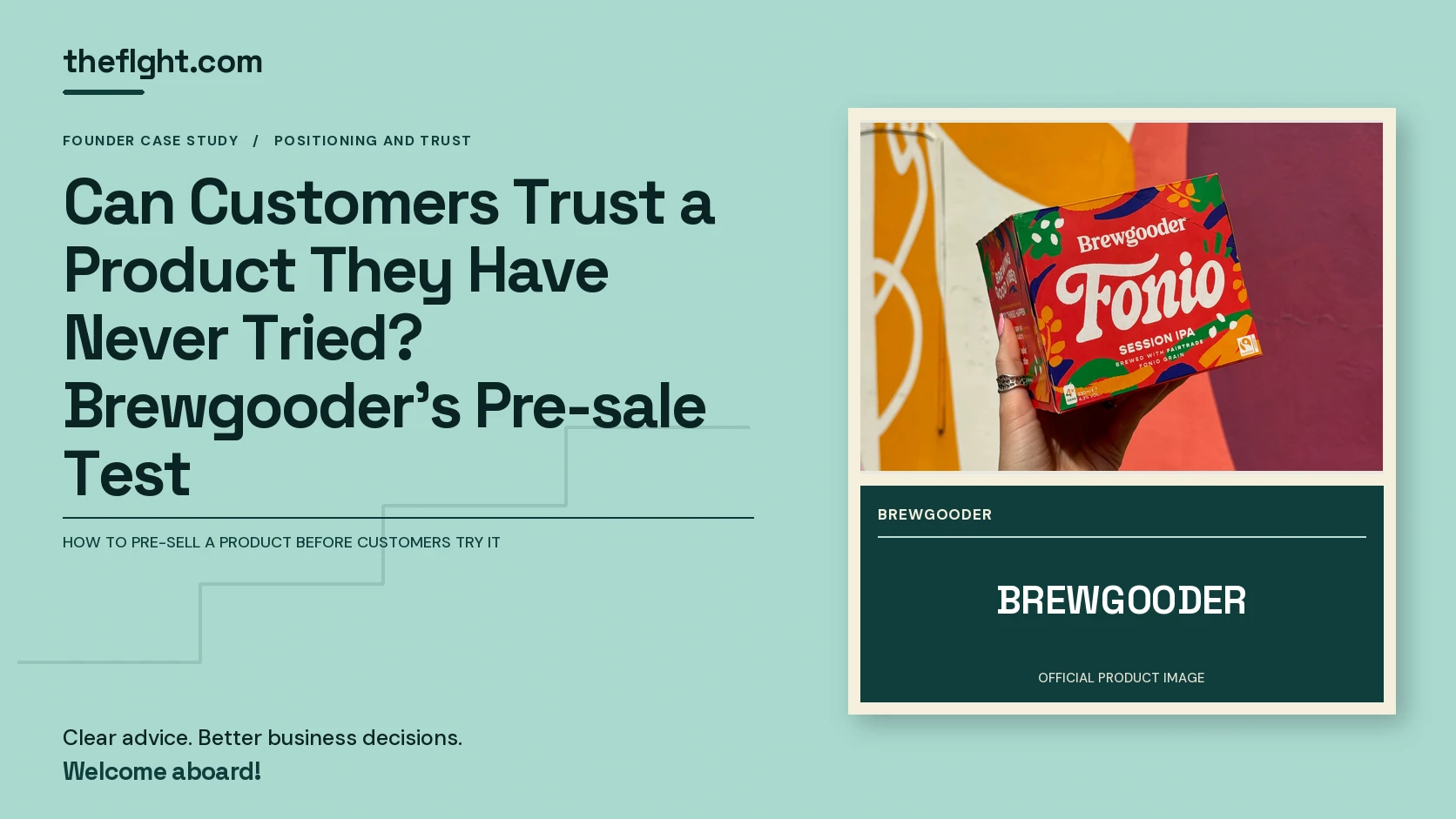
Can Customers Trust a Product They Have Never Tried? Brewgooder's Pre-sale Test
Short answer: Yes, but customers must be able to verify more than your enthusiasm. Show who will produce the item, what exactly the buyer receives, when delivery should occur, what could delay it and how refunds will be funded. Treat paid pre-orders as restricted fulfilment money until the product ships. Proceed only when the order contribution covers production, fees, delivery, failures and a cash reserve.
Pre-selling an untried product can validate willingness to pay and finance a minimum production run. It can also transfer product and delivery risk to the buyer.
Purpose, founder personality and scarcity may persuade people to order. They do not remove your obligation to make something acceptable and deliver it as described. Trust needs an operating chain behind the story.
What Brewgooder's campaign tested
Brewgooder founder Alan Mahon has said the new beer brand attracted about 1,000 UK backers before they had tasted the product, with BrewDog agreeing to produce and stock it. A Sage interview with Mahon describes a £60,000 aim. A contemporaneous Scottish Financial News report describes a £50,000 target. The discrepancy must be resolved from campaign records before either figure is used as definitive.
The case is still useful. Brewgooder did not ask buyers to trust an unknown founder, unknown producer, vague pack and unspecified cause all at once. An established brewing partner reduced production uncertainty, while the social mission gave customers a reason to support the launch before sensory proof was available.
Public accounts do not reveal the complete pledge mix, conversion rate, fulfilment cost, gross margin or reorder rate. The campaign therefore shows a trust mechanism, not proven long-term demand.
My view is that a compelling purpose can earn attention but should never substitute for product evidence. If customers reorder only to support the cause, you have fundraising with goods attached, not yet a durable product business.
Use the Untasted-Product Trust Chain
The Untasted-Product Trust Chain has five links. A credible pre-sale makes each one inspectable.
| Link | Buyer's concern | Evidence to provide | |---|---|---| | Problem | Why should this exist? | Specific customer need or purpose, without inflated claims | | Producer | Can anyone make it properly? | Named manufacturer, capability and agreed production route | | Product | What will arrive? | Specification, quantity, ingredients or materials and limitations | | Delivery | Will it arrive when promised? | Timeline, dependencies, fulfilment method and updates | | Remedy | What if it fails? | Cancellation, refund, replacement and ring-fenced cash approach |
Trust fails at the weakest link. A famous producer cannot rescue an unclear delivery promise. A moving mission cannot make a misleading product description acceptable.
Make the offer concrete before you sell it
Specify pack size, unit quantity, important materials or ingredients, variants, expected dispatch window, delivery geography and total price. Show prototypes honestly. Label renders as renders and samples as samples.
If an attribute remains uncertain, say so and explain when it will be fixed. Do not invite customers to infer a premium specification from photography when the production version may differ.
For food, drink, cosmetics, children's products or other regulated goods, obtain competent advice before taking orders. In the UK, alcohol licensing, age verification, labelling, food safety, consumer rights, advertising and distance-selling rules may apply. Requirements vary by country and sales structure. A production partner does not automatically hold every responsibility for your brand.
Borrow credibility without pretending it is yours
A recognised manufacturer, retailer or adviser can reduce uncertainty. State the exact relationship. “Produced by” is different from “advised by”, and “available through” is different from an endorsement.
Confirm in writing what the partner will do, at what price, by which date and subject to what minimum. Do not launch on a friendly conversation. If their name is central to conversion, secure permission to use it accurately.
Partner credibility also creates concentration risk. Model what happens if the production slot moves or the relationship ends. Your pre-sale page should not promise certainty that the agreement does not provide.
Set the funding target from fulfilment arithmetic
Work from units and cash, not a round marketing number. Include:
| Cash requirement | Typical components | |---|---| | Production | Minimum run, setup, ingredients or materials | | Packaging | Primary pack, labels, cases and compliance changes | | Selling | Platform fees, payment charges and failed payments | | Fulfilment | Storage, picking, postage and address corrections | | Failure | Breakage, spoilage, replacements and refunds | | Timing | Tax and working capital until all orders ship |
The target must also match the reward mix. One hundred low-priced supporters and ten wholesale buyers can create very different margins and delivery work even when campaign revenue is identical.
Worked example: ClearSpring Social Beer
ClearSpring Social Beer wants to pre-sell a first alcohol-free pale ale run. Its contract brewer requires at least 8,000 cans, and ClearSpring orders 8,320. These figures are illustrative, not Brewgooder's figures.
ClearSpring sells cases of 12 cans for £29 including delivery. It plans 620 consumer cases, equal to 7,440 cans, and six hospitality orders of 10 cases each, another 720 cans. Sale commitments total 8,160 cans, leaving 160 for replacements and samples.
| Requirement | Calculation | Amount | |---|---:|---:| | Brewing and canning | 8,320 × £0.82 | £6,822.40 | | Printed packaging | 680 cases × £1.35 | £918.00 | | Consumer delivery | 620 × £5.80 | £3,596.00 | | Hospitality delivery | 6 × £24 | £144.00 | | Campaign and payment fees | estimated | £1,020.00 | | Testing and compliance | quoted | £780.00 | | Failure reserve | fixed | £900.00 | | Total cash requirement | | £14,180.40 |
Consumer revenue is 620 × £29 = £17,980. Hospitality cases sell for £20, producing 60 × £20 = £1,200. Total pre-sale revenue is £19,180.
Headline surplus before overhead and founder labour is £19,180 - £14,180.40 = £4,999.60.
Assume the campaign authorises pledges but collects money and charges transaction fees only after reaching its target. The brewer requires a 60% deposit: £6,822.40 × 60% = £4,093.44. Packaging and testing add £1,698 before dispatch, requiring £5,791.44 available after fees before production.
The campaign sets a £16,000 minimum rather than calling the first £6,000 “funded”. At £16,000, it covers the £14,180.40 plan with £1,819.60 of timing margin. If the threshold is missed, pledges are not collected and production is not ordered. Any non-refundable campaign setup costs need separate founder funding. Verify that the chosen payment arrangement actually supports these conditions.
The calculation also reveals that the mission cannot absorb careless promises. Offering free worldwide delivery or expensive rewards would consume the apparent surplus.
Treat pre-order cash as committed cash
Keep a fulfilment ledger that shows gross receipts, fees already taken, refunds, production commitments and cash still required. Do not use the balance to pay unrelated overhead because the campaign appears ahead.
Set a minimum cash floor equal to unspent fulfilment cost plus the failure reserve. Update it whenever the order mix changes. Wholesale orders may provide less revenue per case but lower fulfilment cost. International consumer orders may do the opposite.
If you offer an all-or-nothing campaign, understand the platform's payment and refund mechanics. If you collect directly, make the condition for proceeding explicit and ensure the refund route is operational.
Separate support from repeatable demand
Tag each order source and, after delivery, ask whether the buyer would repurchase at the standard price. Behaviour matters more than the answer. Measure retained delivery, product complaints, consumption and the second paid order.
Create three groups where data allows: cause-led supporters, product-led customers and trade buyers. Compare their reorder rate and contribution. The groups may overlap, but the distinction stops you from assuming that campaign enthusiasm will recur monthly.
Do not undermine the first test with deep discounts or elaborate gifts. You need to know whether the core product and mission can support the intended price.
Communicate delays before customers chase
Map the critical path from production approval to delivery. Update customers at agreed milestones, including when nothing has changed. A useful update states what is complete, what remains, the current dispatch window and what the delay means for cancellation.
Avoid optimistic dates from suppliers unless you have included time for testing, packing and failed deliveries. If the product is seasonal or intended for an event, the cost of missing the date is higher. Offer a clear remedy rather than asking indefinitely for patience.
What to do in the next 21 days
In the first five days, obtain the manufacturer's written minimum, price, deposit, lead time and responsibilities. Define one saleable pack and calculate the funding target from fulfilment cash.
By day ten, prepare accurate product evidence, partner wording, risks, dispatch window and refund terms. Ask five intended customers to explain the offer back to you. Correct anything they misunderstand.
By day 14, arrange the fulfilment ledger, cash floor and update schedule. Take qualified advice on product, consumer, marketing and licensing obligations. Launch only when each trust-chain link can be evidenced.
At day 21, review conversion by source and pledge type. Do not lower the viable target to declare success. If the arithmetic does not fund safe delivery, refund or extend only under the terms customers originally accepted.
Related guides
Frequently asked questions
Are pre-orders reliable proof of demand?
They are stronger than survey answers or email sign-ups because customers commit money. They are not complete proof of repeatable demand. Scarcity, founder relationships, publicity and a social purpose can create a one-off response. Separate orders by source and measure delivery acceptance, complaints and reorders at the normal price. Also account for refunds and failed payments before reporting a total. A successful pre-sale proves that a defined offer attracted enough early buyers under those campaign conditions. It does not prove that paid advertising, retail distribution or later production runs will be profitable.
How much of the pre-order money can I spend?
Spend only against the cost of producing and fulfilling the promised orders, while preserving enough for remaining obligations and plausible failures. Maintain a live cash floor for production, packaging, tax, delivery, refunds and replacements. The legal treatment of customer money and your insolvency exposure vary by jurisdiction and payment structure, so obtain qualified accounting and legal advice. Do not treat the campaign balance as profit before delivery. If a supplier asks for more cash than planned, update the ledger before paying. Founders create severe trust damage when unrelated spending makes promised refunds impossible.
Should I offer refunds before production starts?
Set clear cancellation and refund terms that comply with applicable consumer law and the campaign platform's rules. In many cases, customers will have statutory rights you cannot remove through your own wording. A fair pre-sale also explains what happens if the funding threshold is missed, the specification changes or delivery is materially delayed. Make the refund mechanism practical, not discretionary. For customised, perishable, digital and alcohol products, rules can differ. Obtain current local advice. Commercially, a transparent remedy can increase trust because the buyer can see that uncertainty has not been hidden.
Can a social mission compensate for an untested product?
It can motivate the first purchase, but it cannot compensate for poor quality, misleading claims or failed delivery. Build the mission into verifiable operations: name the mechanism, recipient, timing and any deduction before funds reach the cause. Avoid vague statements that imply every pound goes directly to impact when production and overhead are also funded. After delivery, compare product-led and cause-led reorder behaviour. A sustainable social business needs customers to value the product enough to return. Otherwise each production run may require another exceptional fundraising campaign.
Do I need a finished prototype before accepting pre-orders?
You need enough evidence to describe accurately what will be delivered and to understand whether it can be produced safely, legally and at the stated cost. That may be a production-ready sample, a tested recipe or a qualified manufacturer's approved specification. A visual mock-up alone is weak for products where taste, fit, safety or performance matters. Label prototypes and renders honestly. If final characteristics remain open, disclose them and allow an appropriate remedy when they change. Higher-risk products require more validation and qualified testing before any sale, even when customers are willing to wait.
What should I do if the campaign misses its target?
Follow the stated funding terms. If the minimum reflected genuine fulfilment cost, do not quietly proceed with too little cash or reduce the product without customer agreement. Refund promptly where required, then review traffic, conversion, average order, cost and objections separately. A missed target may mean insufficient reach, weak trust, poor economics or low demand. Interview both buyers and qualified non-buyers. You can redesign and test again, but do not use retained customer money to finance an unapproved version. The failed campaign has still bought useful evidence if you preserve trust and diagnose the right link.
Comments (0)