In-House Manufacturing vs Contract Packing: Dalston's First Million Bottles
Short answer: Manufacture in-house while small batches are teaching you something a contractor cannot, but compare options using fully loaded cost, not ingredients and labour alone. Request contract-packing quotes before you reach 70% of practical capacity. Outsource when the contractor's landed cost plus switching risk is lower than your true in-house cost and the released founder time has a defined, valuable use.
Owning production can improve recipes, supplier knowledge and quality control. It can also turn the founder into the most expensive person on the bottling line.
The decision is not simply cheaper versus dearer. You are choosing where to hold fixed cost, minimum-order risk, quality responsibility and operational knowledge.
What Dalston's early production revealed
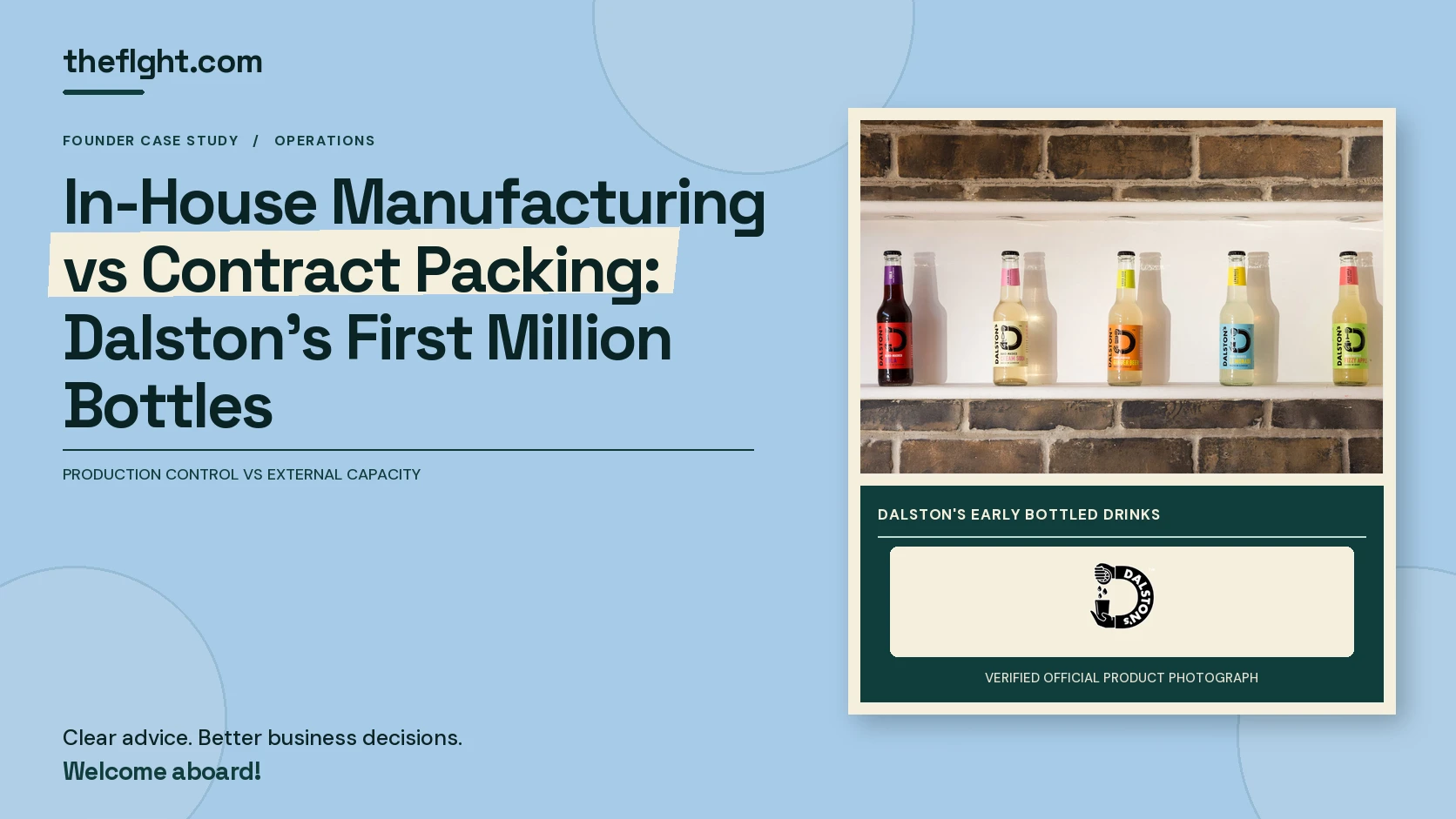
Dalston's founder Duncan O'Brien has described using a small payday loan to buy empty bottles and basic equipment, then obtaining about £5,000 to establish a small factory. Public accounts disagree on whether the initial loan was £300 or £500, so neither amount should be treated as settled without primary records. One first-person account gives the higher figure, while a Sustain interview describes the wider early journey.
O'Brien says the team eventually made about one million bottles end to end, building detailed production knowledge but spending too little time on sales. That is the useful decision tension. In-house manufacturing was not necessarily a mistake. It became costly when operational learning stopped being the main constraint and commercial growth needed attention.
My view is that founders should seek an outsourcing quote earlier than feels necessary. A quote does not commit you. It exposes costs and minimums while you still have time to change packaging, process or forecast.
Use the Make-or-Pack Cost Map
The Make-or-Pack Cost Map compares five dimensions at the same production volume.
| Dimension | In-house production | Contract packing | |---|---|---| | Unit economics | Ingredients, packaging, labour, waste and utilities | Quoted packing price, materials, freight and testing | | Fixed commitment | Premises, equipment, maintenance and supervision | Setup fees, minimum order and deposits | | Capacity | Practical output after cleaning, changeovers and breakdowns | Reserved production slots and contractor lead time | | Control | Immediate process changes and direct inspection | Specification, approval samples and audit rights | | Cash and attention | Cash tied in equipment plus founder operating time | Cash tied in larger batches plus supplier management |
Score each with quoted or observed numbers. Do not mark “control” as automatically better in-house. A disciplined contractor may produce more consistently than a stretched founder team.
Calculate practical capacity, not machine capacity
A filler advertised at 800 bottles per hour does not give you 800 saleable bottles every hour. Include setup, cleaning, label changes, quality holds, staff breaks, breakdowns and rejected units.
If an eight-hour shift includes 90 minutes of setup and cleaning, 45 minutes of stops and 30 minutes of checks, productive time is 315 minutes. At an observed 10 bottles per minute, output is 3,150. A 4% reject rate leaves 3,024 saleable bottles, not the rated eight-hour output of 6,400.
Use actual shift records once available. When orders require more than about 70% of practical capacity for several consecutive weeks, obtain options. The remaining 30% absorbs variability. This is an operating guide, not an industry standard.
Build the true in-house unit cost
Add every cost caused by making the product:
| Cost group | Include | |---|---| | Materials | Ingredients, bottle, closure, label, case and pallet | | Conversion | Production labour, employer costs, utilities and cleaning | | Loss | Spillage, rejects, expired inputs and rework | | Facility | Rent, business rates, insurance and waste collection | | Equipment | Lease or depreciation, maintenance and downtime | | Quality | Testing, records, traceability and compliance work | | Management | Production planning and founder supervision | | Distribution | Storage, pallet handling and onward freight |
Allocate fixed costs at a cautious volume. Using maximum capacity makes the unit cost look artificially low. Run the calculation at 60%, 75% and 90% of practical capacity.
Founder time belongs in the comparison. If you omit it because you do not draw a salary, you may choose the model that keeps the business dependent on unpaid labour.
Read a contract-packing quote properly
The price per bottle is only one line. Ask who buys materials, owns surplus packaging, stores finished stock, arranges testing and pays for a failed batch. Confirm minimum production quantity, changeover charge, deposit, payment date, lead time and annual price review.
Request a trial-run price and a price at two forecast volumes. Ask for expected loss tolerance and how discrepancies are documented. Speak to two current customers whose products resemble yours.
Food and drink manufacturing rules vary by country, product and process. In the UK, requirements may cover premises, hygiene, allergens, labelling, traceability, weights, packaging and alcohol. Obtain qualified local advice and define contractual responsibility. Outsourcing production does not automatically outsource your legal responsibility to customers.
Worked example: Borough Soda Works
Borough Soda Works produces 12,000 bottles monthly. This fictional business compares in-house production with contract packing at its lease renewal. Figures are illustrative; assume premises and equipment cash costs can then be avoided completely.
| In-house monthly cost | Calculation | Amount | |---|---:|---:| | Ingredients and packaging | 12,000 × £0.61 | £7,320 | | Production labour | 190 hours × £16.50 | £3,135 | | Waste and testing | 12,000 × £0.045 | £540 | | Premises and utilities allocation | fixed | £1,850 | | Equipment and maintenance | fixed | £620 | | Founder production management | 38 hours × £30 | £1,140 | | Total | | £14,605 |
True in-house cost is £14,605 ÷ 12,000 = £1.217 per bottle, rounded to £1.22.
The contractor quotes £0.48 for conversion. Borough supplies materials costing £0.61, pays £0.07 per bottle for freight and testing, and faces a £900 setup charge spread across a 36,000-bottle quarterly run.
Contract cost per bottle is £0.48 + £0.61 + £0.07 + (£900 ÷ 36,000) = £1.185. Monthly cost is £14,220, £385 below the £14,605 economic in-house cost. Do not calculate savings from rounded unit prices.
But the packer requires a 36,000-bottle order. Materials and packing before freight require 36,000 × (£0.61 + £0.48) + £900 = £40,140. In-house production buys about one month of inputs at a time. The contractor is slightly cheaper per bottle but demands much more working capital and creates 12 weeks of finished-stock exposure.
Borough does not pay the founder's £1,140 time allowance in cash. In-house cash cost is therefore £14,605 - £1,140 = £13,465. Outsourcing increases cash cost by £14,220 - £13,465 = £755 monthly.
Two proposed wholesale accounts would contribute £650 monthly each after their own production costs. If released founder hours win them, the incremental cash benefit is £1,300 - £755 = £545, not £1,300 plus the £385 economic saving. That would count founder time twice. Any unavoidable rent, equipment or transition payments reduce the £545 further.
Require an inventory cash plan and scheduled sales activity. Neither the new accounts nor a lower unit cost guarantees cash savings.
Protect knowledge and quality when you outsource
Create a manufacturing specification detailed enough that two competent teams would interpret it consistently. Cover ingredients, tolerances, process stages, packaging, label placement, batch coding, tests, release authority and acceptable loss.
Approve a pilot batch before a large run. Retain reference samples and agree what happens when a batch fails. Record which party investigates, pays, remakes and communicates with customers.
Keep enough internal knowledge to challenge results. Outsourcing should remove repetitive conversion work, not your ability to judge the product.
Avoid dependency on one untested supplier. This does not always mean operating two packers, which can be inefficient at low volume. It does mean knowing the lead time and cost of a qualified alternative, owning your specifications and avoiding packaging that only one site can handle without a clear reason.
Know when in-house still wins
Stay in-house when rapid product iteration is the main work, batches are below contractor minimums, the process itself creates defensible knowledge or your quality needs cannot yet be specified reliably. Keep tracking the fully loaded cost.
Do not use “control” to disguise reluctance to document the process. If only the founder can make the product, you have an operational dependency. Build repeatable instructions and train another person even if you retain production.
Some practitioners argue that early food brands should outsource from the start to conserve capital. Others favour in-house learning. Both can be rational. My view is that you should make enough to understand the critical process, but exit routine production once the learning gain is smaller than the sales and management work it displaces.
Make the decision over the next six weeks
In week one, measure three real production runs, including setup, cleaning, waste, rework and founder time. In week two, calculate true cost at three capacity levels.
By week four, obtain two written contract-packing quotes against the same specification and volume. Visit the strongest site, inspect relevant quality systems and speak with customers. Model the cash peak and a delayed production slot.
In weeks five and six, run a paid pilot if the comparison remains attractive. Approve quality, reconcile actual losses and calculate landed cost. Move only when cost, cash, quality and released-time plans all pass. Otherwise improve the in-house system and set the next review volume now.
Related guides
Frequently asked questions
Is contract packing always cheaper at higher volume?
No. Higher volume can reduce the quoted conversion price, but your packaging specification, changeovers, freight, storage and testing may outweigh the saving. An efficient in-house line can also become cheaper after fixed costs are absorbed. Compare both choices at the same saleable volume and include a realistic reject rate. Ask the contractor for tiered prices rather than assuming a scale discount. Then stress-test lower sales. A large order that earns a cheaper unit cost but sits in storage can consume more cash and create greater write-off risk than a dearer short run.
How many contract manufacturers should I approach?
Approach at least three that can genuinely handle your product and expected volume, then compare two serious written proposals. A long list of unsuitable suppliers adds little. Give each the same specification, forecast and questions so prices are comparable. Screen for relevant certification, capacity, lead time, communication and customer references before discussing only cost. Confidentiality and intellectual-property terms may matter, but do not send sensitive formulas without appropriate protection. Legal requirements and contractual remedies vary, so use qualified advisers for material production agreements rather than relying on a supplier's standard terms alone.
What if the manufacturer's minimum order is too high?
Ask whether a trial run, shared production day, standard packaging or fewer variants can reduce the minimum. Compare the premium with the cost of unsold stock. You can also keep production in-house while improving documentation and building demand to the minimum. Do not place a large order solely because the unit price appears attractive. Model how many weeks of sales it represents, the cash collection delay and the loss if packaging or demand changes. If every suitable contractor requires more than you can sell safely, your current scale may not support outsourcing yet.
Should I include my own time in the in-house cost?
Yes. Use a reasonable replacement or opportunity cost even when you do not pay yourself that amount. This shows whether the apparent saving depends on free founder labour. Record production, planning, purchasing, cleaning, problem-solving and quality time, not only minutes on the line. Then state what you would do with released hours. If there is no valuable alternative work, the theoretical saving may not become cash. If those hours can reliably improve sales, supplier terms or product development, excluding them materially distorts the decision.
How do I test a contract packer without risking the whole launch?
Run the smallest paid pilot that uses the real ingredients, packaging and critical process. Agree acceptance criteria in writing, attend the run where practical and retain reference samples. Check yield, fill, seal, appearance, coding, taste or performance, paperwork and delivered quantity. Calculate the landed cost from the invoice and actual losses. Do not approve a full run merely because samples made elsewhere looked good. For regulated or safety-sensitive products, use appropriate independent testing and qualified advice. Define what happens to failed or quarantined stock before production begins.
Can I bring production back in-house later?
Yes, but only if you preserve knowledge, specifications and access to suitable equipment, people and premises. Contracts may contain notice periods, ownership terms for tooling or packaging and restrictions that affect switching. Model the return as a fresh investment decision rather than an emotional response to one supplier problem. You will need capacity, compliance, working capital and trained supervision. Keep batch records and product knowledge while outsourced so you can assess alternatives. A credible second source may be cheaper than rebuilding a factory, particularly when the operational problem is supplier management rather than production itself.
Comments (0)