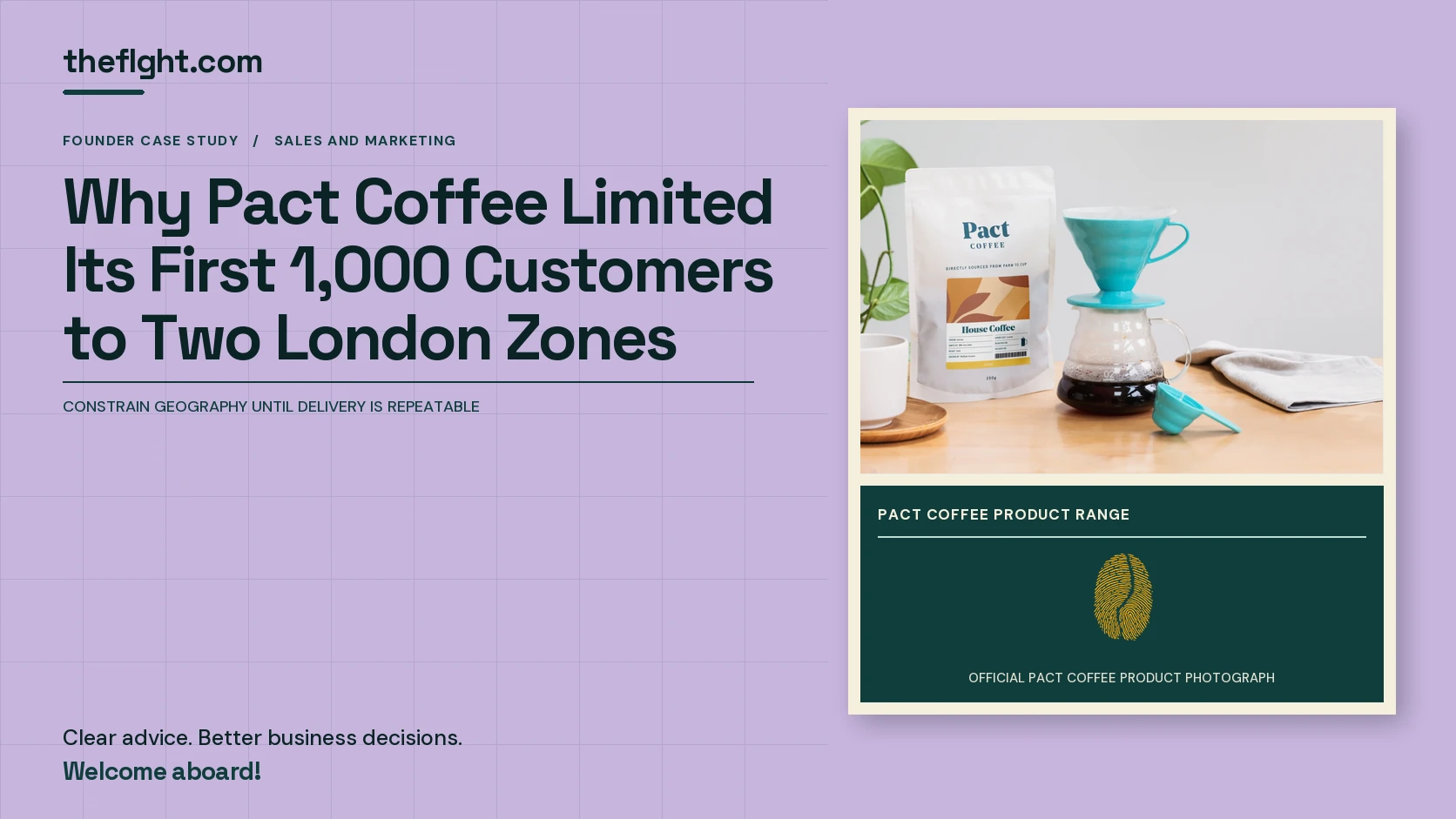
Why Pact Coffee Limited Its First 1,000 Customers to Two London Zones
Short answer: Launch in one area first when customer density reduces delivery and service cost, local contact accelerates learning, or expansion would add operational variables you have not proved. Choose an area capable of producing at least 30 normal-priced orders, track contribution and repeat purchase by postcode, and expand only after one additional zone can be served without weakening delivery economics or customer experience.
A national website can accept an order from anywhere. That does not mean a new business can serve everywhere well. Geographic breadth fragments deliveries, complicates support and makes sparse demand look like a marketing failure.
Pact Coffee founder Stephen Rapoport says in this first-person account that he restricted the early service to London zones 1 and 2 so the first 1,000 customers were within cycling distance of his kitchen. Pact's own history says the 2012 business, then called YourGrind, initially bought roasted coffee from another company, repacked it and later secured investment after proving the concept. Pact describes that operating sequence here, and its company story recalls grinding at home, writing personal notes and sealing bags with hair straighteners.
The lesson is not that every founder should cycle deliveries. It is that a tight area can concentrate enough transactions to reveal whether the offer, fulfilment and repeat behaviour work together.
Use the Two-Zone Density Test
The Two-Zone Density Test compares a proven core area with one adjacent expansion area before a wider launch.
| Test | Core zone | Adjacent zone | Expansion condition | |---|---|---|---| | Suitable demand | Orders per 100 target contacts or visits | Same measure | Within 20% of core | | Delivery density | Orders per route hour | Same measure | Contribution remains positive | | Reliability | On-time and correct orders | Same measure | No material deterioration | | Repeat demand | Reorders in a defined period | Same measure | Enough to support the model | | Learning | Customer contact and issue visibility | Same measure | Problems remain observable |
My position is that a delivery or local service business should earn geographic expansion. Founders often see a small launch as unambitious, but serving a wide area before achieving density can make a viable offer look unprofitable. Concentration is not small thinking. It is a way to stop distance from contaminating demand evidence.
Define why place changes the economics
Map every cost or behaviour affected by distance. For physical delivery, include route time, failed delivery, packaging, carrier pricing and replacements. For a service, include travel, local reputation, scheduling and emergency response. For a digital business, geography may still affect regulation, language, payment or support hours.
If none of these changes materially, a geographic test may be unnecessary. A simple digital product sold in one legal jurisdiction can often launch widely. Do not impose a local boundary as theatre.
Where geography matters, choose the smallest area with enough suitable buyers. Use [local-demand testing before a lease](/market-research/test-local-demand-before-signing-a-lease/) to estimate target density rather than drawing an arbitrary circle around your home.
Keep the first operating model deliberately rough
Pact's early use of bought-in roasted coffee and improvised packing reduced the number of unproved commitments. It let the founder learn about customers before owning a full production setup. That kind of roughness is useful only when the product remains safe, lawful and honestly described.
List which activities the founder will perform manually and what each should teach. Personal delivery can reveal arrival preferences and objections. Hand packing can expose damage and labelling problems. Personal notes may improve retention, but they can also create an experience that future staff cannot reproduce.
Record founder minutes per order at once. "Free" labour can make a local model look profitable. Value it at the rate you would have to pay someone competent to repeat the work.
Measure density, not just order count
One hundred orders spread across 100 distant postcodes can be worse than 40 orders in four streets. Track orders per route hour, delivery cost per order and total contribution per delivery run.
Use:
route contribution = order revenue minus product, packing, payment, delivery labour, travel and expected failure costs
Then divide by route hours. This prevents a busy route with little cash return from appearing successful.
Customer density also improves learning. When similar buyers receive the same offer under comparable conditions, objections and repeat behaviour are easier to interpret. You can tell whether low demand reflects the product rather than ten different acquisition environments.
Worked example: CycleRoast Coffee
CycleRoast sells a fortnightly coffee bag for £18. Product, packing and payment cost £8.20 per order. A rider costs £19 an hour including employment on-costs and equipment allowance. Failed delivery and replacement allowance is £0.80 per order.
In its core zone, a four-hour route delivers 32 orders and uses £8 of travel consumables.
Delivery cost per order is (4 x £19 + £8) ÷ 32 = £2.625, or £2.63 when rounded. Contribution is £18 - £8.20 - £0.80 - £2.625 = £6.375, or £6.38 when rounded. The route contributes exactly 32 x £6.375 = £204.
The business tests an adjacent zone. A four-hour route delivers only 14 orders and uses £11 of travel consumables. Delivery cost is (4 x £19 + £11) ÷ 14 = £6.21 when rounded. Contribution falls to about £18 - £8.20 - £0.80 - £6.21 = £2.79 per order, or exactly £39 for the route before rounding.
| Measure | Core zone | Adjacent zone | |---|---:|---:| | Orders per route hour | 8 | 3.5 | | Delivery cost per order | £2.63 | £6.21 | | Contribution per order | £6.38 | £2.79 | | Four-hour route contribution | £204.00 | £39.00 |
CycleRoast should not open the adjacent zone permanently yet. It needs a pre-launch cluster, a fixed collection point or a higher order density before promising regular delivery. These are illustrative figures, not coffee-sector benchmarks.
Test expansion without hiding the result
Collect interest from the next zone, but do not count names as orders. Offer a clear launch date or limited delivery day and ask for a normal-priced purchase. Hold product, price and acquisition message as steady as possible.
Compare the first 30 adjacent-zone orders with a recent 30-order core cohort. Include refunds, failed deliveries, customer questions and repeat purchase. A publicity spike may fill one route without proving continuing density, so observe at least two buying cycles.
Expansion should meet a cash threshold and an operating threshold. For example, require at least £5 contribution per order and 95% on-time delivery. Your figures will differ. The point is to decide before the test.
Know when concentration becomes dependence
A compact launch can overfit the founder's network or one neighbourhood. Segment the first customers by relationship and acquisition source. If most are friends, colleagues or residents of one building, run a second cluster with strangers before generalising.
Local concentration also creates disruption risk. A road closure, building policy or local competitor can affect many customers at once. Expansion should diversify after the core unit works, not leave the company permanently dependent on one route.
Tax, food safety, labelling, delivery, employment and consumer rules vary by location and product. Check current official requirements and qualified local advice before preparing food, employing riders or expanding into a new jurisdiction.
Decide the next postcode in 30 days
This week, map every recent order by postcode, acquisition source, contribution and repeat status. Define the profitable route density and select one adjacent area. Gather paid orders for a fixed delivery day, run at least two cycles and compare them with the core zone. Expand only if contribution, reliability and repeat behaviour survive. If they do not, keep the boundary and build density rather than spending more to spread the same weak route.
Related guides
Frequently asked questions
Is launching locally useful for an online business?
Yes, when geography changes fulfilment, regulation, trust or learning. A local launch can simplify deliveries, allow direct observation and concentrate referrals. It adds little when the product is fully digital, support is asynchronous and all customers sit under the same legal and payment conditions. Ask what uncertainty the boundary resolves. If the answer is only "it feels manageable", choose a different constraint such as customer type or acquisition channel. A test should isolate a commercial risk, not merely make the founder more comfortable.
How small should my first launch area be?
Choose the smallest area likely to produce at least 30 normal-priced orders within a meaningful buying cycle. Estimate target households or firms, realistic reach and conversion before drawing the boundary. The area must also fit one coherent fulfilment route or service pattern. A single postcode may be too small for a niche business, while an entire city may be too dispersed for low-value delivery. Start from density and travel time, then adjust for customer availability, access restrictions and the need for a comparison zone.
Should I refuse orders from outside the launch area?
Usually yes during a controlled test, unless you can fulfil them without changing the process or contaminating the economics. Explain the boundary and let interested people register for a future zone. An exceptional distant order can consume hours and teach little about the model you are testing. If you accept it, label it separately and charge honestly for the service. Do not promise a date you cannot meet. Consumer and delivery obligations still apply, so state coverage and fulfilment terms clearly before taking payment.
What if customers will pay extra for distant delivery?
Test the complete price rather than assuming the surcharge solves distance. A higher fee may cover the carrier but reduce conversion, repeat purchase or order value. Offer the distant price to a bounded group and compare contribution after failed deliveries and service time. If buyers accept it and the operation remains reliable, the distant area may support a different fulfilment route. Keep the offers distinct in your records. Do not subsidise the test from local customers without seeing the true economics of each zone.
When should I use a courier instead of delivering myself?
Use a courier when its total cost is lower than the value of founder time, reliability is acceptable and outsourcing does not remove essential learning. Compare price, surcharges, failed-delivery handling, damage, claims and customer communication. During the earliest orders, personal delivery can expose problems quickly, but it should have a planned end. Run both methods on comparable routes before switching. Check insurance, food handling, employment status and contractual responsibilities with current official guidance and qualified advisers where those issues apply.
How do I know when to launch nationally?
Launch nationally when the product has repeatable demand, fulfilment cost no longer depends heavily on local density, service levels remain stable through at least one adjacent-zone test, and cash can support the longer cycle. Model carrier zones, returns, customer support and regional acquisition before opening every postcode. A national button is easy to enable and difficult to honour. Consider staged regions or fixed delivery days first. Expand because the operating system travels, not because the local market feels less exciting after the first launch.
Comments (0)