Should You Keep Funding a Business Losing £25,000 a Month? Gousto's Runway Decision
Short answer: Keep funding losses only when each month buys a specific test capable of improving contribution, retention or acquisition cost, and you can see the result before cash reaches a protected stop point. Divide usable cash by net monthly burn, reserve closure costs, then fund no more than two or three decisive tests. Growth without improving cohort economics is not learning. It is a larger version of the same loss.
A £25,000 monthly loss is neither automatically reckless nor automatically investable. Its meaning depends on what creates the loss, how much runway remains and whether recent customers are becoming more valuable.
Founders often defend losses with revenue growth. Neither pays the next payroll. The decisive question is whether the underlying economics are changing quickly enough before the business loses its ability to choose.
What the Gousto story does and does not prove
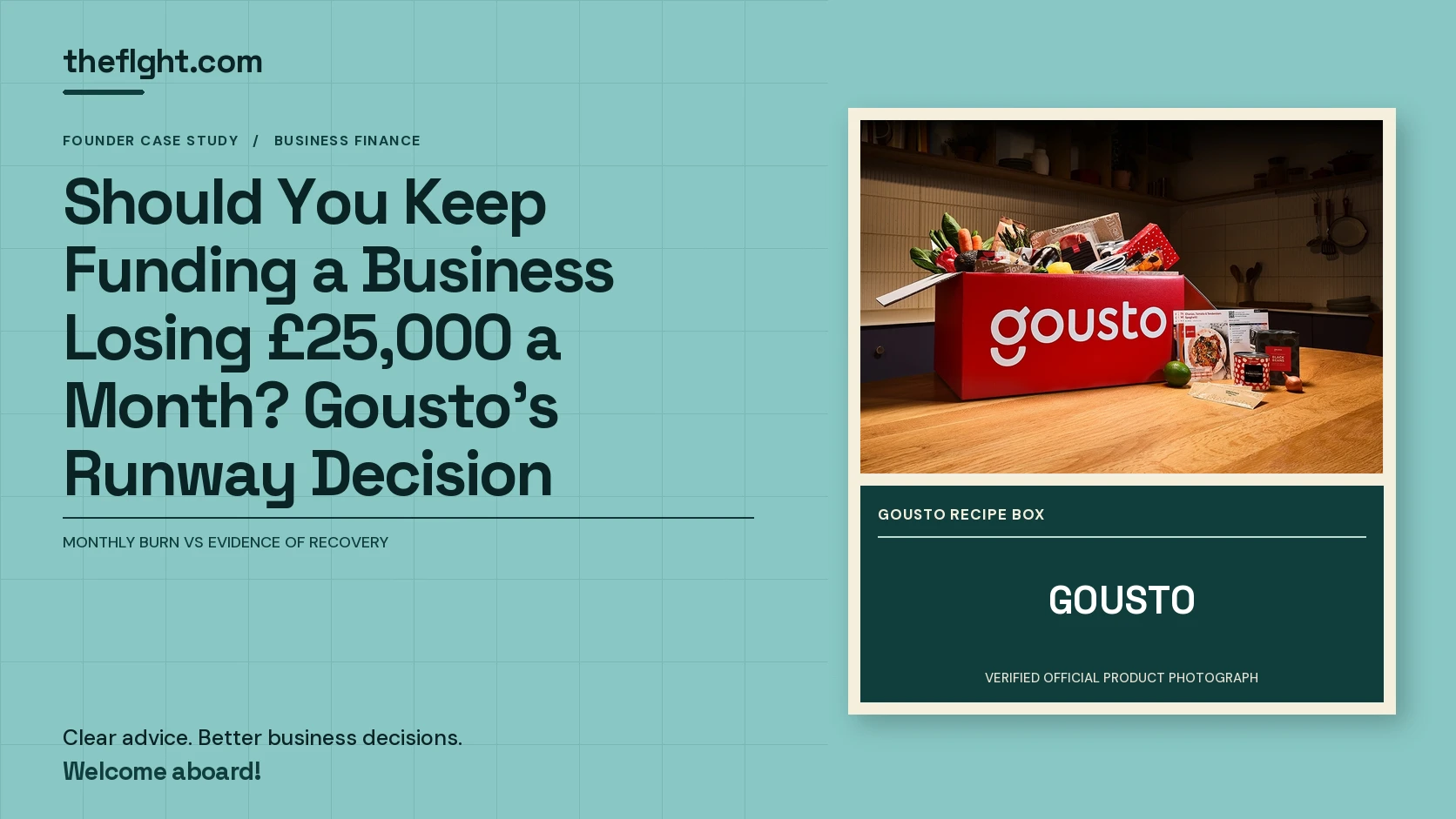
Gousto co-founder Timo Boldt has said the business was losing about £25,000 a month when it sought £100,000 for 7% on Dragons' Den. The founders left without a deal. After the episode aired, the website crashed and the company reportedly raised £1 million within seven days, as described in an early founder profile.
The founders had previously sold recipe kits at a Brick Lane antiques market to obtain direct feedback. That matters because they were testing demand before building a larger delivery operation.
Public figures do not disclose the company's box contribution, acquisition cost, retention cohorts or shutdown threshold at that moment. The later fundraising result does not prove that continuing was economically correct. It proves that attention and investor interest extended the opportunity to work on the model.
My position is stricter than common growth advice: you should not fund losses merely because revenue is rising. Fund a measurable route to better economics. If you cannot name what will be learned by the next £25,000, protect the remaining cash.
Use the Loss-Funded Learning Gate
The Loss-Funded Learning Gate has five conditions. All five must pass before you finance another test period.
| Gate | Required evidence | Failure signal | |---|---|---| | Contribution | Loss is separated into per-order and fixed costs | Every extra order deepens the loss | | Cohort | Retention or repeat purchase is tracked by start month | Growth hides customers leaving quickly | | Test | One operational change has a deadline and owner | “Scale” is the plan rather than an experiment | | Runway | Cash covers the test, reserve and decision time | Success arrives after money runs out | | Stop rule | A numerical failure point is agreed in advance | Founders keep moving the deadline |
Passing the gate does not mean success is likely. It means the next loss purchases decision-quality evidence.
Split the loss into three parts
Start with monthly management figures and separate:
- Negative order contribution: sales do not cover ingredients, packaging, picking, delivery, payment fees, refunds and variable support.
- Acquisition investment: contribution before marketing is positive, but winning a customer costs more than that customer's expected contribution.
- Fixed capacity: staff, premises and systems are sized ahead of current volume.
These losses require different decisions. Negative order contribution usually demands price, product or delivery changes before more volume. High acquisition cost may be acceptable when reliable repeat contribution repays it in time. Fixed capacity may be temporary, but only when credible volume can use it before runway ends.
Do not hide all three inside EBITDA or a bank-balance change. You need order and cohort views as well as company totals.
Calculate runway after protecting the landing
Usable cash is not the bank balance. Subtract tax already owed, customer money you may need to refund, committed supplier payments and a closure or retrenchment reserve.
If cash before protected obligations is £180,000 and net burn is £25,000, headline runway is 7.2 months. Reserving £55,000 for notice, refunds and closure leaves £125,000 testable cash, or five months. Do not subtract the reserve twice.
Your decision needs to arrive earlier. A new funding round, redundancy process or supplier exit can take months. Set the stop point while choices remain.
Financing, insolvency, employment and director duties vary by country and company circumstances. In the UK, directors of a company approaching insolvency can owe duties that change the decision. Obtain prompt advice from a qualified accountant and insolvency solicitor. Do not use a general article to decide whether continuing to trade is lawful.
Judge customers in cohorts
A subscription or repeat-purchase business can appear healthy while replacing departing customers with expensive new ones. Group customers by the month they first purchased. For each cohort, record acquisition cost, first-order contribution, repeat contribution, refunds and cancellations.
Estimate payback from observed behaviour, not a lifetime-value fantasy. If four months of data exist, do not assume the average customer stays for three years without evidence. Use conservative scenarios and update them monthly.
A loss can be rational when recent cohorts pay back faster than earlier ones because packaging, fulfilment, pricing or retention has improved. It is harder to justify when revenue rises but payback time lengthens.
Worked example: Weeknight Recipe Box
Weeknight Recipe Box is fictional; figures are illustrative. Its £170,000 bank balance less £45,000 for tax, supplier commitments and wind-down leaves £125,000 testable cash, or five months at £25,000 monthly burn.
Its current customer economics are:
| Metric | Calculation | Result | |---|---:|---:| | Average first box revenue | stated price | £48.00 | | Food, packing, delivery and fees | total | £38.50 | | Contribution per delivered box | £48 - £38.50 | £9.50 | | Acquisition cost per customer | marketing spend ÷ new customers | £42.00 | | Contribution needed after first box | £42 - £9.50 | £32.50 |
If an active customer contributes £9.50 per later box, acquisition payback requires £32.50 ÷ £9.50 = 3.42 further boxes. In practice, the fourth repeat box crosses payback, so a customer needs five contributed boxes including the first.
Only 34% of new customers currently reach a fifth box. Scaling that funnel buys many customers who never repay acquisition.
The team runs one 60-day cohort test costing £16,000. It limits acquisition to one delivery area, aims to reduce delivery cost by £3.20 a box and changes the second-week choice flow. Combining the changes sacrifices attribution, but produces a complete payback observation within the available runway.
After 60 days, cash use is 2 × £25,000 burn + £16,000 = £66,000. Testable cash falls from £125,000 to £59,000, while the £45,000 protected reserve remains untouched. The decision occurs on day 60, after the cohort has had time to reach five boxes.
The pass rule is contribution of at least £12.50 per box and average cumulative contribution of at least £42 for every acquired customer in the cohort by day 60. Fifth-box retention of 44% is a diagnostic, not proof of payback: customers who stop earlier still change the average. If the full cohort misses £42, the company stops paid growth or narrows the model.
The example shows why “we need more time” is incomplete. Time must be attached to a measurable economic change and an affordable observation window.
Distinguish a fundraising event from a model improvement
New cash changes runway, not unit economics. Publicity can also create an acquisition burst that will not repeat at normal cost. Analyse customers obtained from the event separately from paid and organic cohorts.
When investment arrives, do not immediately restore every postponed hire. Allocate money to the constraints identified by the gate. Preserve enough runway to observe the effect and respond when the hypothesis fails.
Practitioners disagree about how early a growth business should target profitability. Some favour heavy investment where network effects or scale economies are strong. Others demand positive economics sooner. My view is that early profitability can wait, but contribution logic cannot. You must know how a mature order or customer is expected to repay its acquisition and service cost.
Set stop, narrow and continue outcomes
Avoid a single pass or fail decision. Define three outcomes:
| Result | Action | |---|---| | Test passes with sufficient runway | Continue at a controlled acquisition level | | One component improves but full gate fails | Narrow geography, segment, range or channel and retest once | | Economics and learning remain flat | Stop growth spend, sell, wind down or redesign before further funding |
Narrowing is not the same as denial. It removes the part causing loss and preserves evidence from the part that works. But allow one bounded retest, not an endless series of smaller pivots.
What to do in the next 14 days
Within two days, reconcile cash and identify the protected reserve. By day four, split the monthly loss into contribution, acquisition and fixed capacity. Build cohorts from actual orders and payments, using conservative treatment for refunds and missing data.
By day seven, choose no more than two changes that could materially improve the weakest number within an observable period. Set cost, owner, deadline, pass mark and stop rule. Ask your accountant to challenge the cash model and obtain legal advice immediately if solvency is uncertain.
On day 14, fund only the tests that pass the Loss-Funded Learning Gate. Freeze unrelated expansion. Put the decision meeting in the calendar before the experiment begins, while you still have cash and choices.
Related guides
Frequently asked questions
Is losing £25,000 a month always too much for a small business?
No. The amount only has meaning beside cash, contribution, learning speed and financing capacity. A company with £2 million of available cash and rapidly improving cohorts faces a different decision from one with £60,000 and unchanged losses. Convert the amount into protected runway and identify what causes it. Even a £3,000 monthly loss can be fatal when the owner has six weeks of cash. Conversely, a planned £25,000 investment month can be rational if the test is bounded and affordable. Never use another company's burn as permission for your own.
How much runway should remain when I stop a test?
Enough to carry out the next chosen action lawfully and without a distressed scramble. That may include staff notice, supplier commitments, professional advice, customer refunds and time to seek funding or sell assets. There is no universal number of months. Work backwards from those obligations and add uncertainty. Set the decision date before the cash floor, not on it. If directors' duties, insolvency or personal guarantees may be involved, seek qualified local advice immediately. Waiting for the bank account to approach zero can remove options and increase harm to employees, customers and creditors.
Can fast revenue growth justify negative contribution?
Rarely for an ordinary small business. If each additional order loses cash before fixed costs, growth usually accelerates the problem. Exceptions can exist where a deliberate subsidy creates a defensible network or contracted future value, but that requires strong evidence and suitable finance. Do not assume scale will reduce costs enough. Obtain supplier quotes and model the exact volume at which contribution turns positive. Then ask whether working capital and demand can carry you there. Revenue growth is useful when it improves purchasing, delivery density or retention, not when it merely makes the loss larger.
What is the difference between burn and loss?
Accounting loss records revenue and expenses under accounting rules, while cash burn describes the net reduction in cash during a period. They can differ because customers pay early or late, stock is purchased before sale, equipment is capitalised and loans or investment add cash. For runway, start with cash movement and adjust for exceptional financing or delayed bills. For business quality, also inspect contribution and accounting results. Ask an accountant to reconcile the measures. Using profit alone can miss a working-capital crisis, while using bank movement alone can mistake new investment for operating improvement.
Should I raise investment before fixing unit economics?
Raise only if investors understand what remains unproven and the capital will fund a credible route to evidence. New money can finance product development, capacity or tests that current cash cannot support. It cannot make poor customer economics healthy by itself. Prepare cohort data, scenarios and a clear use of funds rather than relying on total revenue. Equity, debt and crowdfunding have different costs, obligations and legal requirements. Get qualified advice on valuation, dilution, securities rules, tax and director duties. Do not accept money whose repayment or growth expectations force you to scale the defect.
What if retention takes longer to observe than my runway allows?
Use earlier indicators only when you have evidence that they predict later retention, and reduce spending while you wait. You might track second-order choice, skipped deliveries, support issues or consumption, but do not relabel an unproven proxy as lifetime value. Narrow acquisition to a small cohort, negotiate costs or extend runway through profitable work rather than buying a large sample. If the decisive behaviour occurs after cash runs out, the current test is unaffordable. Change the model, financing or observation method. Hope is not a bridge between a short runway and a long payback period.
Comments (0)