What Happens When Crowdfunding Outsells Capacity? Flow Hive's 20,000-Order Fulfilment Test
Short answer: Stop treating the campaign total as available cash. Freeze optional features, segment orders by product and destination, reserve fees, tax, refunds, production and freight, then rebuild the schedule from verified supplier capacity. Communicate a dated delivery range within 72 hours of identifying the gap. Add capacity only after a pilot run meets quality and throughput targets.
Crowdfunding concentrates demand before a young business has proven production. That is its attraction and its risk. Every additional order supplies cash while creating another manufacturing, support and delivery obligation.
A campaign can be commercially successful and operationally insolvent at the same time.
Flow Hive's demand shock
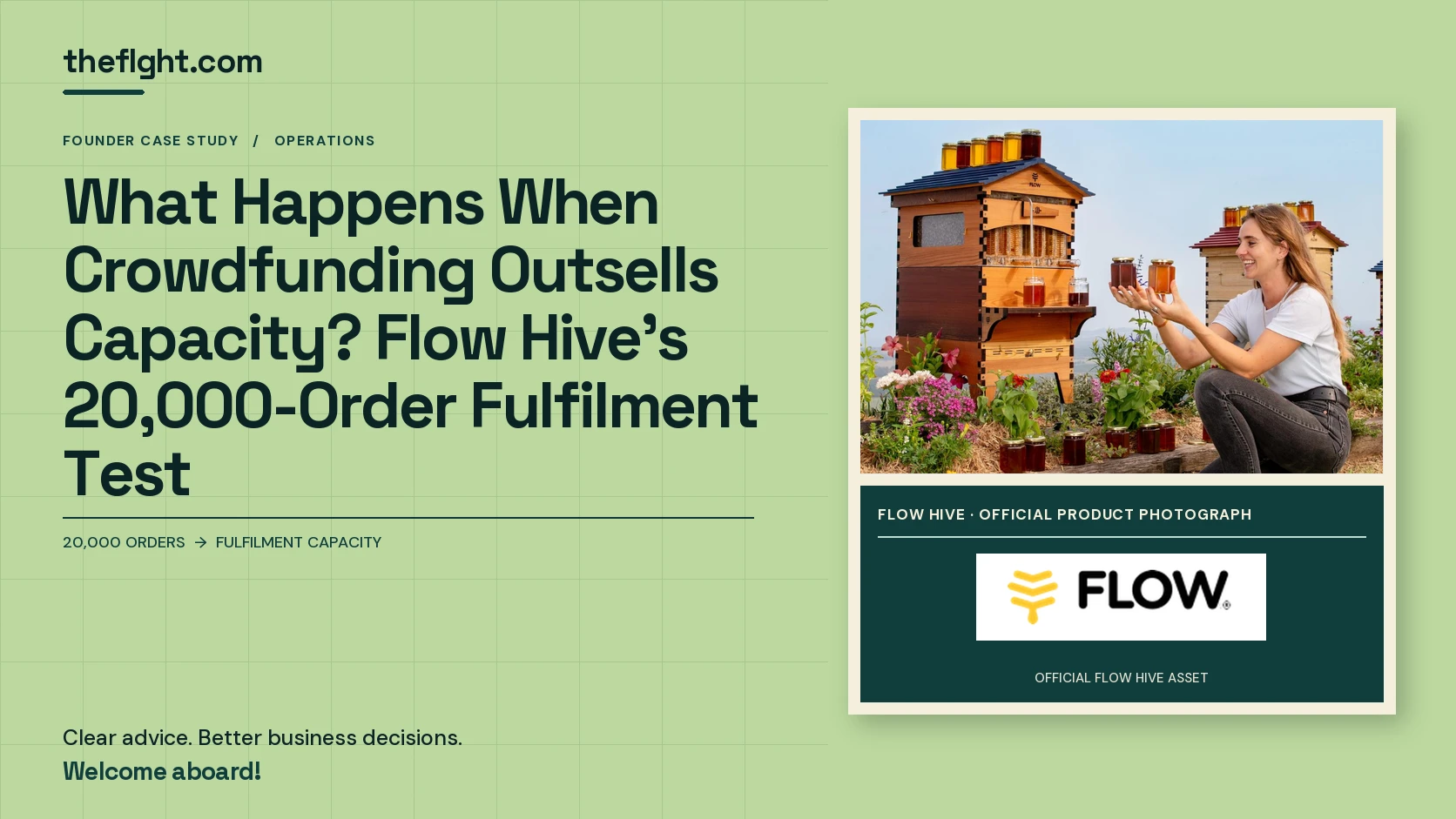
Cedar and Stuart Anderson set a US$70,000 crowdfunding target for Flow Hive. According to the company's press history, the target was reached in 177 seconds. The six-week campaign produced more than US$12.3 million in pre-orders and about 20,000 orders.
The company describes a scramble to fulfil before Christmas, but says it delivered its commitments a few weeks behind the schedules published on Indiegogo. An IP Australia case study later reported more than 50,000 hives sent to over 100 countries. That is a later cumulative shipment figure, not the campaign order count.
Public sources do not disclose tooling deposits, supplier count, unit cost, fees, duty, defect rate or cash buffer. US$12.2 million is gross demand, not profit or free cash.
My position is that a campaign should be designed to become temporarily unavailable before it becomes operationally unbounded. A waiting list loses some sales. Accepting orders you cannot cost or schedule can lose the business.
Use the Crowdfunding Fulfilment Stress Map
The Crowdfunding Fulfilment Stress Map converts each pledge into six connected obligations.
| Stress area | Required number | Failure signal | |---|---|---| | Net cash | Gross less fees, tax and refunds | Production deposit exceeds available cash | | Materials | Units, yield loss and lead time | One component controls the schedule | | Throughput | Approved units per day | Forecast uses theoretical machine speed | | Quality | Inspection, defects and rework | Capacity rises while yield falls | | Logistics | Pack, freight, duty and destination | Shipping quote is not destination-specific | | Communication | Order status and support capacity | Backers learn delays from silence |
Build expected and downside cases. A downside case should include higher freight, a delayed component and a defect batch. Replace assumptions with written quotes as quickly as possible.
Reconcile cash before ordering anything
Start with collected campaign funds, not the public total. Deduct platform and payment fees, expected refunds and chargebacks, tax, campaign production costs and rewards already promised. Then reserve customer-support and remediation cash.
Separate inventory deposits from final supplier payments. Map the date each amount leaves the account and when remaining funds are released by the platform. A profitable order book can still create a cash gap if factories and freight are paid before funds clear.
Tax, consumer, product-safety, customs and refund obligations vary by country and destination. Obtain qualified local advice and do not assume that describing customers as backers removes their rights.
Find the true bottleneck
List every component, supplier, tool, inspection and packaging step. For each, record approved daily output, lead time, minimum order, payment date and recovery alternative.
The bottleneck is the lowest verified throughput after yield loss. A machine producing 500 parts daily does not create 500 finished units if inspection rejects 8% or another component arrives at 300 a day.
Increase capacity in pilots. Approve samples, then a small production run, then a controlled ramp. Doubling orders across an untested second supplier can double defect investigation instead of output.
The [supplier-vetting guide](/operations/finding-and-vetting-suppliers/) explains why references, financial stability, site capability and exit planning belong beside price.
Segment the order book
Group orders by product configuration, customisation, destination and promised window. Produce the simplest, most common configuration first only if that respects communicated commitments and does not strand scarce components for earlier orders.
Avoid adding stretch features after the campaign. Every version increases materials, instructions, inspection and support paths. If a promised extra threatens the core product, communicate the trade-off and obtain advice before changing the offer.
Calculate fulfilment margin by segment. Remote destinations or unusual variants may be loss-making even when the average order looks profitable.
Worked example: HoneyGate Equipment
HoneyGate Equipment planned for 1,000 pre-orders but receives 8,000 at an average £185, producing 8,000 x £185 = £1,480,000 gross. These figures are illustrative.
| Cash obligation | Calculation | Amount | |---|---:|---:| | Platform and payment fees | 8% x £1,480,000 | £118,400 | | Refund reserve | 5% x £1,480,000 | £74,000 | | Production cost | 8,000 x £86 | £688,000 | | Packing and freight | 8,000 x £31 | £248,000 | | Tax and duty reserve | forecast | £142,000 | | Support and remediation | forecast | £72,000 | | Remaining contingency | | £137,600 |
Only £137,600, or 9.3% of gross sales, remains before overhead and founder pay. A £15 freight overrun per order would cost 8,000 x £15 = £120,000, almost exhausting it.
The original line has verified output of 70 approved units daily. At six days a week, 8,000 units require 8,000 divided by 420 = 19.05 weeks before maintenance or disruption. A second supplier claims 100 units daily, but its 200-unit pilot has a 12% defect rate. HoneyGate does not add that claimed capacity to the schedule.
It funds a corrective pilot, holds the first supplier at stable output and communicates a 22- to 26-week delivery range by region. It pauses new orders until approved throughput reaches 110 units daily with defects below 3% for three weeks. The decision protects delivery rather than preserving campaign momentum.
Communicate before certainty is perfect
Tell backers what changed, which orders are affected, what you know, what is still being verified and the next update date. Provide realistic ranges rather than one optimistic date.
Give support staff one source of truth. Record cancellations and reasons. Silence may reduce today's inbox but increases chargebacks, complaints and distrust later.
Do not promise that every order is “on track” because production has begun. Report approved finished units, not raw parts or theoretical capacity.
Decide whether to pause, cap or continue sales
Continue only when the latest order can be produced and delivered within a range you can defend, and its cash contribution remains positive under the downside case. Cap sales when one constraint is near its limit. Pause when lead times, unit economics or product safety are unknown.
Scarcity language must be truthful. A pause is an operational control, not a manufactured marketing tactic.
Stabilise the campaign in seven days
Within 24 hours, freeze scope and reconcile net available cash. By day two, segment all orders and identify the limiting component or process. By day three, obtain written capacity and freight confirmations and publish an honest update.
During days four to six, revise the cash schedule, approve no new supplier without a pilot and set quality gates. On day seven, decide the sales cap or pause and assign weekly metrics: approved units, defect rate, cash committed, orders shipped, cancellations and support backlog.
Related guides
Frequently asked questions
Is crowdfunding revenue recognised when the campaign closes?
Accounting and tax treatment depends on the arrangement and jurisdiction, and cash received does not necessarily equal earned revenue. You may still owe products, refunds, tax and platform charges. Keep campaign funds separate in management reporting and record fulfilment obligations. Ask a qualified local accountant how to recognise income, tax and liabilities for your specific campaign. For operating decisions, use net available cash after realistic reserves rather than the public gross total. A large bank balance can largely belong to suppliers and customers economically.
Should I add a second factory immediately?
No. Qualify it through samples, a pilot batch and measured yield before including its claimed output in the customer schedule. Confirm tooling ownership, materials, subcontractors, inspection, lead time, payment and remediation. A second factory reduces concentration only if it can reproduce the specification consistently. It can also create version differences and split scarce quality staff. Add capacity in controlled stages while the existing line remains stable. For safety-critical products, use appropriate independent testing and comply with the rules in each destination.
How much refund reserve should I hold?
Build it from platform rules, your offer, customer rights, historical cancellation where available and expected delay. Five percent might be a useful scenario, but it is not a universal benchmark. Run higher cases, especially after a schedule change. Include chargeback fees and stock that cannot be resold. Consumer and crowdfunding rules differ across jurisdictions, so obtain qualified local legal and accounting advice. Do not spend the reserve because refunds are initially low; requests can rise sharply after a missed milestone.
What should I tell backers when dates slip?
State the cause without blaming, the orders or regions affected, finished output to date, the revised delivery range and the next update date. Explain what you are doing and which material uncertainty remains. Provide the cancellation or remedy route required by the original offer and applicable law. Avoid a single precise date when supplier evidence supports only a range. Update even when little has changed. Trust is better protected by an accurate constraint than by repeated reassurance that later proves false.
Can I use new orders to pay for old ones?
That is a serious warning sign. New-order cash can finance growth when every cohort has positive fulfilment contribution and the schedule remains achievable. If previous orders cannot be completed without later sales, the model resembles a cash spiral and can collapse when demand slows. Pause sales, reconstruct cohort economics and seek qualified insolvency, accounting and legal advice promptly. Do not hide the dependency with average margins. Each order cohort should carry its production, delivery, support and refund obligations under a downside case.
How do I set a safe campaign cap?
Start with verified approved throughput during the promised window, subtract existing commitments and a disruption buffer, then test the resulting units against cash and supplier minimums. Use the slowest critical component, not final assembly alone. If the factory can approve 400 units weekly for 12 weeks and you reserve 20% for disruption, capacity is 400 x 12 x 80% = 3,840 units. Reduce the cap further when freight, certification or support has a lower limit. Recalculate before opening another tranche.
Comments (0)