Partner vs Build: How PiggyVest Entered a Regulated Market
Short answer: Use a regulated partner when licensing time and specialist operations would delay a test, but only after mapping who holds customer money, performs checks, handles complaints, reports incidents and bears loss. Keep customer communication and performance data visible to you. Pursue your own infrastructure or licence when partner constraints repeatedly damage service and the economics can fund permanent compliance capability.
A partner can supply permission and operating knowledge. It cannot make your responsibilities disappear. Customers may still associate every failure with your brand, and regulators may still expect oversight.
The choice is not speed versus bureaucracy. It is which responsibilities you can competently hold now and which control you need later.
PiggyVest's partnership route
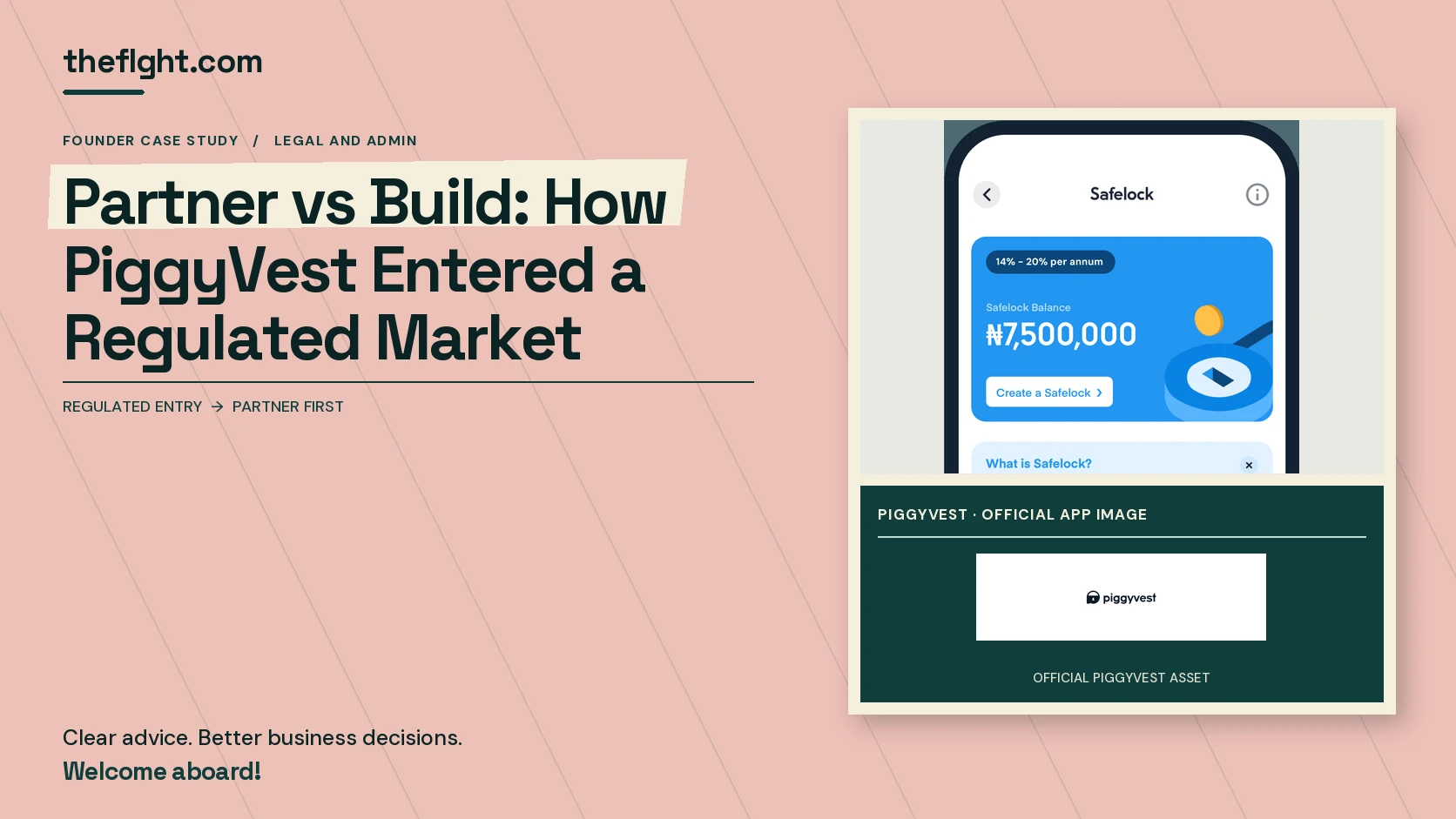
Piggybank.ng, later PiggyVest, launched around automated saving, initially focusing on people who wanted to save NGN 1,000 a day. The founders had technology experience but no previous financial-services operating background.
In the company's two-year founder account, the team says a microfinance-bank partnership helped it learn banking, payments, markets and government securities. More than 300 registrations arrived in two days. Users had saved NGN 21 million by the end of 2016 and close to NGN 1 billion during 2017; the first four months of 2018 reportedly matched all of 2017.
Savings volume is not company revenue, and registration is not activation. The account does not publish partner terms, safeguarding arrangements, failed debits, fee income or acquisition cost. Those gaps are essential to a responsible decision.
My position is that a young regulated business should prefer a well-governed partnership over prematurely imitating an institution. The qualification matters. A weak partner does not reduce risk; it concentrates it somewhere you cannot control.
Use the Regulated-Partner Responsibility Map
The Regulated-Partner Responsibility Map assigns an owner, evidence and failure response to every material duty.
| Responsibility | Possible owner | Evidence to inspect | Failure question | |---|---|---|---| | Customer funds or assets | Licensed partner or safeguarded account | Reconciliation and legal structure | Who restores a shortfall? | | Identity and eligibility | Either party under agreed process | Checks, exceptions and audit trail | Who stops prohibited use? | | Product communication | Customer-facing business | Approved wording and records | Who corrects a misleading claim? | | Complaints and redress | Shared, with one accountable route | Timelines and case records | Who pays and communicates? | | Data and security | Both across defined systems | Access, encryption and incident plan | Who reports a breach? | | Regulatory reporting | Licensed entity, with your inputs | Submission calendar and sign-off | What happens when data is late? |
Never accept “the partner handles compliance” as a complete answer. Write the action, owner, deadline, evidence and escalation.
Define the customer outcome before seeking a licence
PiggyVest began with a narrow saving behaviour rather than a broad financial supermarket. That focus matters because every additional product can introduce new permissions, disclosures, risks and partners.
Describe one customer job, money flow and failure case. Then ask a qualified local adviser which activities are regulated, which authorisations apply and whether an appointed or outsourced arrangement is lawful. Requirements vary materially by country and product. This article is an operating framework, not legal advice.
The [legal and financial setup checklist](/legal-and-admin/legal-and-financial-setup-checklist/) can organise the wider actions, but only local professionals and relevant authorities can determine your obligations.
Vet capability, not the licence badge
Confirm the partner's authorisation directly with the relevant regulator. Then investigate financial strength, governance, incident history where available, technology, reconciliation, support, subcontractors and exit capability.
Ask for a live walkthrough of onboarding, failed payments, withdrawal, complaint and daily reconciliation. Speak with two current or former commercial partners. A licence establishes permission; it does not establish service quality.
Model concentration risk. If one partner can stop the entire service, maintain a documented contingency. A second live partner may be too expensive early, but data portability, alternative diligence and exit terms are still necessary.
Price the partnership completely
Include setup, minimum fees, transaction charges, reserve requirements, reconciliation work, customer support and internal oversight. Add the cash effect of settlement delays. A low per-transaction price can still create a severe working-capital burden.
Compare partner economics with your expected net revenue per active customer. Volume held or processed is not revenue. The guide on [whether a business can make money](/business-finance/can-this-business-make-money/) helps separate the two.
Also price failures. Who pays for reversals, fraud, inaccurate interest, partner downtime or remediation? Contractual liability caps may not match the damage to your reputation.
Worked example: DailySave Finance
DailySave Finance wants to offer automated saving through a licensed institution. These figures are illustrative and not a recommendation about legal structure.
The partner charges £18,000 setup, £3,200 monthly minimum and £0.18 per successful deposit. DailySave expects 2,000 active customers making 18 deposits monthly. Transaction fees are 2,000 x 18 x £0.18 = £6,480. Total monthly partner cost is £9,680.
DailySave earns a disclosed service fee averaging £6.40 per active customer, or 2,000 x £6.40 = £12,800. Internal support, reconciliation and oversight cost £2,100. Monthly contribution after partner and internal direct cost is £12,800 minus £9,680 minus £2,100 = £1,020.
Assuming the £2,100 internal direct cost does not fall during the stress period:
| Stress case | Monthly contribution | |---|---:| | Expected 2,000 active customers | £1,020 | | 1,500 active customers | negative £560 | | 2,000 customers, 25 deposits each | negative £1,500 |
More usage reduces contribution because the price metric and partner charge are misaligned. DailySave renegotiates a volume tier and changes its revenue model before launch. It also maps a failed withdrawal: partner investigates within two hours, DailySave updates the customer, and named officers decide redress within one working day.
The example shows why signing a licensed partner is not the finish. Economics and responsibility must work under the same customer behaviour.
Know when to seek more control
Review your own licence or infrastructure when the partnership blocks a core customer outcome, introduces excessive variable cost, restricts data needed for service or creates repeated incidents. First ask whether renegotiation, a second partner or a partial build solves the constraint.
Owning regulated infrastructure adds capital, people, governance, reporting and continuing supervision. The decision should be funded as a permanent operating model, not a one-off application project.
Do not tell customers that becoming directly licensed makes the product safe by itself. Trust comes from clear communication, sound controls and reliable execution under either model.
Complete the map before launch
In the first week, draw the customer and money flows, including failure paths. During week two, obtain regulatory advice and verify partner permissions. By week three, price the expected, low-volume and high-usage cases.
Before any live customer, test onboarding, deposit, withdrawal, reconciliation, complaint, outage and data export. Assign named owners and response times. Launch a capped pilot only after the contract, operational evidence and customer wording agree. Review the partnership monthly and exercise an exit test at least annually.
Related guides
Frequently asked questions
Does using a licensed partner mean I do not need legal advice?
No. The partnership may change which permissions you need, but it does not answer the question. Your marketing, customer contract, data processing, complaints, fees and operational role can still create obligations. The analysis depends on jurisdiction and the exact activity, including who controls funds and makes decisions. Use a qualified local lawyer or compliance professional and verify statements with the relevant authority. Treat a partner's sales assurance as one input, not an independent legal opinion. Document the advice against the actual product flow.
How do I verify a partner's licence?
Search the relevant regulator's official register and match the legal entity, permissions, restrictions and status. Do not rely on a logo or trading name. Ask the partner to identify which permission covers your proposed activity and have your adviser confirm it. Review enforcement or restriction notices where public. Recheck before launch and periodically afterwards, because permissions and conditions can change. Also verify which entity signs your contract; a licensed group company does not automatically cover services supplied by another affiliate.
Who should handle customer complaints?
Give customers one clear route, even if work is divided behind the scenes. The responsibility map should state who acknowledges, investigates, decides, pays redress, reports and keeps records. Your brand should not send a customer between companies. Set response and escalation times that comply with applicable rules and can be met operationally. Run test complaints before launch. Requirements vary by product and country, so a qualified local adviser should confirm the process, wording, ombudsman or regulator routes and record-retention obligations.
Should I use more than one regulated partner?
Not automatically. Two live partners can reduce concentration risk but add integration, reconciliation, contract and customer-experience complexity. Early on, a well-vetted primary partner plus a documented and periodically reviewed alternative may be proportionate. Measure how long migration would take and whether data can be exported in a usable format. If an outage would stop a high-volume or critical service, dual capability may become operationally necessary. The choice should follow measured impact and recovery requirements, not a general preference for redundancy.
When should I apply for my own licence?
Consider it when your model is proven, partner constraints create measurable harm and you can finance specialist staff, governance, capital and continuing supervision. The application fee and timeline are only part of the cost. Build a three-year operating budget and a transition plan that protects customers. Speak with regulators and advisers early, but do not present an application as inevitable. A partnership may remain the better permanent model if it preserves good economics and service. Licensing requirements and supervisory expectations vary significantly by jurisdiction.
Can I launch a waiting list before the partnership is complete?
You can usually research demand, but avoid implying that a regulated service is available, authorised or guaranteed before that is true. Collect only data you need, state how it will be used and do not take funds or commitments without advice. Advertising, financial-promotion and data rules vary by country and product. Have qualified local professionals review the wording. A waiting list measures interest, not lawful readiness or paid demand. Use interviews and non-transactional prototypes to learn while the operating and regulatory route is being confirmed.
Comments (0)