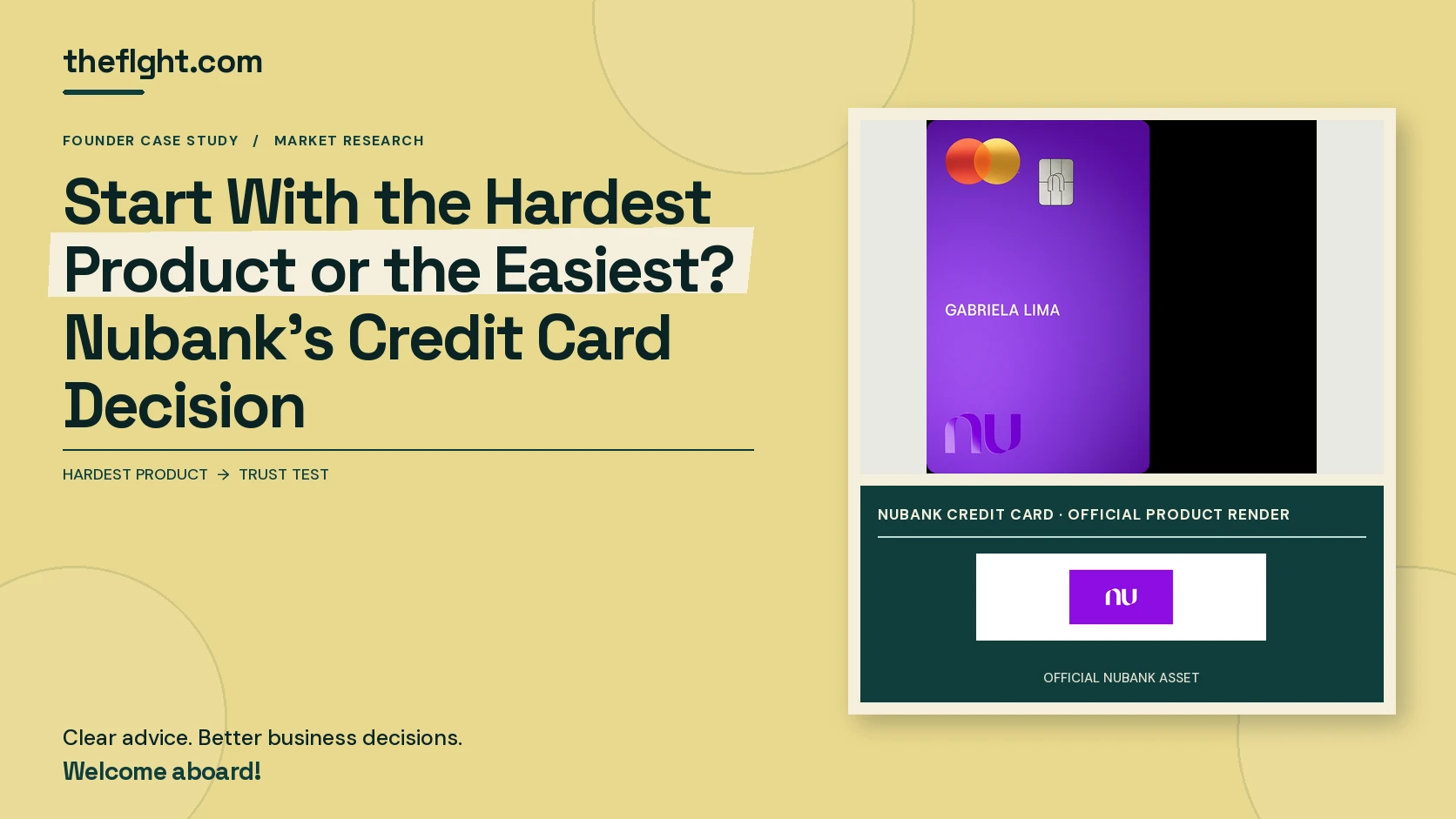
Start With the Hardest Product or the Easiest? Nubank's Credit Card Decision
Short answer: Launch the harder product first only when solving it creates customer trust, proprietary learning or distribution that makes later products materially easier. Cap the pilot so one failure cannot sink the business, and prove that the hardest risks can be measured before scale. Otherwise start with the simplest paid outcome and preserve cash for the next step.
The easiest product can reach market faster but teach you little about the advantage you ultimately need. The hardest can create a defensible foundation while exposing the business to operational, financial and regulatory failure before it has experience.
Difficulty is not a strategy. The hard product must buy a specific future advantage.
Why Nubank began with credit cards
Nubank started with a small team in Brazil in 2013 and made the first transactions on its credit card on 1 April 2014. The product had no annual fee and was controlled through a mobile app.
This was not an unconstrained choice among equally available products. In the Sequoia account of Nubank's early decision, co-founder Cristina Junqueira says the main reason for choosing cards was that they were then one of the few products the company believed it could offer without being a regulated entity. Nubank did not have a banking licence. A subsequent rule brought card issuers into regulation and forced the company to launch by April 2014 or face a licensing delay the founders believed could exhaust its seed capital.
A later Nubank regulatory filing explains that starting with cards also helped it build customer trust, collect proprietary behavioural data and establish a base for later services. David Vélez told Harvard Business School that the company spent effectively nothing on marketing and invested in service that generated word of mouth.
The public evidence does not disclose the earliest credit limits, approval rate, losses, cost to serve or first-100 referral rate. Those numbers determine whether the same decision would have been survivable for another company. Nubank's story supports testing a hard strategic assumption, but it does not prove that the founders freely chose the hardest product solely because difficulty created an advantage.
My view is that “start easy” is incomplete advice. Start with the smallest product that proves the hardest strategic assumption. Sometimes that product is operationally difficult. If you avoid the assumption, you may build an easy product with no path to advantage.
Use the Hard-Product Beachhead Test
The Hard-Product Beachhead Test scores whether difficulty creates reusable assets or merely cost.
| Test | Question | Pass evidence | |---|---|---| | Strategic asset | What becomes easier after launch? | Data, trust, distribution or capability reused later | | Observable risk | Can the main failure be measured quickly? | Defined loss, reliability or complaint metric | | Capped exposure | Can customer and cash exposure be limited? | Pilot limit, reserve and stop rule | | Customer pull | Does the hard product solve urgent pain? | Paid use or meaningful commitment | | Expansion path | Do later products fit the same relationship? | Shared customer, data and channel |
A pass requires all five. A high score on ambition cannot compensate for uncapped exposure.
Name the assumption the product must prove
For a lender, the hard assumption may be whether risk can be assessed while providing a better customer experience. For a marketplace, it may be whether supply and demand can meet. For a manufacturer, it may be whether a difficult process meets quality consistently.
Write the assumption in a form that can fail: “Among 200 capped accounts, net loss remains below £X and at least Y customers repeat.” Avoid “customers will love a modern experience”.
Use [testing a business idea before spending money](/business-ideas/test-your-idea-before-spending/) to design the smallest behaviour that exposes the assumption. A mock-up cannot test credit loss, but it can test application demand before live lending.
Value the asset created by difficulty
The hard product should create something that later competitors cannot buy instantly. Nubank's account emphasises behavioural data and trust. Your asset might be supplier knowledge, verified performance history, permissions or embedded workflow.
Estimate how the asset changes the next product: acquisition cost, approval accuracy, launch time, retention or contribution. If you cannot connect the first product to a measurable later benefit, its difficulty is probably not strategic.
Be careful with data claims. Collecting more data does not automatically create insight or permission to reuse it. Data protection, credit, consumer, discrimination and marketing rules vary by jurisdiction. Obtain qualified local legal and compliance advice before designing collection, decisions or reuse.
Cap financial and operational exposure
Set pilot limits for customer count, individual exposure, total loss, transaction volume and service workload. Define who can stop the pilot and how customers will be protected if it stops.
Monitor leading signals as well as final losses. Failed verification, missed first payments, complaints, response times and manual reviews can show pressure before an accounting loss matures.
Fund the downside. A launch reserve is not growth capital. If the business needs every pound of customer repayment to meet next month's obligations, the hard product is not safely contained.
Worked example: PurpleCard
PurpleCard is deciding between a prepaid budgeting account and a limited credit card. These figures are illustrative and are not lending advice.
The prepaid product would cost £85,000 to launch and contribute £3 per active customer monthly. It produces transaction data but little evidence about underwriting.
The credit pilot costs £170,000 to launch. PurpleCard caps it at 300 customers with an average £500 limit, creating 300 x £500 = £150,000 maximum authorised exposure. Expected utilisation is 40%, so average outstanding receivables over the six-month pilot are forecast at £60,000. The £170,000 launch spend does not fund those receivables. PurpleCard separately secures capacity for the £150,000 authorised exposure and ring-fences £72,000 of liquidity, equal to the £60,000 expected balance plus a 20% buffer.
| Credit pilot item | Calculation | Amount | |---|---:|---:| | Interest and interchange contribution | 300 x £11 monthly x 6 months | £19,800 | | Service and processing | 300 x £4 x 6 months | £7,200 | | Expected net credit loss | £60,000 x 6% | £3,600 | | Funding and capital allowance | £60,000 x 10% x 6/12 | £3,000 | | Six-month contribution before build | £19,800 minus £7,200 minus £3,600 minus £3,000 | £6,000 |
The 10% annual funding and capital allowance is an illustrative assumption, not a current market rate. PurpleCard must replace it with the actual cost of its funding, liquidity and required capital structure. The credit option does not recover its £170,000 launch cost in six months, and it also ties up funding for receivables. Its justification must be the strategic asset. PurpleCard sets pass conditions: loss below 8% of average receivables over six months, 70% monthly active use, complaint resolution within two working days and 35% of customers joining a later savings pilot.
At six months, net loss is 5.5% of average receivables, active use is 76%, complaint response meets the target, and 121 of 300 customers join savings, a 40.3% expansion rate. The hard product has produced risk evidence, trust and a route to a second product.
If loss had reached 10%, the expansion result would not rescue the decision. Capped exposure and a pre-agreed stop rule prevent strategic storytelling from excusing a dangerous core.
Compare with the easy-product counterfactual
Model what the easy product would prove, how quickly and at what cost. It may provide acquisition evidence, operational practice and revenue while the hard capability is developed safely.
Do not compare the hard product's full future with the easy product's first version. Give each a 12- or 24-month sequence. The correct answer may be easy first when the learning transfers and cash risk falls.
The article on [how much money you need to start](/business-finance/how-much-money-do-you-need/) helps convert both sequences into runway rather than headline build cost.
Decide the first product in four weeks
In week one, list the strategic assumptions behind the eventual business. By week two, map one hard and one easy product against the five tests. Get qualified advice on regulated or safety-critical duties.
During week three, price both 12-month sequences, including reserves and permanent operations. In week four, define a capped pilot and stop conditions for the winning route. Do not launch until a named person owns daily risk monitoring and customer remediation.
Related guides
Frequently asked questions
Does launching the hardest product create a stronger moat?
Only when the difficulty creates a reusable asset such as trusted data, operating knowledge, permissions, distribution or proven performance. Complexity alone is easy for a larger competitor to reproduce and expensive for you to maintain. Identify the asset and show how it improves a later product or lowers a future cost. If the advantage disappears when a vendor offers the same component, it may not be a moat. Also consider whether customers value the result enough to compensate for the slower and riskier launch.
Should a fintech always begin with payments rather than lending?
No. Payments may create transaction data and frequent use with less balance-sheet risk, but the right sequence depends on customer pain, permissions, economics and the capability you need to prove. Lending can create strong value and learning while exposing customers and the business to loss. Neither route is inherently safer in every jurisdiction. Map the exact money flow and obligations, then obtain qualified local regulatory, legal and risk advice. Copying another company's sequence without its capital and controls is dangerous.
How small should a hard-product pilot be?
Small enough that the worst credible loss and service failure can be absorbed, but large enough to observe the core risk more than once. Set limits from capital and consequence rather than an arbitrary user count. For credit, cap customers, individual limits and total balances. For hardware, cap units and environments. For health or safety products, a qualified professional and applicable regulation should define testing. Increase the pilot only after the leading and outcome measures meet thresholds for a full decision cycle.
What if the easy product generates revenue sooner?
Include that revenue in the counterfactual, along with the learning it funds. Earlier cash can make the easy route strategically superior even if it does not prove the hardest assumption immediately. Ask whether the product builds the same customer relationship and whether profits can genuinely finance the next stage. If it attracts a different segment or creates a separate operation, it may become a detour. Compare contribution, founder attention and time to the decisive evidence across both sequences, not launch dates alone.
Can customer-service quality be a strategic asset?
Yes, when it creates trust, referrals and operating knowledge that are difficult to reproduce. Measure it through response, resolution, repeat use, complaints and attributable referrals rather than anecdotes. Service becomes a weak moat if it depends entirely on founders performing exceptional manual work. Document processes, train people and connect recurring issues to product improvement. In regulated services, service quality also includes accurate disclosures, fair customer outcomes and effective redress, not friendly language alone. Applicable standards vary by country and sector.
When should I add the easier products?
Add one when the first product's core risks are controlled, the same customers have a verified adjacent need and the addition uses an asset the first product created. Test demand with a paid or otherwise meaningful commitment before building. Set a clear capacity threshold so expansion does not weaken reliability. A second product that introduces a new customer, channel and risk model is another startup, not simple cross-selling. Compare its expected contribution with improving the original product before allocating the team.
Comments (0)