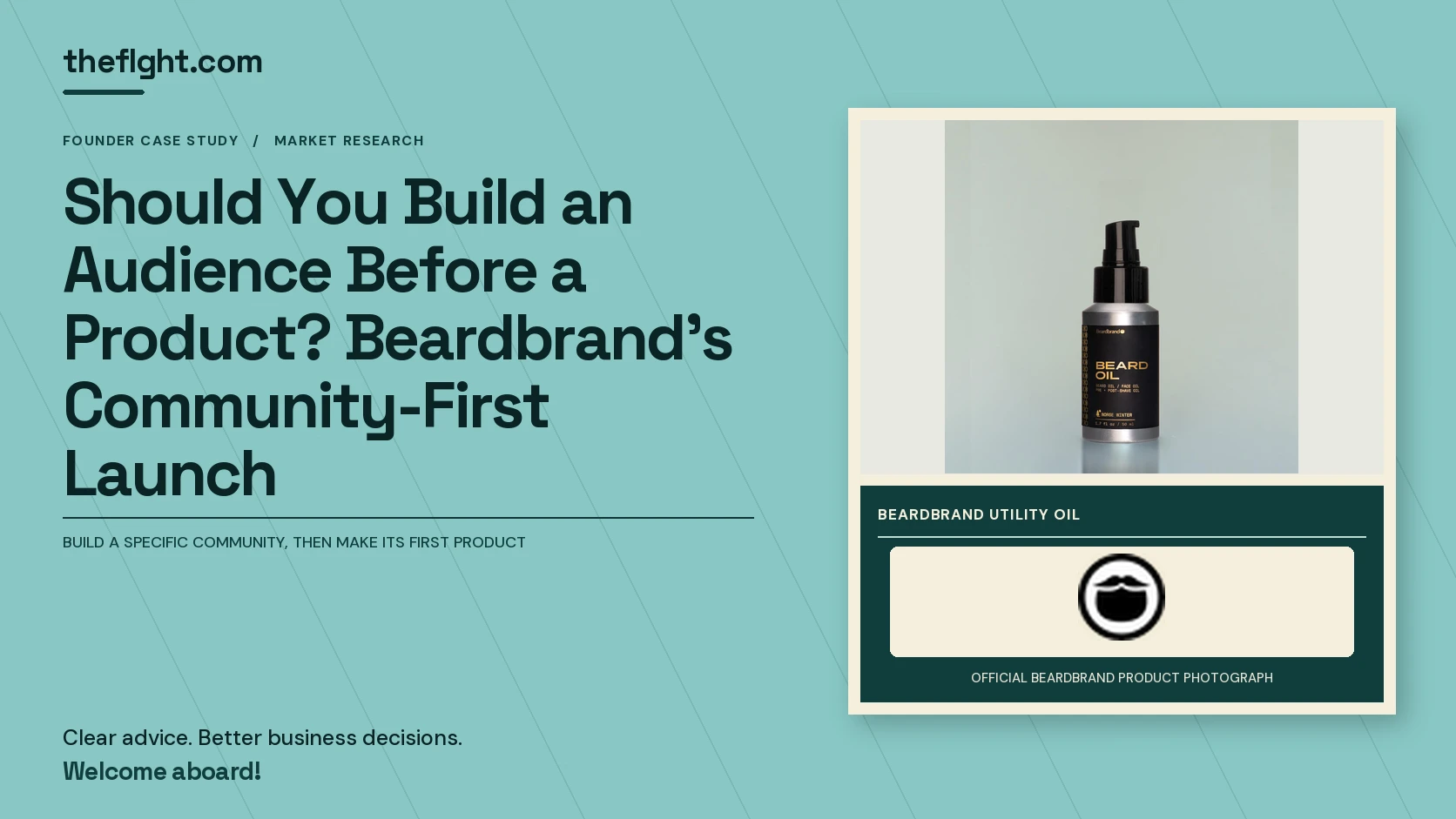
Should You Build an Audience Before a Product? Beardbrand's Community-First Launch
Short answer: Build an audience first when useful content gives you direct access to a specific group whose unresolved buying problem you can observe. Do not wait for a large follower count. After 100 relevant subscribers or regular participants, test one normal-priced offer and judge the strategy by paid conversion, contribution and repeat demand. If the audience consumes content but avoids commercial action, treat it as media reach, not a customer base.
An audience can lower the cost of finding early customers and improve product language. It can also become a comfortable substitute for making an offer. Likes reward publishing skill, not necessarily purchase intent.
Beardbrand founder Eric Bandholz said he started the business as a blog and community in February 2012 after noticing an underserved group he called urban beardsmen. Ecommerce launched in January 2013 with three products and no established sales. In a contemporaneous founder interview, he reported monthly revenue rising from roughly $1,000 to $40,000 by October, with $60,000 projected for November. Shopify's founder interview records the timeline and reported figures.
Those figures are self-reported and do not isolate how much revenue came from the existing audience, press coverage or other channels. That missing attribution is central to the decision.
Use the Audience-to-Offer Conversion Chain
The Audience-to-Offer Conversion Chain separates attention from commercial evidence.
| Link | Evidence | Weak substitute | |---|---|---| | Shared problem | Repeated questions and workarounds | Broad lifestyle interest | | Reachable people | Direct, permission-based contact | Platform follower count | | Buying signal | Requests for products or recommendations | Likes and compliments | | Offer response | Normal-priced orders | Giveaway entries | | Contribution | Cash after product and acquisition | Revenue alone | | Return | Repeat purchase or referral | One press-driven spike |
My position is that you should not spend a year building an audience before testing an offer. Build and test in overlapping cycles. Once 100 suitable people regularly engage, offer the smallest product that addresses the repeated problem. More content without a transaction delays the evidence the business needs.
Build around a problem, not a personal following
Define the audience by the job or frustration they share. "People who like my videos" is not a segment. "Men growing a beard for the first time who cannot find straightforward grooming guidance" is closer to one.
Publish material that helps the group make progress and invites specific responses. Track recurring questions, current purchases, failed alternatives and the language people use. This is [customer-segment research](/market-research/first-profitable-customer-segment/), not merely content marketing.
Avoid manufacturing a problem to sell the future product. Useful content should stand on its own and distinguish evidence from opinion. Health, cosmetic, financial and performance claims may be regulated. Check current rules and qualified advice for your topic and market.
Own a lawful route to contact
Platform reach can disappear or be withheld by algorithms. Give people a clear reason to join an email list, forum or event where they knowingly choose contact. Collect only necessary data, explain its use and honour preferences.
Do not describe the list as owned in an unlimited sense. Privacy and direct-marketing rules govern what you can do with it. In the UK, check current Information Commissioner's Office guidance and obtain qualified advice for consent, legitimate interests, cookies and international transfers.
Measure reachable members: people who open, reply, attend or participate within a defined period. Ten thousand dormant followers are less useful than 300 people who repeatedly discuss the target problem.
Let requests shape one first offer
Group questions into buying jobs. If people repeatedly ask which product to use, what specifications matter and where to buy, there may be an offer. Choose one that can be sourced or made safely in a small quantity.
Beardbrand launched with three products rather than a full grooming range. The practical principle is a constrained offer, not the number three. Keep variants low, state what you stock and use the first orders to learn.
Do not ask followers only whether they would buy. Present the product, price, delivery and returns, then request payment. If manufacturing is not ready, use clear pre-order terms or a paid manual service that tests the same value.
Attribute the launch properly
Tag every order by first known source: existing subscriber, organic search, press, referral, paid campaign or unknown. A media feature can create a launch spike that the community did not produce. That is still useful, but it changes what is repeatable.
Calculate conversion from active reachable members, not total followers:
audience conversion = audience-attributed buyers divided by active reachable members offered the product
Then calculate contribution after product, fulfilment, payment, returns and content production attributable to the launch. Content takes founder time even when no cash changes hands.
Worked example: Borough Beard Care
Borough Beard Care publishes practical grooming articles for six months. It has 800 email subscribers, of whom 360 opened or replied in the last 60 days. It launches one beard oil at £24.
Eighty orders arrive, but attribution shows 45 from active subscribers, 25 from a local article and 10 unknown. Audience conversion is 45 ÷ 360 = 12.5%, not 80 ÷ 800.
| Per order | Amount | |---|---:| | Selling price | £24 | | Product and bottle | £7.20 | | Packaging and delivery | £4.80 | | Payment and returns allowance | £1.20 | | Contribution | £10.80 |
The 45 audience-attributed orders contribute 45 x £10.80 = £486. Launch content and email work took 14 hours at £30, or £420. The launch therefore adds £486 - £420 = £66 before general overhead, but that is only the incremental launch result.
The preceding six months of audience building averaged six hours a month at £30, plus £120 of cash expense: 6 x 6 x £30 + £120 = £1,200. Including that earlier investment, the audience route stands at £486 - £420 - £1,200 = -£1,134. At £10.80 contribution per later order, another 105 orders would recover that amount if they required no further content cost. Those earlier costs are sunk when deciding whether to fulfil the launch, but they belong in any honest retrospective comparison of audience-first acquisition.
The audience produced paid evidence, not profit yet. Borough should measure 60-day repeat purchase and whether the next launch requires fewer content hours. These figures are illustrative, not grooming-sector benchmarks.
Distinguish community value from customer extraction
A community is not an inventory of leads. If every discussion becomes a sales prompt, trust falls and the evidence becomes biased towards the founder's agenda. Keep useful non-commercial participation and state when a recommendation benefits your business.
Invite criticism from non-buyers and customers. Publish limitations and suitable-use guidance. This strengthens trust and protects positioning from becoming a personality cult.
When members create much of the value, set conduct, moderation and commercial rules. Do not use member posts, images or personal stories in marketing without permission.
Know when product should come first
Build the product first when feasibility, safety or technical performance is the main uncertainty, or when the intended buyers do not gather around content. A specialist industrial component may need a prototype and direct sales rather than a public audience.
Audience-first also performs poorly when the founder enjoys publishing but avoids stock, service and pricing decisions. Set a commercial test date at the start. If you cannot form a credible small offer after 100 relevant active members and repeated problem evidence, reconsider whether the audience and business belong together.
Run the first offer in 30 days
Review your last 50 audience questions and group them by paid problem. Identify active reachable members and choose one narrow offer. Calculate contribution, prepare lawful sales and data terms, and present it at normal price to a bounded cohort. Attribute every order. After 30 days, compare conversion, contribution, refunds and repeat intent with the cost of producing the content. Continue audience investment only when the chain reaches profitable or strategically useful customer behaviour.
Related guides
Frequently asked questions
How large should my audience be before I launch?
There is no universal number. One hundred active, relevant people is enough for a first bounded offer in many consumer niches, while an expensive specialist product may need fewer qualified buyers. Count people who recently opened, replied or participated, not all-time followers. Estimate the number of orders required to test contribution and divide by a conservative conversion rate. If you need 30 orders and expect 10% conversion, you need roughly 300 active suitable members or another acquisition route. Launch to learn before chasing a round audience milestone.
Should I start an email list or a social community?
Choose the format that fits the audience's existing behaviour and the problem. Email gives a direct permission-based route and useful attribution. A community enables member-to-member learning but requires moderation. Social platforms can accelerate discovery but limit control and data. You may use all three with distinct roles, but avoid splitting a small audience across empty spaces. Explain data use and marketing choices clearly. Privacy, cookie and direct-marketing requirements vary, so use current official guidance and qualified advice rather than assuming a platform handles compliance.
What if my followers dislike being sold to?
Make the commercial relationship explicit before launch and keep the offer relevant to the problem your content addresses. People object more to surprise, pressure and irrelevant promotion than to a clear useful product. State when you benefit, publish limitations and give an easy way to decline marketing. Watch unsubscribes, complaints and participation after the offer. If trust falls sharply, examine frequency and fit. Do not promise a permanently non-commercial community and later reverse the terms without meaningful notice and choice.
Can sponsorship revenue validate my future product?
It validates that advertisers value access to the audience, not that members will buy your product. Sponsorship can finance research and production, but keep its economics separate. Track sponsor concentration, fulfilment time and the effect on trust. When you launch your own offer, measure member conversion independently. Also disclose paid relationships and follow advertising rules. A profitable media business may be better than forcing a product onto the audience, so compare both models rather than treating sponsorship as merely temporary.
Should I manufacture my own first product?
Not necessarily. Reselling or working with a verified manufacturer can test category demand with less development and stock risk. Your differentiation may initially come from selection, education and service. Calculate margin, control, minimum order, claims and supplier dependence. Private label or original formulation becomes sensible when repeated customer evidence justifies the cost and you can meet safety and labelling obligations. Cosmetics and grooming products have jurisdiction-specific rules, so obtain qualified product, legal and safety advice before manufacturing or placing your name on goods.
How do I know whether content caused the sale?
Use tagged links, customer questions, first-touch source and a short post-purchase question, then accept that attribution remains imperfect. Compare active subscribers offered the product with a similar group not yet offered it where practical. Look at timing and repeat behaviour, not only the last click. Press, referrals and search may interact with content. Report a range when source is uncertain. Preserve raw channel records for later cohort review. The decision does not require perfect attribution, but it does require separating audience-driven orders from a one-off external feature.
Comments (0)