Can a Demo Video Validate Demand Before You Build? Dropbox's 75,000-Person Waitlist
Short answer: A demo video can validate that a defined audience understands and wants a proposed software outcome before the full build. It cannot prove reliability, retention or willingness to pay. Show one realistic workflow, send it to the people who already face the problem, and require a meaningful next action. Build further only when at least 20 qualified viewers request access and a smaller group accepts a paid pilot or equivalent commitment.
Software can be difficult to validate with screenshots because the value lies in behaviour across time or systems. A clear demonstration can make that future experience concrete without financing production infrastructure first.
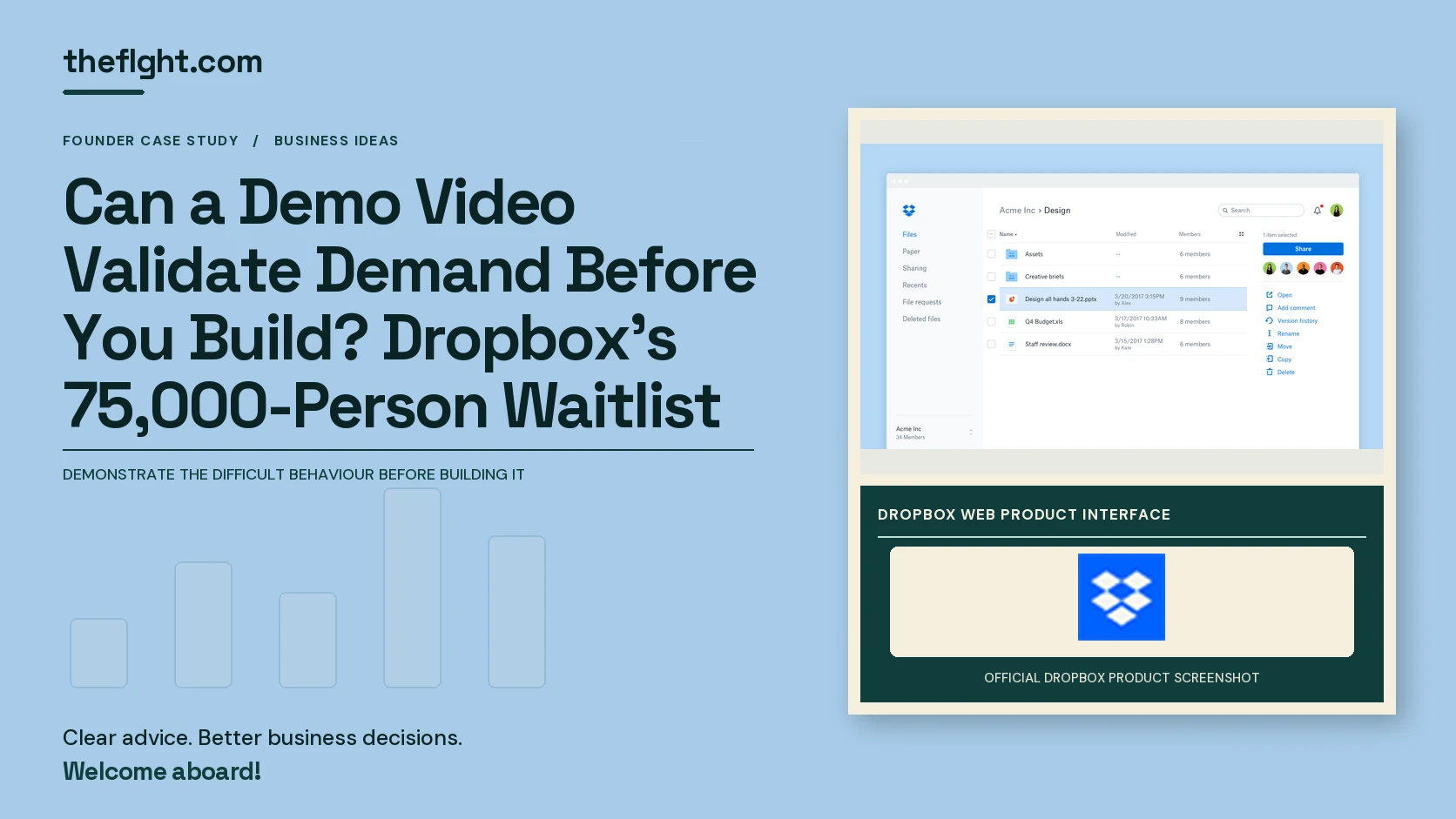
Dropbox co-founder Drew Houston said an early demonstration video helped move the private-beta waiting list from about 5,000 to 75,000 people overnight. He explained that the video contained references tailored to the Digg audience, making it legible to a technically minded first segment. TechCrunch's founder interview records the figures and targeting.
That jump proves attention and sign-up intent in one community. It does not tell us how many became active, retained or paid. A useful founder should preserve that distinction.
Use the Demo-before-Build Evidence Ladder
The Demo-before-Build Evidence Ladder prevents a large waitlist from being treated as a finished business case.
| Rung | Customer action | What it proves | |---|---|---| | 1. Relevant view | Suitable prospect watches the workflow | The message reached the audience | | 2. Comprehension | Prospect can explain the outcome | The concept is understandable | | 3. Request | Prospect joins for a defined use | Some intent exists | | 4. Costly commitment | Prospect gives time, data, deposit or access | Problem matters enough to act | | 5. Paid use | Prospect pays and reaches value | Initial commercial evidence | | 6. Repeat use | Customer returns in the natural cycle | Product may have durable value |
My position is that founders should use a demo before a prototype when the main uncertainty is whether customers understand and want a complex interaction. Use a prototype first when feasibility, safety or hands-on usability is the central risk. A persuasive video cannot settle whether the product can be built reliably.
Demonstrate one completed job
Choose a workflow that begins with a recognisable trigger and ends with a valuable result. Do not tour menus or narrate a long vision. Show what the customer does, what the system does and what changes afterwards.
Label simulations honestly. If the interface is a visual mock-up, do not imply that data is actually syncing, calculations are verified or security exists. Misleading demonstrations destroy the trust the test is meant to measure and may breach advertising or consumer rules.
Keep the video short enough that a qualified prospect will finish it, but long enough to show the critical sequence. Three to five minutes is a useful working range for one software job, not a universal rule.
Use [a prototype before asking customers to pay](/business-ideas/build-a-prototype-before-asking-customers-to-pay/) when prospects must interact to judge the value.
Put it in front of a problem-aware audience
Dropbox tailored its demonstration to Digg users rather than releasing a generic corporate film. The lesson is audience selection, not inserting jokes into every video.
Find a community, role or workflow where people already describe the problem. Follow community rules and contribute context rather than dropping promotional links indiscriminately. Record source-level views, completion, sign-ups and later commitments.
Do not combine traffic from friends, general social followers and target buyers into one conversion rate. A small relevant audience gives more useful evidence than a large untargeted one.
Ask for the next costly action
A generic "join the waitlist" button produces ambiguous names. Ask what the viewer wants to use the product for, what they use now and when they need the outcome. Then offer a specific next step: a pilot interview, data-import session, refundable reservation or paid manual version.
The action must fit the maturity and risk. Do not request sensitive files for software that lacks security controls. Do not take deposits unless terms, refunds and fulfilment are clear.
Track the funnel from unique qualified viewer to completed commitment. Total views are not the denominator if most viewers could never buy.
Worked example: CloudPocket Sync
CloudPocket proposes automatic file synchronisation for small architecture practices. A four-minute video shows a drawing updated on an office computer appearing on a site laptop with version history.
The founder sends it to 240 qualified practice managers. Results are:
| Ladder stage | People | Conversion from prior stage | |---|---:|---:| | Qualified viewers | 180 | 75% of recipients | | Completed at least 75% | 126 | 70% | | Requested pilot access | 38 | 30.2% | | Joined a setup interview | 20 | 52.6% | | Paid £75 for a manual pilot | 8 | 40% |
The video and landing page cost 24 founder hours valued at £30 plus £180 of direct expense, or 24 x £30 + £180 = £900. Paid pilots generate 8 x £75 = £600, but the work is not finished when payment arrives. Each manual pilot needs two founder hours at £30 and £8 of infrastructure, so delivery costs 8 x ((2 x £30) + £8) = £544. Total test cost is therefore £900 + £544 - £600 = £844, or £105.50 per paying pilot after the promised pilot work is included.
CloudPocket has stronger evidence than a free waiting list, but not proof of scalable software. It should deliver the eight pilots, measure weekly reuse and test technical feasibility before a full build. These figures are illustrative, not software conversion benchmarks.
Test the riskiest feasibility assumption next
Demand evidence should change what you build, not trigger every feature shown. List the promises in the video and rank them by technical, legal and operational risk. Prototype the hardest essential promise first.
For Dropbox-like synchronisation, the hard work includes consistency, conflicts, security and cross-device reliability. A smooth visual demonstration does not remove those risks. For financial, medical or employment software, errors can cause material harm and require regulated controls.
Software, privacy, intellectual property, accessibility and advertising rules vary by jurisdiction and use. Obtain qualified legal and security advice before processing customer data or making performance claims.
Avoid manufacturing false evidence
Do not optimise the video solely for shares. A controversial title can create traffic from people who enjoy the content but do not need the product. Monitor downstream behaviour by source.
Do not count duplicate sign-ups, bots or inactive addresses. Confirm interest after a delay and ask for the intended use. A waitlist loses value over time, so record acceptance when invitations eventually go out.
Most importantly, state what the test failed to prove. Dropbox's 75,000-person number is memorable precisely because it is large. Your useful result may be eight paid pilots and a clear reason not to spend £60,000.
Run the video test in 14 days
In days one to three, choose one job and script the honest workflow. By day seven, create the simplest credible visual demonstration and a specific next action. Send it to a bounded problem-aware audience, track the full ladder and interview people who decline. By day 14, decide whether to test payment, feasibility or a different segment. Do not commission the full build until both demand and the riskiest technical assumption have evidence.
Related guides
Frequently asked questions
Does the demo need working software behind it?
No, if you state clearly that it is a concept or simulation and avoid collecting data or money under false assumptions. A visual prototype can test comprehension and interest. It cannot prove speed, accuracy, security or feasibility. If those properties drive the buying decision, build enough of the system to demonstrate them truthfully. Label what is real and what is illustrative on the page and in follow-up. Advertising and consumer rules apply to pre-launch claims, so obtain qualified advice for material performance statements.
How polished should the video be?
Polished enough that production defects do not obscure the workflow, but no more. Clear audio, legible screens and a coherent sequence matter. Expensive animation can make a weak concept look temporarily impressive and raise the test cost. Start with a screen recording or clickable mock-up and founder narration. If suitable viewers misunderstand the job, revise the message before funding production. Caption the video for accessibility. Keep the first version so you can compare whether later polish changes comprehension or merely increases viewing.
Is a large free waitlist useful?
Yes, for estimating interest, recruiting testers and planning capacity, but it is not a customer count. Segment sign-ups by source, use case and date, then reconfirm them before launch. Measure invitation acceptance, activation and paid conversion later. A list from one viral event may decay quickly. Avoid valuing every address equally in forecasts, and remove invalid or duplicate entries. Use [pre-orders versus a waiting list](/business-ideas/pre-orders-versus-a-waiting-list/) when a paid commitment is safe and appropriate, and keep marketing consent separate from product-access requests.
Can I take payment from the demo page?
Only when the customer receives clear terms about what exists, what they are buying, delivery timing, cancellation and refunds, and you can meet the obligation. A refundable reservation or paid manual pilot may be more honest than selling unavailable software. Do not store sensitive payment information yourself without appropriate systems. Tax, consumer, crowdfunding and payment rules vary by country and buyer type. Use qualified legal and accounting advice before taking advance money, especially for a delivery date you cannot yet predict.
What if viewers copy the idea?
The greater early risk is usually building something nobody wants. Share enough to test the customer outcome without publishing proprietary technical detail. Use confidentiality agreements selectively for genuine trade secrets, not as a condition for every customer interview. Copyright, patents and trade-secret protection differ and public disclosure can affect patent options, so obtain qualified intellectual-property advice if the innovation may be protectable. Keep dated development records. Remember that execution, distribution and customer knowledge are rarely captured by seeing a four-minute concept video.
When should I stop testing and start building?
Start the next build stage when a defined audience reaches the commitment rung, their use cases converge, and the critical technical assumption is testable with a bounded prototype. Do not wait for certainty. Set a budget and success threshold for the next risk. For example, eight paid pilots may justify a £3,000 feasibility sprint, not a £100,000 production system. Continue customer contact during development and test actual use as soon as a safe slice works. Each expenditure should buy evidence for the next irreversible decision.
Comments (0)