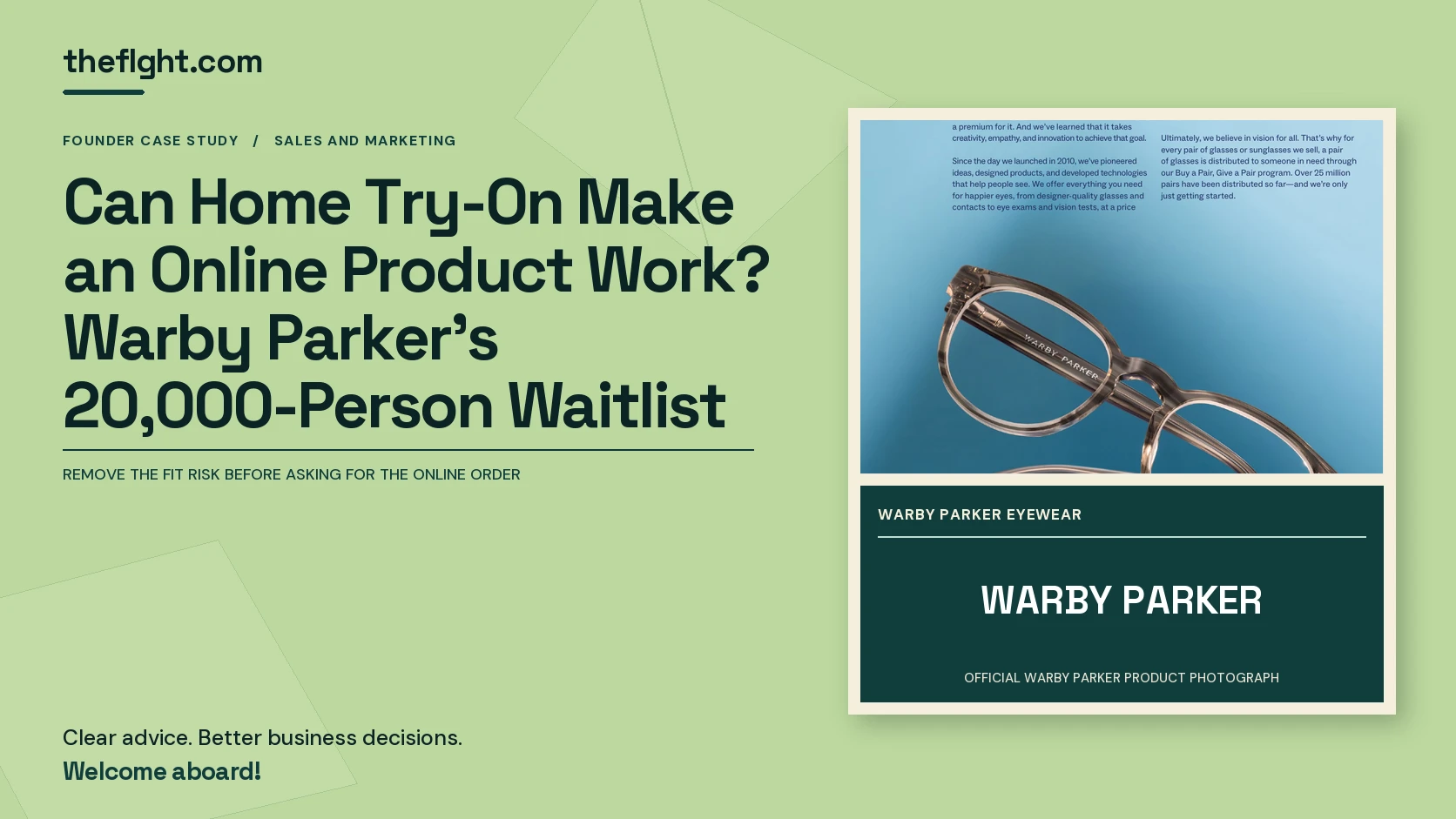
Can Home Try-On Make an Online Product Work? Warby Parker's 20,000-Person Waitlist
Short answer: Home try-on can make a fit-sensitive product work online when the trial removes the buyer's main uncertainty and enough recipients purchase to repay two-way postage, handling, damage and sample stock. Test 30 to 50 trial boxes before scaling. Divide net trial cost by purchase contribution to find break-even conversion, then require about 20% headroom. If the calculation gives 27.3%, target at least 33% before paid acquisition amplifies the risk.
The barrier to buying some products online is not lack of awareness. It is the customer's inability to judge fit, feel, colour or use from a screen. Sending samples can bring the decision into the home, but it turns stock into a travelling sales operation.
Warby Parker's regulatory filing says the company reached its first-year sales target in three weeks, sold out of its 15 most popular styles in four weeks and built a waiting list of thousands for its Home Try-On programme. The figures appear in Warby Parker's S-1 filing. Co-founder interviews put the Home Try-On queue at about 20,000 people and describe sending five frames for customers to assess at home. This founder discussion covers the programme and waitlist.
The launch demonstrates demand and a bottleneck. It does not publish the early trial-box contribution, loss rate or conversion needed to copy the model safely.
Use the Try-at-Home Friction Matrix
The Try-at-Home Friction Matrix compares the customer's uncertainty with the business cost of resolving it.
| Customer friction | Trial response | Business exposure | Evidence needed | |---|---|---|---| | Fit or size | Multiple samples | Size stock and cleaning | Purchase and exchange rate | | Colour or finish | Physical swatches | Sample production and loss | Change in conversion | | Feel or comfort | Limited-use product | Hygiene and damage | Safe reuse rate | | Compatibility | Test unit or fitting | Technical support | Successful installation | | Trust | Return option and proof | Fraud and return shipping | Net contribution after abuse |
My position is that home try-on should solve one costly uncertainty, not compensate for weak product information. Improve photography, measurement and specifications first. Send physical samples only when the remaining uncertainty materially suppresses purchases and the sample route is cheaper than a shop, showroom or high return rate.
Identify the decision that cannot happen on screen
Interview recent non-buyers and returners. Ask what they could not judge, what evidence they sought and what finally caused action. Distinguish fit from general mistrust. A trial box will not fix an unknown brand, unclear price or poor delivery terms by itself.
Estimate the value of resolving the uncertainty. If ordinary product-page conversion is 2% and a trial cohort converts at 18%, the programme may create value. But compare like-for-like traffic and include customers who would have bought without the trial.
Use [website versus social media versus physical location](/sales-and-marketing/website-vs-social-vs-physical-location/) to compare the trial with pop-ups, appointments or retail partners rather than assuming the only alternative is a permanent shop.
Calculate one complete trial cycle
Track the box from available inventory to customer and back into saleable condition. Include:
- outbound and return postage
- pick, checking, cleaning and repacking labour
- packaging wear
- payment-authorisation or fraud cost
- loss, late return and damage
- capital tied up while samples travel
- support and reminder time
Then subtract any separately charged trial fee that you retain. Divide total net programme cost by completed trial boxes, including boxes that never produce a sale.
Do not count the sample stock as free because it remains an asset. It has a purchase cost, limited useful cycles and opportunity cost when popular styles sit in customers' homes rather than sale inventory.
Set availability before promotion
A waitlist can control limited sample stock, but explain timing and prioritise fairly. Calculate trial-box capacity:
monthly box capacity = number of sample sets x 30 days divided by average cycle days
If 100 sets take ten days from dispatch to inspection and reavailability, theoretical capacity is 300 cycles a month. Reduce it for delays, repair and operational buffer.
A 20,000-person queue can create publicity while also producing disappointment. Measure how wait time affects acceptance and purchase. Expand sample stock only when conversion and contribution justify it.
Worked example: FiveFrame Eyewear
FiveFrame offers five frames for seven days. One trial cycle costs:
| Trial item | Amount | |---|---:| | Outbound and return postage | £8.40 | | Picking, checking and cleaning | £4.20 | | Packaging wear | £1.10 | | Loss and damage allowance | £2.30 | | Support and reminders | £1.50 | | Net trial cost | £17.50 |
Fifty trial boxes cost 50 x £17.50 = £875. Twelve recipients buy glasses at £125. Product, prescription-lens processing, payment and final delivery cost £61, leaving £125 - £61 = £64 purchase contribution each.
Purchase contribution is 12 x £64 = £768. After trial cost, the cohort loses £768 - £875 = -£107 before overhead. Conversion is 12 ÷ 50 = 24%, which sounds strong but does not make the programme profitable.
At £64 purchase contribution and £17.50 trial cost, break-even conversion is £17.50 ÷ £64 = 27.3%. FiveFrame needs at least 14 purchases from 50 boxes, or it must reduce trial cost, charge a reasonable fee or increase contribution. These figures are illustrative and do not represent optician economics.
Control loss without making the trial hostile
Use clear eligibility, a verified payment method where lawful, return reminders and a simple return process. Do not place excessive holds or obscure charges. State what happens if samples are late, damaged or missing before dispatch.
Hygiene, medical-device, optical, product-safety, prescription, accessibility, privacy and consumer rules vary by country and product. Eyewear can involve regulated professional activity. Obtain qualified legal and clinical or optical advice for your exact offer. A case study about frames does not authorise remote prescription services.
Fraud controls should be proportionate. Rejecting many genuine buyers can cost more than occasional loss and undermine the friction the programme was designed to remove.
Compare trial customers with ordinary buyers
Measure purchase rate, order value, returns, support and repeat purchase by route. Trial customers may buy more confidently and return less, which can justify a higher acquisition cost. They may also be lower-intent browsers attracted by free samples.
Track incremental sales. If half the trial buyers would have purchased anyway, assign only the additional conversion benefit to the programme. A simple holdout group seeing strong measurement and virtual information, but no home trial, can improve the comparison.
Also ask which samples were chosen and why. A trial programme is a research channel as well as fulfilment, but research value should not conceal an unprofitable sales route indefinitely.
Choose the smallest physical solution
Full products are not always necessary. Fabric swatches, material samples, fit consultations, refundable showroom appointments or one demonstration unit may resolve the same uncertainty at lower cost. Test the lightest intervention first.
If physical retail creates better contribution after rent and staff, use it. "Online-first" is not a principle worth losing money for. A blended model can let shops handle fitting while the website handles range and repeat purchase.
Run a 50-box test
Within one week, identify the single uncertainty the trial must resolve and calculate full cycle cost. Prepare written terms and safe handling. Send no more than 50 boxes to suitable prospects, with a comparable non-trial group if possible. Review conversion, incremental sales, returns, cycle days, loss and contribution. Continue only when the purchase contribution repays the trial route with a margin for overhead. If it does not, reduce physical scope or test an appointment route.
Related guides
Frequently asked questions
Should customers pay for home try-on?
They can. A modest fee, refundable against purchase, can screen casual demand and recover part of postage while preserving the trial's purpose. Test whether it materially reduces suitable participation. State the charge, refund conditions and any payment hold clearly before ordering. Do not present a charge as refundable if practical conditions make recovery unlikely. Track fee-paying and free cohorts separately. Consumer and payment rules vary, and card pre-authorisations expire or operate differently by provider. Obtain current legal and payment advice for your country and product.
How many items should go in each trial box?
Send enough to create a real comparison without multiplying stock, handling and choice overload. Warby Parker used five frames, but that does not make five universal. Start from the customer's decision: two sizes may resolve fit, while three material swatches may resolve finish. Model how each added item affects capital tied up, loss and cycle time. Test whether purchase conversion improves. If the fifth sample adds cost but rarely changes the chosen product, remove it and make more boxes available.
What if customers return samples late?
Design reminders and return packaging before launch, and state the due date and consequences clearly. Track late days because they reduce capacity even when the item returns intact. A reasonable refundable hold or late charge may help where lawful, but heavy penalties can deter genuine buyers and create disputes. Contact customers before applying a charge and provide support for lost labels or accessibility needs. Consumer, payment and fairness rules vary, so obtain qualified advice for the terms you plan to enforce.
Can home try-on replace a returns policy?
No. A pre-purchase trial and the customer's rights after purchasing are separate. The final product may differ through prescription, customisation, manufacturing variation or wear. State both processes clearly and make the final-product return route easy to find. Some personalised products have different cancellation treatment, but quality and description obligations still apply. Do not claim that trying a sample removes lawful remedies. Check current consumer guidance and obtain qualified legal advice, especially for made-to-measure, hygiene-sensitive, medical or prescription goods. Train support staff to distinguish the two processes.
How do I account for sample stock?
Record the stock and its depreciation or write-off according to your accounting policy and applicable rules. For management decisions, allocate purchase cost across the number of safe expected cycles and add loss, damage and cleaning. Track each unit's location and condition. Do not treat samples as zero-cost merely because they remain owned by the business. Review usable life after each cycle. Ask a qualified accountant about inventory valuation, impairment, VAT and write-offs. Operational records should also distinguish trial stock from sale stock to prevent overselling.
When is a pop-up better than home try-on?
A pop-up may be better when many customers can visit one place, expert fitting materially improves the decision, samples are expensive to ship, or hygiene and loss risk are high. Compare rent, staff, travel and footfall with trial-box cost and reach. A short appointment pop-up can also test which questions customers need answered before you commit to a shop. Home try-on is stronger when convenience and private comparison matter. Test both on net contribution and returns, not on the number of visitors or boxes sent.
Comments (0)