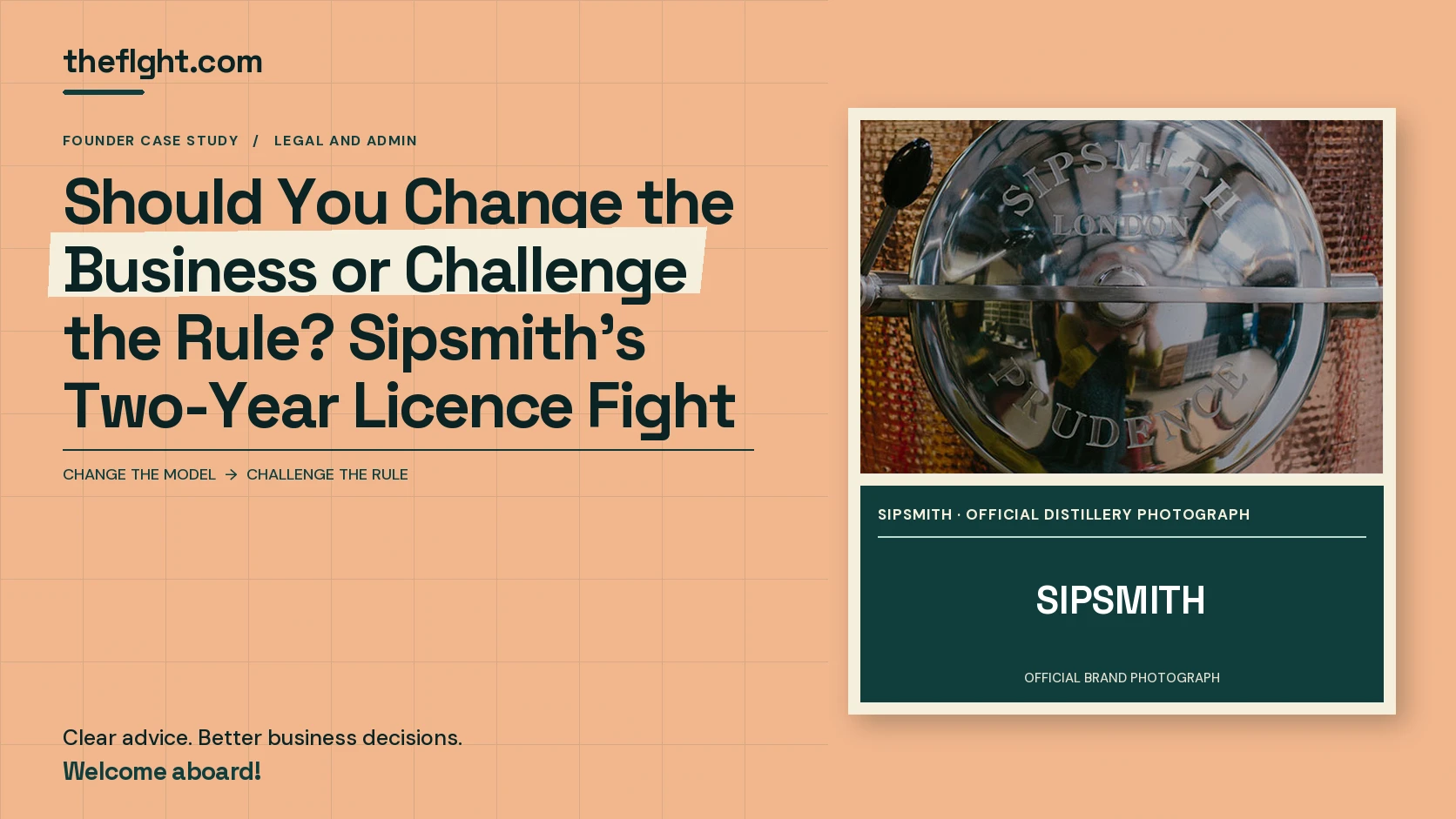
Should You Change the Business or Challenge the Rule? Sipsmith's Two-Year Licence Fight
Short answer: Challenge a regulatory barrier only when qualified advice identifies a lawful approval route, the rule blocks a commercially important advantage and you can finance the full delay without assuming approval. In parallel, cost an adapted model that complies now, such as using a licensed producer or changing the product. Set a cash limit, decision date and evidence milestones before you begin, because persistence is not a strategy when the authority has no lawful discretion to grant what you need.
Regulation can expose a weak idea. It can also preserve a rule designed for a different operating scale.
You need to know which situation you face before spending months persuading an authority. The answer comes from the current legal text, regulator practice and specialist advice, not from another founder's story.
Use the Regulatory Block Route Map
The Regulatory Block Route Map compares three routes through the same six questions: pursue approval, adapt the model or stop. Complete it before lobbying, buying equipment or signing premises.
| Question | Pursue approval | Adapt now | Stop | |---|---|---|---| | Legal route | Discretion, appeal or policy change exists | Existing compliant structure exists | No lawful or affordable route | | Strategic value | Blocked feature creates material advantage | Advantage survives outsourcing or redesign | Advantage disappears under compliance | | Evidence | Safety and control case can be proved | Partner already holds capability | Evidence cannot meet the standard | | Time | Delay fits runway and market window | Faster launch justifies reduced control | Window closes before either route works | | Cash | Full downside is funded | Partner and transition cost are funded | Both exceed affordable loss | | Reversibility | Assets retain value if refused | Contracts permit later migration | Commitment would trap capital |
My position is that you should build the compliant fallback at the same time as the approval case. A regulator is not your product-development department, and a two-year wait with no alternative can turn one legal dependency into an existential bet.
What Sipsmith's licence fight establishes
Sipsmith's founders wanted to distil gin on a small copper still in London. A Piper interview with Fairfax Hall and Sam Galsworthy says they spent around two years lobbying HM Revenue & Customs before receiving a licence and launching with master distiller Jared Brown in 2009.
Sipsmith has described its first still, Prudence, as a 300-litre still. A company interview says the prevailing position before 2009 effectively required a still of at least 1,800 litres. Trade material from Distilled UK similarly describes a two-year effort concerning small-batch distillation below 1,800 litres.
The popular account is often compressed into “Sipsmith changed a 200-year-old law”. Historical excise legislation and licensing practice are more complicated than that slogan. The useful, supportable point is narrower: the founders faced an official licensing barrier to their intended scale, pursued the issue over a long period and eventually obtained approval.
Do not treat their outcome as precedent for a current application. Rules, regulator discretion and guidance change. Obtain written, current advice for your product, premises and jurisdiction.
Identify the exact source of the block
Ask the authority to identify the legislation, regulation, licence condition, policy or evidential gap behind its position. A front-line “we do not allow this” may describe normal practice rather than the complete legal route, but it may also reflect a binding rule.
Have a qualified adviser distinguish among:
- A prohibition with no discretion.
- A licence standard you can meet with better evidence.
- An interpretation that can be reviewed or appealed.
- A policy that may be changed prospectively.
- A premises or operator problem unrelated to the business model.
The route, decision-maker and timetable differ. Lobbying for legislative change when the real issue is an incomplete application wastes runway. Appealing a binding statutory limit wastes it too.
Keep a written issues log. Record the authority, contact, date, question, answer, source cited and next evidence required. Oral encouragement is not approval, and an application received is not a licence granted.
Price the approval route before buying fixed assets
Create a monthly pre-revenue budget covering professional fees, application charges, testing, premises, insurance, founder living costs, staff, equipment deposits and financing. Add the cost of information requests and resubmission. Use a downside timetable longer than the regulator's indicative service period, particularly when the issue is novel.
Avoid irreversible commitments where possible. Negotiate conditional leases, refundable equipment reservations and staged supplier payments linked to approval. A cheap long lease is expensive when the permitted activity cannot begin.
Ring-fence the amount required to launch after approval. If legal work consumes production and working-capital cash, winning the licence can still leave the business unable to trade.
The [legal and financial setup checklist](/legal-and-admin/legal-and-financial-setup-checklist/) covers the wider sequence, but regulated sectors require specialist additions.
Cost the compliant alternative honestly
An existing licensed manufacturer, authorised partner, smaller scope, different premises or changed product may permit lawful trading sooner. Do not dismiss that route as impure. Compare what customers value with what control you surrender.
For each alternative, document unit cost, minimum order, quality, intellectual property, customer data, lead time, audit rights and termination. A partner may provide market evidence while your own application continues. It may also create dependence or prevent the product being made as intended.
Check whether the alternative truly complies. A partner's licence does not necessarily cover your activity, claims, storage, sale or responsibilities. Written specialist advice matters.
Worked example: Borough Still House
Borough Still House plans a small botanical spirit operation. Its adviser identifies a credible but uncertain approval route for the proposed premises. Management compares a 12-month approval pursuit with contract production at an already licensed distillery.
The approval route costs:
| Item | Calculation | Amount | |---|---:|---:| | Legal and licensing advice | Fixed estimate | £18,000 | | Technical evidence and testing | Fixed estimate | £11,500 | | Conditional premises cost | 12 x £1,750 | £21,000 | | Founder subsistence | 12 x £2,000 | £24,000 | | Application and insurance | Estimate | £5,500 | | Pre-launch cash | Total | £80,000 |
The business also needs £42,000 after approval for equipment completion, stock and working capital. Pursuing approval safely therefore requires £80,000 + £42,000 = £122,000. The founders have £96,000 and cannot fund the downside without exposing personal tax and living reserves.
A licensed contract producer requires £9,000 in development and compliance work plus a 4,000-bottle minimum. The producer charges £8.40 a bottle versus an estimated £5.60 in-house, a £2.80 difference. The first run's extra production cost is 4,000 x £2.80 = £11,200, so the adapted route requires £20,200 before other selling costs.
At a wholesale price of £15, contract production leaves £15 - £8.40 = £6.60 before distribution and overhead. It is less attractive per unit but creates lawful market evidence and preserves £75,800 of the founders' cash compared with the estimated approval spend.
Borough chooses a 12-month contract with transfer provisions while funding a narrower approval process. If customers will not buy at the price required by contract production, owning a still would not repair demand.
These figures are illustrative. Alcohol licensing, excise, food, planning and advertising requirements vary and need qualified local advice.
Set milestones that are not controlled by optimism
Approval itself may remain outside your control, but intermediate evidence is measurable. Set dates for a written legal opinion, regulator pre-application response, accepted evidence plan, complete submission and formal decision or appeal right.
At each milestone, compare actual cash and time with the approved downside. Stop or adapt when:
- the legal route no longer exists;
- required evidence cannot be produced;
- the revised cost breaches the limit;
- the commercial advantage no longer justifies delay;
- the market test fails through the compliant alternative.
Do not count media interest, supportive politicians or friendly meetings as licensing progress unless they change a formal requirement or decision.
Build the decision file over the next 20 working days
In the first week, obtain the current written basis of the regulatory block and commission qualified advice on approval, appeal and compliant alternatives. During week two, price the full downside timetable and list every commitment that depends on approval.
In week three, obtain proposals from compliant partners or redesign the smallest lawful version of the offer. In week four, set the cash ceiling, formal milestones and stop date. Proceed with a challenge only when the route, strategic value and runway pass together. Otherwise adapt or stop before sunk cost makes the decision for you.
Related guides
Frequently asked questions
Should I contact the regulator before paying for legal advice?
Usually make an early factual enquiry, but do not rely on general guidance for a material investment. Ask which published rules, application route and pre-application process apply. Then give a qualified adviser the written response, business model, product and premises facts. Regulators generally cannot design your business or guarantee an outcome before assessing a complete application. A short professional review can prevent you asking the wrong authority or interpreting informal comments as permission. The order may differ in urgent or highly regulated matters, so use sector-specific advice from the beginning where consequences are serious.
How long should I budget for a business licence?
Use the authority's current published service period only as the base case. Add time for evidence, premises work, questions, corrections, hearings and possible review. Ask advisers and recent applicants about the range, not just the average. Build a monthly cash case beyond the optimistic date and avoid commitments that become irreversible first. Sipsmith's reported two-year experience is not a forecast for another licence. Your sector, authority, novelty and application quality determine the path. If the downside timetable cannot be funded, use a compliant alternative or postpone fixed costs.
Can I trade while an application is pending?
Only if current law expressly permits the activity without the approval or under a valid interim arrangement. An application does not normally equal permission. Trading prematurely can create enforcement, insurance, tax, contract and reputational consequences. Ask the relevant authority and a qualified local adviser in writing before accepting orders or operating. You may be able to test non-regulated parts of the offer, conduct lawful research or use an authorised partner, but the boundaries must be explicit. Do not describe a future approval as secured in customer or investor communications.
Is using a licensed partner always safer?
No. It can reduce approval time, but you still need to verify that the partner's authorisation covers the activity and that responsibilities for production, storage, records, claims, complaints and recalls are clear. Review the partner's compliance history, insurance, capacity and financial position. Contracts should address audits, data, intellectual property, termination and transition. You may retain legal duties even when work is outsourced. Use sector and jurisdiction-specific advice. Commercially, model the higher unit cost and dependence as carefully as you model your own licence delay.
How do I know whether lobbying is realistic?
Start with a legal analysis of who has power to change the outcome. A regulator may have discretion, an appeal body may review a decision, or only legislation may change the rule. Then identify evidence that the existing policy objective can still be protected under your proposal. One company's inconvenience is rarely enough. Industry support, safety evidence and a workable control regime can strengthen a case, but none guarantees change. Set a time and cash limit. Lobbying becomes dangerous when meetings continue without a decision-maker, formal route or new evidence.
What should a conditional lease include?
It may make commencement, completion or rent conditional on specified licences, planning or other approvals, with long-stop dates and termination rights. The exact drafting, deposits, access, works, reinstatement and allocation of delay risk matter. A vague statement that the landlord “supports the application” does not protect you. The landlord may also need to provide documents or consent. Property and licensing law vary, so use a qualified solicitor who understands the intended regulated use. Do not sign first and plan to negotiate protection after an approval problem appears.
When should I abandon the regulated idea entirely?
Stop when no lawful route exists, required controls would destroy the customer value, downside cost exceeds affordable capital, or a compliant market test shows insufficient paid demand. Also stop when approval would arrive after the relevant market window or leave too little cash to launch. The decision should follow the pre-set ceiling, not the founder's need to justify money already spent. Preserve transferable research, brand or product assets where lawful, then evaluate a different offer independently. Obtain professional advice before closing applications, contracts or a regulated entity.
Comments (0)