Pre-orders vs Inventory Finance: Who Gives A Crap's First Production Run
Short answer: Use pre-orders when the product can be specified honestly, buyers will tolerate the lead time and the net receipts cover production plus fulfilment and a refund reserve. Use inventory finance when demand is already evidenced, rapid availability matters and contribution can repay the full finance cost under a slow-sales case. Commit pre-order receipts only to costed fulfilment milestones, and ring-fence the remaining delivery, replacement and refund reserve.
Both routes move cash into the production cycle. They transfer risk differently. Finance puts repayment risk on the business. Pre-orders transfer waiting and delivery risk to customers, which creates obligations rather than free capital.
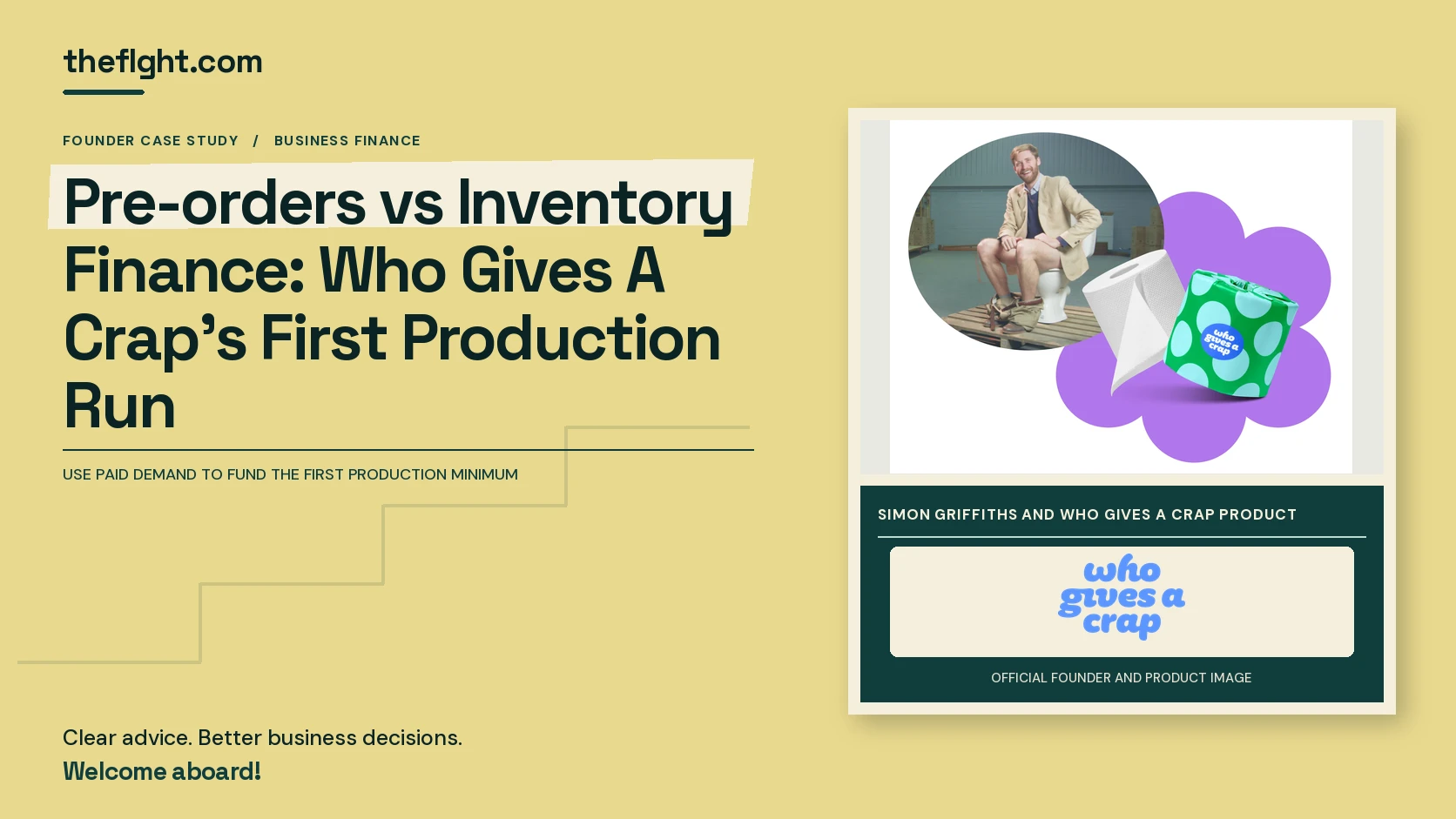
Who Gives A Crap says its founders launched a crowdfunding campaign in 2012 and Simon Griffiths remained on a toilet during a 50-hour livestream until pre-orders reached $50,000. The company delivered its first product in March 2013. The company's wholesale history records the campaign and delivery. In a founder interview, Griffiths said the target reflected the first production run and an ambition to find about 1,000 initial customers. The interview explains the first-run logic.
The public pages use a dollar sign without a complete cost statement here, so do not infer currency, margins or cash remaining after fulfilment. The durable lesson is the funding structure.
Use the Prepaid Production Cash Bridge
The Prepaid Production Cash Bridge reconciles money raised with obligations created.
| Bridge section | Pre-order route | Finance route | |---|---|---| | Cash received | Customer payments after fees | Loan, overdraft or facility drawdown | | Immediate obligation | Produce, deliver or refund | Repay principal, interest and fees | | Demand evidence | Strong if buyers pay intended price | Must come from earlier sales or contracts | | Delay risk | Customer trust and refund exposure | Interest and stock holding increase | | Upside retained | No ownership dilution, but reward owed | No customer reward beyond sale | | Failure consequence | Refund, complaints and reputation | Debt enforcement and cash pressure |
My position is that an unproved consumer product should prefer a bounded pre-order campaign to debt-financed inventory, provided fulfilment can be costed conservatively. Debt is cleaner only after demand and lead time are known. Borrowing to discover whether strangers want a full factory minimum combines market risk with fixed repayment.
Calculate the amount you can actually use
Start with gross customer payments, then subtract:
- platform and payment fees
- tax that must be remitted
- reward production cost
- packaging and delivery
- expected refunds, replacements and failures
- customer-service and campaign costs
The remainder is available towards production. A campaign that "raises £40,000" may contribute far less to the factory invoice.
Then model production deposit, balance, inspection, freight, duty, import VAT treatment, storage and fulfilment timing. Use [working-capital planning](/business-finance/how-much-working-capital-do-you-need/) rather than a single launch total.
Pre-order, crowdfunding, consumer, tax and financial-promotion rules vary by jurisdiction and by whether buyers receive products, debt or equity. State delivery and refund terms clearly, keep appropriate records and obtain qualified legal, tax and regulated financial advice.
Set the campaign target from fulfilment backwards
Do not choose a round number because it sounds achievable. Calculate the safe cash requirement, subtract founder funds genuinely available, then divide the remaining net need by net cash per pre-order.
pre-orders required = funding gap divided by net cash available per pre-order
Round up and add a clear contingency. If the required customer count is implausible for your reachable audience, reduce the production run, renegotiate the minimum or do not launch.
The campaign should also have a stop condition. If minimum funding is not reached, refund or do not collect payments according to the stated mechanism. Producing a partial run without enough fulfilment cash is worse than cancelling honestly.
Compare the debt case under slow sales
Inventory finance should be tested at slower sales, higher returns and a longer cash cycle than expected. Include arrangement fees, interest, personal guarantees, security and the effect of repayments before stock sells.
Calculate monthly cash debt service and the number of units required to cover it from contribution, not revenue:
units for monthly debt service = monthly finance payment divided by contribution per sold unit
If normal overhead already consumes most contribution, the order cannot safely carry debt. See [savings versus borrowing](/business-finance/use-savings-or-borrow-to-start/) before accepting personal exposure.
Worked example: HonestRoll Paper
HonestRoll needs £28,000 for a first run of 2,000 boxes, including production, freight and arrival costs. It has £5,000 of founder cash and wants a £3,000 contingency, creating a total safe need of £31,000 and an external gap of £31,000 - £5,000 = £26,000.
A pre-order box sells for £48. Payment fees are £2.40, post-arrival picking and domestic delivery cost £9, and the refund reserve is £2.60. The production cost is already inside the £28,000 run budget, so subtracting it again would double-count it. Net cash available towards that run is £48 - £2.40 - £9 - £2.60 = £34 per order.
Required pre-orders are £26,000 ÷ £34 = 764.7, rounded up to 765.
| Route | Pre-orders | Inventory facility | |---|---:|---:| | Gross cash or borrowing | 765 x £48 = £36,720 | £26,000 | | Cash usable towards run | 765 x £34 = £26,010 | £26,000 | | Fixed repayment | None, but fulfilment owed | £2,405 monthly for 12 months in this illustration | | Customer delivery obligation | 765 boxes | Begins only when later orders are taken |
The pre-order route is viable only if HonestRoll can reach and fulfil 765 buyers. The finance illustration requires 12 x £2,405 = £28,860 of repayments, a £2,860 finance charge on £26,000 before any separate arrangement fee. Allocating the £28,000 run cost across 2,000 boxes gives £14 per box. After the same £14 of fees, delivery and reserve, a normal £48 stock sale contributes £48 - £14 - £14 = £20 while preserving £14 to replace the sold inventory. It therefore needs £2,405 ÷ £20 = 120.25, or 121 boxes a month to service the repayment sustainably. If it liquidated the batch without replacing stock, £34 from each sale would be available and 71 sales could cover one payment, but that would shrink the business rather than fund a repeatable cycle.
HonestRoll should use pre-orders if its audience and fulfilment test support 765 orders. Otherwise, it should negotiate a smaller production run rather than assume debt makes demand appear. These figures are illustrative and the finance payment is not a market quote.
Protect the promise during production
Ring-fence fulfilment cash and update customers at predetermined milestones. Report delays with the revised date, reason and available options. Do not wait until the promised week to reveal a known problem.
Inspect production before final payment where possible, insure appropriate risks and retain evidence of specifications. A campaign creates many small creditors in practical terms, even when the legal classification differs. Treat their money with that seriousness.
Avoid adding stretch products that introduce new tooling, packaging or suppliers. More gross pledges can reduce the chance of delivering the original product.
Use pre-orders as evidence, not applause
Analyse order source, average value, geography, refunds and repeat intent. Friends and mission-aligned supporters may create the first run without representing repeatable acquisition. Separate them from strangers who bought at the intended future price.
After delivery, measure defects, true landed cost, reorder rate and customer-service time. Only then decide whether the second run should use retained contribution, another pre-order period or finance.
Make the route decision in seven days
By day two, obtain written production, freight and fulfilment costs. By day three, calculate net usable cash per pre-order and the required customer count. By day five, obtain an actual finance illustration and model slow sales. On day seven, choose the route whose downside you can survive and publish no campaign until product, terms and refund handling are ready. If neither bridge reaches completed fulfilment with contingency, reduce the run rather than forcing the funding.
Related guides
Frequently asked questions
Are pre-orders revenue as soon as customers pay?
Cash may arrive immediately, but accounting and tax recognition depend on the transaction and jurisdiction. Economically, the money carries an undelivered obligation until you provide the product or refund the customer. Keep it separate in your management view and do not treat gross receipts as profit. Record fees, tax, fulfilment and refund exposure. Ask a qualified accountant how deposits and advance payments should appear in your accounts and VAT records. The bank balance can rise while free working capital remains close to zero.
How long will customers wait for a pre-order?
It depends on product novelty, trust, price and how clearly the date is explained. Do not choose a lead time from optimism. Add production, inspection, freight, customs, fulfilment and a realistic buffer, then test the date with buyers. Longer waits generally increase enquiries, cancellations and reputation risk. Update customers before milestones are missed. Consumer cancellation and delivery rights vary by country and product, so check current official rules and obtain qualified advice rather than writing a "no refunds" term that may be ineffective.
Should I offer an early-bird discount?
Only if the remaining contribution still funds the run and the lower price will not invalidate demand evidence. A discount rewards waiting and risk, but it can attract buyers who will not pay the future price. Cap the quantity, show the normal intended offer honestly and calculate net cash at each tier. Avoid extreme discounts that leave later customers subsidising early fulfilment. After delivery, measure how many early buyers reorder at full price before treating the campaign as proof of sustainable demand.
What if the campaign exceeds its target?
Accept additional orders only while production, working capital, customer support and delivery can scale safely. More money also means more goods owed. Recalculate supplier capacity, fulfilment cost and schedule before extending the campaign. Avoid unrelated stretch goals and new variants that add failure points. Consider closing early or placing later buyers in a separate delivery batch with explicit terms. The aim is a completed profitable run, not the largest public headline. Keep contingency proportional as volume increases, and confirm any new factory deadline in writing.
Is equity crowdfunding safer than inventory finance?
It removes scheduled debt repayment but introduces dilution, legal preparation, investor communication and governance. Investors fund the company and take business risk; pre-order customers buy a product and retain delivery or refund rights. Do not mix the two. Equity may suit a larger long-term plan, but it is disproportionate for a small stock gap if the business can fund it through contribution. Securities and financial-promotion rules are strict and jurisdiction-specific. Use an authorised platform and qualified professional advice before offering shares.
When is inventory finance the better choice?
It can be better when you have reliable paid demand, known landed costs, predictable sell-through and customers who require immediate availability. It may also smooth a repeat seasonal purchase when historic contribution comfortably covers repayment. Compare total finance cost with lost contribution from stockouts and the risk of slower sales. Avoid relying on one retailer's forecast unless there is a firm, enforceable order and acceptable payment timing. Model personal guarantees and a delayed payment case with a regulated finance adviser.
Comments (0)