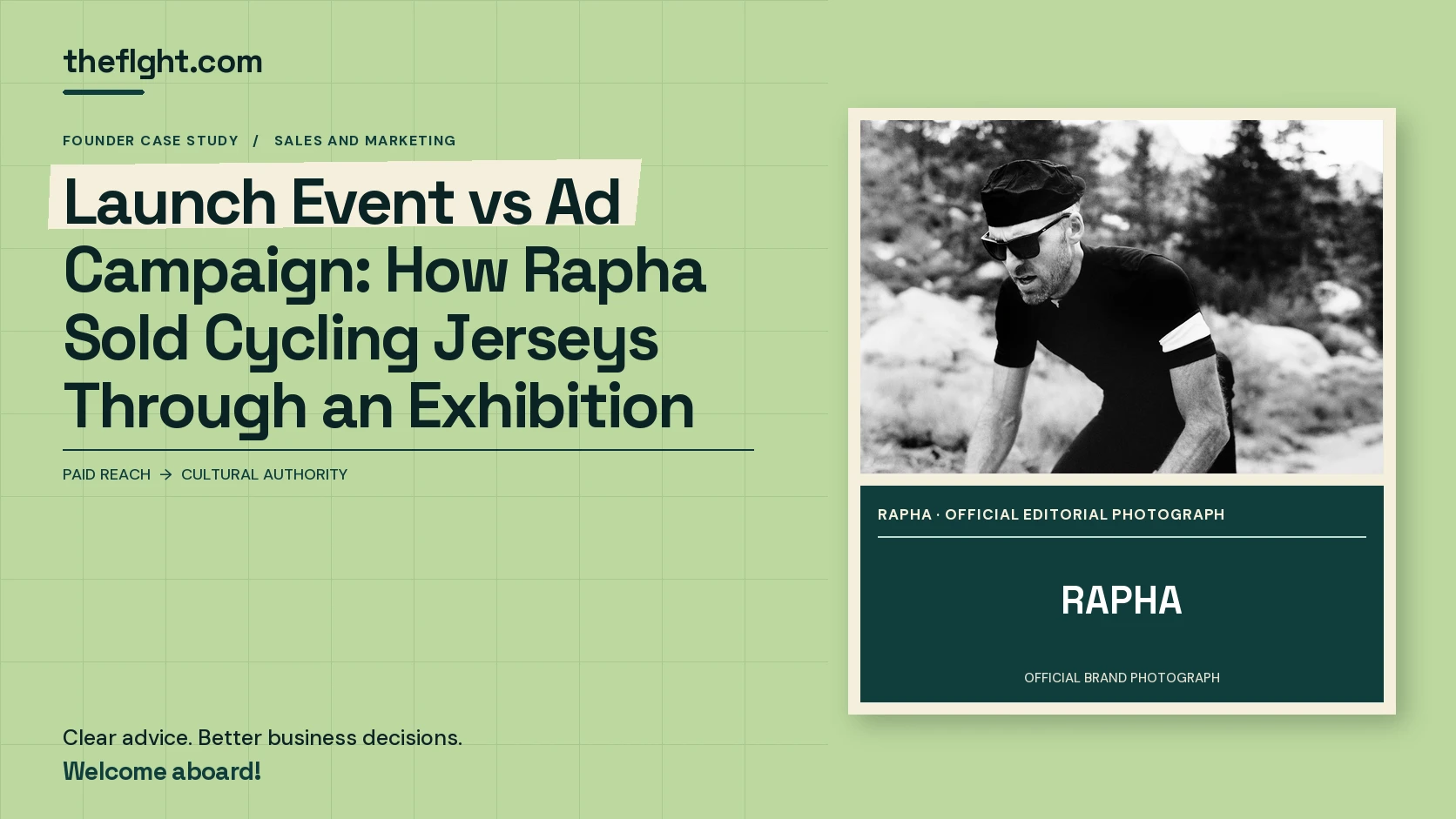
Launch Event vs Ad Campaign: How Rapha Sold Cycling Jerseys Through an Exhibition
Short answer: Use an event instead of broad advertising when the product needs context, the target community gathers around a shared interest and you can reach qualified people directly. Build the event around a subject they would value without the product, make purchase and follow-up simple, then judge it on 90-day contribution and attributable customers. Do not fund an elaborate launch unless expected contribution from a realistic attendance case covers the full event and follow-up cost.
An advert rents a moment of attention. A credible event can let customers experience the world the product belongs to.
That advantage disappears when the event becomes an expensive party for friends, press and suppliers. Cultural relevance is not commercial evidence until identifiable customers pay.
Use the Authority-Led Launch Sequence
The Authority-Led Launch Sequence turns expertise and community context into measurable demand through five steps.
| Step | Purpose | Evidence | |---|---|---| | Subject | Choose a theme the audience values | Qualified registrations and partner interest | | Proof | Demonstrate knowledge beyond the product | Attendance, dwell and useful engagement | | Product | Show why the offer belongs in that world | Trial, questions and product-page visits | | Purchase | Provide a clear buying route | Full-price orders and collected cash | | Continuation | Retain the relationship after the event | 30- and 90-day repeat, referral and contribution |
My view is that a premium launch event should be editorial first and retail second. If nobody would attend without a sales pitch, paid advertising is likely the more honest and measurable route.
What Rapha launched through “Kings of Pain”
Rapha introduced its first cycling range in 2004 around a month-long exhibition at London's Truman Brewery. BikeRadar's account of the launch describes “Kings of Pain” as a display of photography and memorabilia celebrating cycling's hardship and culture.
Founder Simon Mottram later explained in a New Business interview that Rapha chose direct-to-consumer sales rather than relying on traditional retailers, with products present in a corner of the exhibition. Rapha's own history of its Classic Jersey identifies that jersey as part of the founding range.
Public accounts do not state the event's exact attendance, first-month orders or contribution. The defensible lesson is the launch architecture: Rapha placed a premium clothing product inside an informed expression of road-cycling culture and made direct purchase possible. The exhibition supplied context that a generic clothing advertisement could not.
Choose a subject narrower than the product category
“The future of fashion” is too broad. “The working clothes of independent ceramicists” can attract a defined community and give a durable apron or jacket a credible setting.
The subject should connect to the customer's identity or work without pretending your brand created that culture. Use historians, practitioners, customers, objects and stories with permission and accurate attribution. Pay contributors where appropriate. Do not borrow a community's credibility while giving it nothing useful.
Write the audience qualification in behavioural terms. “People who completed at least 20 outdoor rides last quarter” is more useful than “affluent lifestyle consumers”. Then estimate how many can be reached through clubs, publications, partners and direct invitations.
Set the commercial path before designing the room
Decide what a visitor can buy, at what price, how stock will be handled and how an out-of-stock size or colour will be ordered. Train staff to explain fit and function without turning every conversation into pressure.
Use a distinct checkout or attribution code for the event. Record direct sales, later online sales from attendees and referrals separately. Follow-up requires lawful consent; an RSVP is not permission for unlimited marketing.
Measure:
- cost per qualified attendee;
- attendee-to-full-price-customer rate;
- average contribution per order;
- 30- and 90-day repeat or referral;
- total event contribution after production and follow-up labour.
Press coverage and social reach can support discovery, but do not assign revenue to them without a defensible path.
Cost an event against a comparable campaign
Include venue, production, transport, insurance, staff, contributor fees, stock, payment equipment, photography, accessibility, security, follow-up and your time. Separate reusable assets from one-off decoration, but do not value them at full cost savings unless they will genuinely replace future spend.
Compare with the same budget used for a small, targeted ad and landing-page test. The event may generate deeper engagement but reaches fewer people. Advertising may reach qualified prospects repeatedly and provide cleaner acquisition data.
Do not compare event revenue with advertising clicks. Compare collected customer contribution over the same 90-day period.
Worked example: Fell & Loom Jackets
Fell & Loom makes a £185 repairable cycling jacket. Each sale leaves £92 contribution after product, fulfilment, payment and expected returns. The brand plans a three-day exhibition about winter riding, with route photography, repair demonstrations and talks from local riders.
| Event cost | Amount | |---|---:| | Venue and insurance | £4,200 | | Exhibition production and transport | £3,100 | | Contributors and staff | £2,850 | | Invitations, photography and follow-up | £1,650 | | Founder time | £1,400 | | Total | £13,200 |
The brand expects 900 visitors, of whom 60% match the target customer. If 8% of 540 qualified visitors buy within 90 days, that is 43.2, rounded down to 43 customers. Their first-order contribution is 43 x £92 = £3,956, far below event cost.
Even if 20% of buyers make a second contribution-equivalent purchase or referral, the added amount is 43 x 20% x £92 = £791.20. Total attributable contribution would be £4,747.20.
The event needs £13,200 divided by £92 = 143.5, or 144 first-order equivalents, to break even. That is 26.7% of qualified visitors, before allowing for people who would have bought anyway.
Fell & Loom reduces the format to a one-night club partnership costing £3,600. At the same £92 contribution, it needs 40 order equivalents. It also runs a £1,200 matched digital campaign so the two routes can be compared. The smaller event preserves the authority idea without asking an unproved launch to recover £13,200.
These figures are illustrative. Include VAT, employment, venue and consumer obligations that apply to you.
Protect credibility from the sales target
Do not make contributors endorse the product unless they genuinely agree and the relationship is disclosed. Keep talks and exhibits accessible without requiring a purchase. If the event promises cultural or educational value, deliver it even to visitors who buy nothing.
Use accurate product availability and launch claims. “Limited first run” should mean a genuinely bounded production decision, not artificial scarcity. Make returns, delivery and privacy terms visible at purchase.
Event, alcohol, music, image, accessibility, health and safety, data and consumer requirements vary. Obtain qualified local advice and permissions.
Decide between event and ads in 21 days
In week one, define the narrow subject, qualified audience and product contribution. Obtain real event costs and calculate the break-even number of order equivalents.
During week two, test interest with direct invitations and a simple paid campaign to the same audience. Do not book a major venue from likes. In week three, choose the smallest event whose downside is affordable, set attribution and 90-day follow-up, or redirect the budget to the better qualified channel. The launch method should follow economics and context, not a desire to look established.
Related guides
Frequently asked questions
How many people need to attend a product launch event?
Work backwards from contribution, not atmosphere. Divide total event cost by expected 90-day contribution per attributable customer to find the order equivalents required. Then divide by a cautious attendee-to-customer rate to estimate qualified attendance. If the event costs £5,000 and each customer contributes £100, you need 50 order equivalents. At 10% conversion, that means 500 qualified attendees, not 500 total visitors. Replace the assumed rate after a smaller event. A tightly matched room of 80 can outperform a public crowd of 1,000.
Should I sell products inside the exhibition?
Usually yes, when purchase is convenient, appropriate to the event and clearly separated from participation. Offer the intended price, sizes or variants, delivery information and normal consumer protections. If stock cannot be held, provide a simple ordering route rather than a vague expression-of-interest form. Record immediate and later orders with lawful attribution. Do not make guests endure a sales presentation to access the promised content. The event should remain useful without a purchase, which protects both credibility and the quality of your demand signal.
Can press coverage justify an event that loses money?
Only when the coverage reaches qualified buyers and has a measurable commercial or strategic value exceeding the loss. Count attributable visits, orders, retailer enquiries or partnerships, not media mentions alone. Estimate the outcome before committing and cap the amount you will spend for it. Press can introduce a new premium position, but coverage is neither guaranteed nor controlled. An event that needs national attention to break even is a speculative publicity campaign. Use a smaller format unless the business can afford the complete downside.
How do I attribute online sales after an event?
Use event-specific links or codes, ask customers how they heard about you, and record consented attendee cohorts over a fixed window. Give one primary and one assisting source rather than crediting every touch. Compare with normal baseline sales and exclude existing customers where the decision concerns acquisition. Attribution remains imperfect, so present a range rather than false precision. Follow data-protection and marketing rules, collect only necessary information and explain its use. Do not add attendees to ongoing email marketing merely because they registered for entry.
What if people love the event but do not buy?
Separate subject appeal from product fit. Review whether qualified visitors tried the product, understood the difference, accepted the price and had an immediate use. The event may have attracted fans of the topic rather than buyers of the offer. Interview non-buyers about their actual alternative and next purchase, then test a changed message or segment in a smaller cohort. Do not repeat the same expensive format because engagement felt positive. Cultural authority can be real while the product, price or audience remains commercially wrong.
Is a pop-up shop the same as a launch exhibition?
No. A pop-up is principally a temporary retail location, while an authority-led exhibition gives independent value through a subject and uses the product as part of that context. The cost lines can overlap, but success measures differ. A pop-up prioritises footfall, conversion and store contribution. An exhibition also measures qualified attendance, engagement and later attributed purchase. Decide which job you need. Combining both can work, but do not use exhibition praise to hide weak retail sales or judge educational content only by same-day transactions.
When is paid advertising the better choice?
Choose advertising when the product is easy to understand remotely, the audience can be targeted, the budget is limited and you need rapid message or price tests. Ads are also preferable when an event's break-even attendance is implausible or venue risk is high. Start with a capped campaign and measure customer contribution, not clicks. An event is stronger when physical trial, community and context materially change trust. You can combine them, but allocate each customer consistently and compare the full cost over the same period.
Comments (0)