Can a Premium Product Sell Without Promotion? Fever-Tree's Six-Week Waitrose Test
Short answer: Test a premium product at its intended shelf price for at least one complete repurchase cycle, without launch discounts that hide resistance. Measure full-price units per store per week, stock availability, repeat replenishment and contribution after retailer deductions. Compare stores and a credible alternative, because aggregate sell-through can be created by a few strong locations, prominent placement or stock shortages rather than broad premium demand.
Discounts can help shoppers try an unfamiliar product. They also answer the wrong question when your decision is whether the premium price works.
A clean test does not mean doing nothing. The product still needs correct distribution, shelf placement and availability. It means holding the variable you want to prove, price, steady enough to interpret the result.
Use the Unpromoted Shelf Test
The Unpromoted Shelf Test isolates six parts of retail demand. Every week, record all six by store rather than celebrating total orders shipped to the retailer.
| Measure | Question | Why it matters | |---|---|---| | Availability | Was the product actually buyable? | Zero sales from no stock are not rejection | | Shelf visibility | Could the target shopper find it? | Placement can distort comparison | | Full-price sell-through | How many available units sold? | Tests willingness to pay | | Replenishment | Did the store order again? | Separates pipeline fill from consumer sales | | Repeat period | Did demand persist after first trial? | Reduces novelty effect | | Contribution | Did collected wholesale cash cover the route? | Volume without margin is not validation |
My view is that a premium brand should refuse a deep introductory discount during its first decisive price test, even if that reduces headline volume. It is cheaper to discover weak full-price demand in six weeks than after funding a national promotional calendar.
What Fever-Tree's early retail test showed
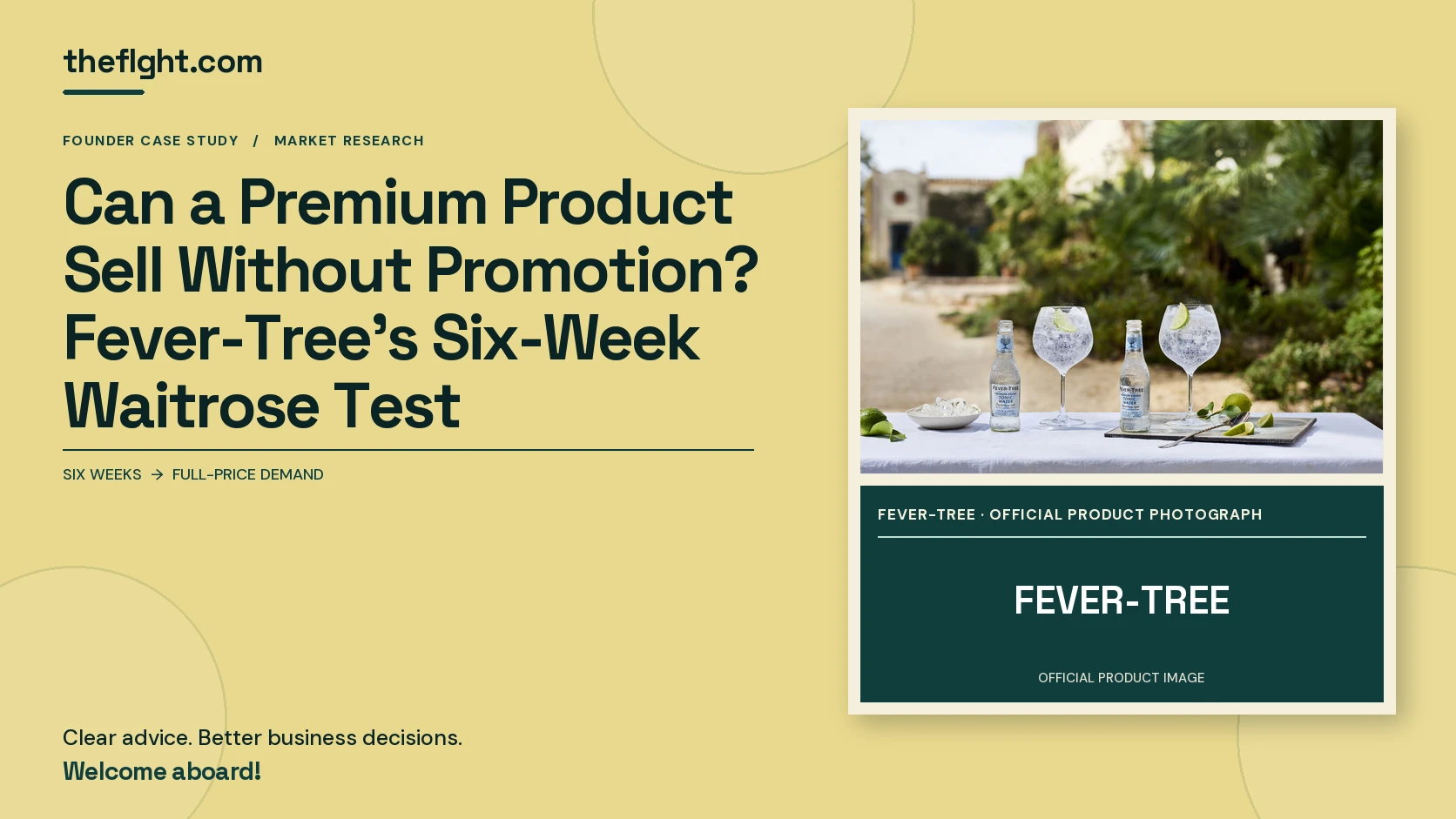
Fever-Tree founders Charles Rolls and Tim Warrillow developed a tonic positioned above mainstream mixers and launched the first product in 2005. Fever-Tree's company history describes an 18-month development process and an early Waitrose listing.
In a detailed founder interview, Warrillow recounts that Waitrose did not allow promotional activity for the first six weeks. He says the tonic sold on its own and earned wider distribution. The public account does not disclose store count, weekly units, shelf position or margin, so it cannot supply a benchmark conversion rate.
The useful decision is the test structure. A premium proposition met shoppers at its shelf price without a discount campaign, and the retailer could observe whether normal purchasing justified expansion.
Define the premium claim in customer terms
Premium cannot mean only “costs more”. State the difference a buyer can experience or verify: ingredient, performance, origin, design, service or reduced risk. Then identify the occasion and customer who values it.
Fever-Tree linked premium tonic to the quality of the spirit it accompanied. The product did not need every soft-drink buyer to agree. It needed enough customers in the relevant drinking occasion to accept the price and buy again.
Choose one primary comparison product and calculate the absolute price difference per use. A bottle that costs 60p more but serves four drinks creates a 15p difference per occasion. Customers may judge that differently from a 50% price premium stated abstractly.
Do not make ingredient, health, environmental or performance claims without evidence. Advertising and labelling requirements vary by country and category. Obtain qualified advice.
Agree the test conditions with the retailer
Document stores, dates, initial units, normal shelf position, retail price, promotions excluded, reporting frequency and the expansion decision. Confirm who controls replenishment and how out-of-stocks will be treated.
Ask for item-level weekly sales and stock where the retailer can provide them. If only wholesale orders are available, conduct store checks or use agreed proxy evidence. A retailer ordering ten cases into a depot is not proof that shoppers bought ten cases.
Avoid changing pack, price, placement and message during the same test. Correct a compliance or availability problem immediately, but record the date and analyse the periods separately.
Calculate sell-through correctly
Use available units, not delivered units, where possible:
weekly sell-through = units sold divided by units available for sale during the week
Also track units per store per week. A 60% sell-through on five available units may represent three sales, which can be commercially weak depending on replenishment and margin.
Split stores into cohorts by format, location and initial rate. The median store can be more informative than the average when a few sites dominate. Record the share of stores that reorder without intervention.
Contribution should deduct product, packaging, freight, retailer deductions, promotional accruals and account cost. Even an unpromoted test may include listing, samples or required logistics.
Worked example: Fenland Pressé
Fenland Pressé tests a premium mixer in 24 independent food stores for six weeks. Each store receives 24 bottles at a £1.55 wholesale price. The planned retail price is £2.60. Product, pack and freight cost Fenland 92p per bottle, leaving 63p wholesale contribution before test costs.
The stores make 576 bottles available. Weekly reports show 408 consumer sales, but store checks reveal 48 bottles were unavailable for at least half the period because of delayed replenishment. Fenland uses 528 effectively available units:
408 divided by 528 = 77.3% sell-through
The headline looks strong. Store distribution matters:
| Store cohort | Stores | Units sold | Units per store over six weeks | |---|---:|---:|---:| | Strong | 6 | 180 | 30.0 | | Middle | 10 | 170 | 17.0 | | Weak | 8 | 58 | 7.25 |
Fourteen stores reorder, a 58.3% reorder rate. Fenland's contribution on sold units is 408 x £0.63 = £257.04. Sampling stock, travel and retailer setup cost £1,450, so the test loses £1,192.96. That can be rational research expenditure, but it is not profitable distribution.
A deep 25% consumer discount might increase units while obscuring whether £2.60 works. Instead, Fenland extends the middle cohort for six more weeks at full price, repairs replenishment and declines national production until at least 75% of those stores reorder.
The surprising result is that 77% aggregate sell-through does not equal broad demand. Six stores produced 44% of all sales.
These figures are illustrative. Use your actual tax, retailer and product costs.
Separate price resistance from poor execution
When sales are weak, check in order: availability, correct shelf location, price label, product condition and staff or customer understanding. Only then treat low movement as price resistance.
If shoppers pick up the product and return it after seeing the price, price may be the problem. If they never see it, discounting will not fix discovery. Short, structured observation and retailer feedback can diagnose the difference without collecting unnecessary personal data.
Test one response. A clearer occasion message can be compared at the same price. A smaller pack can reduce the cash price while preserving unit economics, but it is a new product test. A temporary discount measures promotional elasticity, not original premium demand.
Set the expansion rule before week one
Choose the minimum units per store per week, percentage of stores reordering, full-price contribution and acceptable out-of-stock rate required for expansion. Define the action if one measure fails.
For example: expand only if median sales exceed three units per store per week, 70% of stores reorder by week six, availability exceeds 95% and contribution remains positive after channel costs. The figures must follow your category and economics, not this illustration.
If only a specific store type passes, narrow distribution rather than averaging it with weak sites. A premium product may have valid demand in affluent independents, cocktail retailers or hospitality while failing in general grocery. That is segment evidence, not necessarily product failure.
Run the test over eight weeks
Use two weeks to agree conditions, confirm compliant stock and establish reporting. Trade for at least one normal repurchase cycle, six weeks in this example, without a price promotion.
Review availability weekly but do not rewrite the proposition after every slow day. At the end, calculate store-level full-price sales, reorders and contribution. Expand only to locations resembling the passing cohort. If price remains the suspected barrier, run a separate price test rather than retroactively interpreting a promotion.
Related guides
Frequently asked questions
How long should a retail demand test run?
Long enough to cover initial trial and at least one plausible repeat or replenishment cycle. Six weeks can suit a frequently purchased grocery item, while durable or seasonal products may need much longer. Include ordinary trading weeks rather than relying on holidays or events. Agree the period before launch and avoid stopping after the first strong weekend. Track availability throughout. A long test with frequent stockouts contains less evidence than a shorter fully stocked one. Retailer planning calendars and product shelf life may also constrain timing.
Should I ban all sampling during the test?
Not necessarily. Sampling can help an unfamiliar taste product get considered, but it becomes another variable. If the decision is whether unaided shelf demand exists, keep sampling out of the core period or isolate it to matched stores and dates. Record samples, staff time and resulting purchases. Free taste acceptance is not full-price demand. For food and drink, obtain permission and comply with hygiene, allergen and licensing rules. Report sampled and unsampled results separately rather than combining them into one attractive sell-through figure.
What sell-through rate is good for a new product?
There is no universal percentage. It depends on units initially stocked, purchase frequency, shelf life, store format, margin and replenishment. A high percentage from two units per store may be commercially weak, while steady weekly movement from a deep display can be strong. Set a required units-per-store rate from your contribution and the retailer's space expectations, then pair it with reorder and availability. Ask the buyer what continuing performance the category requires. Use your test to establish a comparable range rather than borrowing an unrelated benchmark.
What if the retailer insists on an introductory discount?
Negotiate a small group of full-price control stores or a later unpromoted window. If that is impossible, record the promotion precisely and avoid claiming it proves the normal price. Calculate contribution during and after the discount, plus who funded it. A promotion can test awareness or price elasticity, but it cannot answer every question. Do not accept a discount that makes each sale contribution-negative merely to secure a listing. Retail agreements and promotional practices need commercial, accounting and legal review where material.
How do I know whether customers bought again?
Retail data may not identify individuals, and you usually do not need personal data. Use store replenishment, repeated weekly sales after the launch cohort should be consumed, loyalty analysis supplied lawfully by the retailer, or a direct post-purchase study with proper consent. For a mixer, compare sustained movement across several likely consumption cycles. Avoid claiming individual repeat from aggregate sales alone. Data protection and retailer policies vary, so collect the minimum necessary evidence and use qualified advice for customer-level tracking.
Can a premium product succeed in only a few stores?
Yes. Concentrated success can identify the correct first segment, occasion or location. Compare passing and failing stores for customer profile, adjacent products, basket, visibility and staff behaviour. Then expand to matched stores and see whether performance transfers. Do not call six exceptional sites a national market, but do not dilute their evidence by forcing unsuitable distribution. A focused profitable channel can be a complete small business. The decision depends on whether the accessible segment supports your required volume and overhead.
When should I lower the premium price?
Lower it only after confirming that stock was available, the shopper understood the difference and the current price caused rejection. Test a changed price in a comparable cohort while holding placement and product constant. Measure contribution, not units alone. A 15% price cut that lifts volume 10% usually worsens gross contribution. You may instead need a smaller pack, clearer occasion or narrower channel. If no price acceptable to customers covers complete costs, the product or channel must change rather than relying on permanent promotions.
Comments (0)