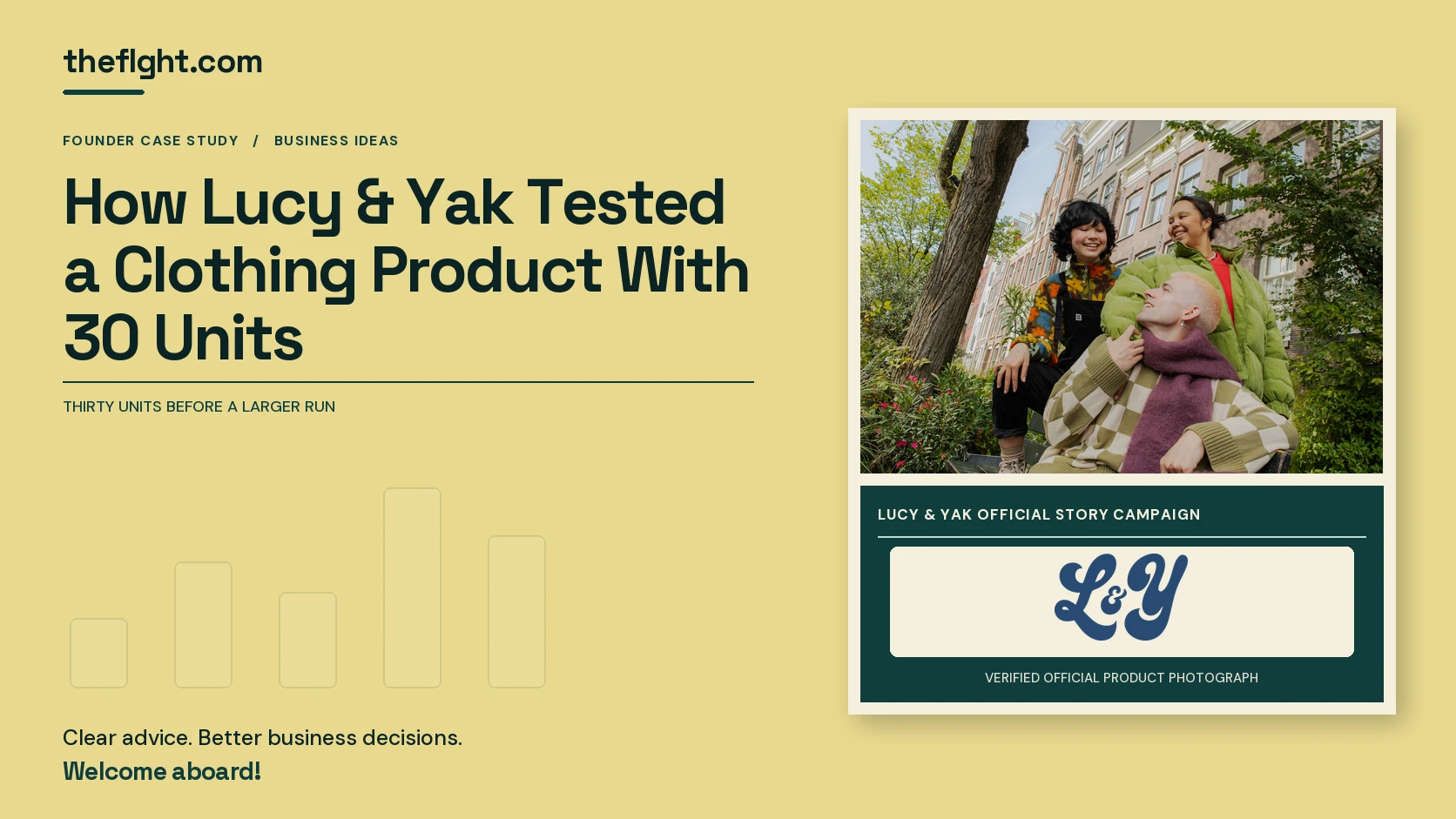
How Lucy & Yak Tested a Clothing Product With 30 Units
Short answer: Start with the smallest batch that can reveal buying behaviour, product defects and return risk, usually 20 to 50 units for one tightly defined design. Sell it to a relevant audience at the intended price, keep at least 25% of your cash outside the reorder, and place a larger order only if at least 70% sells within your planned window without discounting and the contribution remains positive after returns.
Thirty sales can justify another controlled batch. They cannot prove that you have a scalable clothing business.
That distinction matters because a quick sell-out may reflect a warm audience, scarce stock or a low price. The useful evidence is not the photograph of an empty stockroom. It is what happened by size, how much cash returned, which buyers kept the product and whether you can repeat the result with less founder effort.
What Lucy & Yak's first batch actually established
Lucy Greenwood and Chris Renwick already had an audience from selling vintage clothing when they tested their own dungarees. Greenwood has said that they had about 18,000 Depop followers, commissioned an initial 30 pairs and reinvested after those sold. The next order was 60 pairs. The company was reportedly turning over about £30,000 a month before the founders left India, according to her account of the early business.
Those figures are founder-reported and do not disclose unit cost, returns or the precise sell-out period. They support the decision pattern, not a claim that 30 is a universal magic number.
The founders had an advantage that many new labels do not: a sizeable audience already interested in clothing. Their test therefore answered whether that audience would buy this product. It did not independently prove that cold customers could be acquired profitably.
My view is that most first-time clothing founders order too much, not too little. A higher unit cost on 30 pieces is often cheaper than a lower unit cost on 300 pieces that do not sell.
Use the Thirty-Unit Reorder Ladder
The Thirty-Unit Reorder Ladder has five rungs. You move upwards only when the evidence below you holds.
| Rung | Question | Evidence required before moving up | |---|---|---| | Audience | Did relevant people see the offer? | Named channel, qualified reach and intended customer profile | | Sell-through | Did they buy at the real price? | At least 70% sold in the chosen window without blanket discounting | | Product | Did the item work after delivery? | Returns, defects and size exchanges remain inside your cost allowance | | Cash | Did sales refill the production pot? | Positive contribution after production, packing, payment fees and returns | | Repeatability | Can you sell the next batch beyond novelty? | Second channel, repeat orders or demand from people outside the warm audience |
The thresholds are working guides, not industry standards. Set your own window from the buying cycle. Seven days may suit a limited social launch, while eight weeks may be reasonable for a seasonal retail test.
Choose one product question
A useful first batch isolates one decision. Test one core silhouette, one fabric family and a restrained colour choice. Sizes can vary because fit is part of the evidence, but ten designs across 30 units tell you little about any one design.
Write the question before ordering. For example: “Will women who already buy relaxed workwear pay £74 for these dungarees, and will fewer than four of 30 units come back?”
That is better than “Do people like the brand?” Likes, compliments and email sign-ups do not return production cash. Payment at the intended price does.
Decide what counts as relevant demand
A warm audience is legitimate. It is often the cheapest place to begin. You just need to label the evidence correctly.
Track where each order came from:
| Buyer source | What it proves | What it does not prove | |---|---|---| | Friends and family | Basic checkout and fulfilment work | Market demand or price acceptance | | Existing resale audience | Adjacent buyers accept the new product | Cold acquisition is affordable | | Organic search or recommendation | The offer travels beyond the founder | Paid marketing will work | | Paid advertising | A specific message can buy attention | Customers will repeat or refer |
Do not combine the rows and report one conversion rate. Ten buyers from 100 existing followers are not equivalent to ten buyers from 100 cold advert clicks.
Count returned products as unsold until resolved
Clothing revenue is provisional until the return period has passed. A 30-unit launch that records 28 orders and six returns did not achieve 93% sell-through. It achieved 22 retained sales, or 73%, unless the returned items were resold within the test window.
Record the reason against size, style and manufacturing batch. “Changed mind” may be demand noise. Repeated tightness at the hip or broken fasteners point to a product problem. Exchanges still create postage and handling costs even when revenue survives.
You also need a consistent size guide and honest photography. A product that sells through misleading presentation is not validated. It is storing refund work for later.
Worked example: Bracken Dungarees
Bracken Dungarees orders 30 pairs in one design across five sizes. Its founder supplies £1,155 launch capital, all spent before sales begin. Figures are illustrative; replace them with supplier quotes and actual behaviour.
| Item | Calculation | Amount | |---|---:|---:| | Production | 30 × £28 | £840 | | Inbound freight and duty | fixed estimate | £135 | | Photography and samples | fixed cost | £180 | | Total launch cash | £840 + £135 + £180 | £1,155 | | Selling price | 30 × £72 | £2,160 potential revenue |
Within 21 days, Bracken sells 25 pairs. Three are returned and one can be resold during the period, leaving 23 retained sales.
Retained revenue after refunds is 23 × £72 = £1,656. Assume the payment provider does not return its fee when an order is refunded. There are 26 charges, the original 25 plus one resale, totalling £1,872. Fees at 2.2% plus 20p per charge are £1,872 × 2.2% + £5.20 = £46.38. Outbound packing and postage cost 26 × £5.20 = £135.20. Return handling and postage cost 3 × £6.50 = £19.50.
Contribution before fixed launch costs, founder labour and overhead is £1,656 - £644 cost for 23 retained units - £46.38 - £135.20 - £19.50 = £810.92. Seven units remain in stock, with £196 of production cost already paid.
Cash requires a separate bridge. Starting capital of £1,155 less the £1,155 launch outlay leaves zero before sales. Receipts after refunds less fees, outgoing postage and return handling leave £1,656 - £46.38 - £135.20 - £19.50 = £1,454.92 in the bank. Only £299.92 is new cash above the original capital. A £1,265 reorder leaves £189.92, just 13% of available cash, failing the 25% reserve rule.
Bracken first sells the seven remaining units. Assuming no further returns, each adds about £72 - £1.78 payment fee - £5.20 postage = £65.02, or £455.14 in total. Available cash becomes about £1,910.06, before tax, founder drawings and overhead. A 40-unit replenishment at £27.50 each plus £165 freight costs £1,265, uses 66% of that cash and leaves £645.06. That passes the 75% spending limit if no other payments are due.
The interesting result is that a strong-looking 25-order launch does not finance an immediate doubling once returns and operating costs are counted.
Set the reorder rule before the launch
Write three numbers in advance: sell-through threshold, maximum return rate and minimum cash reserve. This prevents excitement from rewriting the standard after a busy weekend.
A reasonable working rule might be:
- At least 70% of the batch is retained by customers within 30 days.
- Returns stay below 15%, with no repeated safety or construction fault.
- Contribution is positive after fulfilment, fees and return costs.
- The reorder uses no more than 75% of available business cash.
- At least five buyers came from outside personal contacts.
If one condition fails, investigate before scaling. You may need to fix sizing, increase price, change the product page or repeat the same batch size through another channel.
What to do over the next 30 days
During the first three days, define one garment, its customer, intended price and pass conditions. By day seven, obtain written quotes that include minimum quantity, sampling, freight, duties and lead time. Do not place an order until the cost per retained sale can leave a positive contribution.
In week two, recruit a relevant audience and prepare accurate fit information, photographs and a simple return process. Launch the batch in week three. Record buyer source, size, discount, return and support time for every unit.
On day 30, close the first test window. Reorder the same amount, increase cautiously or stop using the ladder. Do not order 300 units because 30 sold. Make the second batch earn the third.
Related guides
Frequently asked questions
Is 30 units enough to test a clothing brand?
It is enough to test one narrow product decision, but not enough to validate an entire brand. Thirty units can reveal price acceptance, obvious fit problems, fulfilment friction and whether a relevant audience buys. It cannot provide stable evidence across many styles, seasons or acquisition channels. Treat the result as permission for another measured step. If the first buyers are friends or existing followers, use the second batch to reach people who do not know you. A small test is successful when it reduces uncertainty cheaply, not when it produces a dramatic sell-out post.
What if my manufacturer requires 100 units?
Negotiate samples, shared fabric, fewer colours or a higher unit price for a smaller run before accepting 100 units. You can also test the offer with pre-orders, provided the delivery date, refund rights and production uncertainty are stated clearly. Do not describe a mock-up as available stock. If no supplier can produce an affordable test, the capital requirement is part of the idea's risk. Compare the likely cost of unsold stock with the premium for a short run. Requirements vary by product and country, so check labelling, product safety and consumer rights with qualified local advisers.
Should I discount the first batch to get sales?
Usually no, if your purpose is to test the intended price. A launch discount tests demand for the discounted offer and can hide weak margins. If you use an introductory price, record it separately and state the later price before purchase. You can reward testers through early access or a defined service benefit without changing the product economics. When sales stall, speak to qualified non-buyers before cutting price. The problem may be fit information, trust, timing or the design itself. A price reduction is useful only when price is the uncertainty you deliberately want to test.
How should I split 30 units across sizes?
Use evidence from the audience you will actually sell to, not a generic fashion ratio. Ask a sample of intended buyers for the size they currently purchase, compare the chosen manufacturer's measurements and keep the initial design forgiving where possible. Record interest before ordering, but remember stated size is weaker evidence than a retained purchase. A perfectly even six units across five sizes is simple but may distort demand. If you lack evidence, keep the batch small enough that a wrong split is survivable and ask the supplier whether repeat production can be adjusted quickly.
Do pre-orders give better evidence than holding stock?
Pre-orders give stronger evidence than sign-ups because money changes hands, but they introduce delivery and refund obligations. Buyers may also behave differently when delivery is delayed. State the expected dispatch date, cancellation position and what happens if production fails. Ring-fence enough cash to refund every order until you are confident the run can be delivered. UK consumer requirements and payment-provider rules can apply, while other countries differ. Obtain current local advice for your sales model. A small stocked batch tests fulfilment and returns more realistically, so choose according to the uncertainty that matters most.
When should I increase from 30 units to 60?
Increase only after retained sell-through, product quality and cash all pass the rule you set before launch. Sixty is reasonable when the first batch sold largely at full price, return reasons are understood, the next order leaves a reserve and you have evidence beyond personal contacts. Repeat the design rather than adding several untested products at once. If the first run sold out because one influencer mentioned it, wait to see whether demand persists. Doubling is not a reward for selling out. It is a controlled purchase of more evidence, financed without putting the business at risk.
Comments (0)