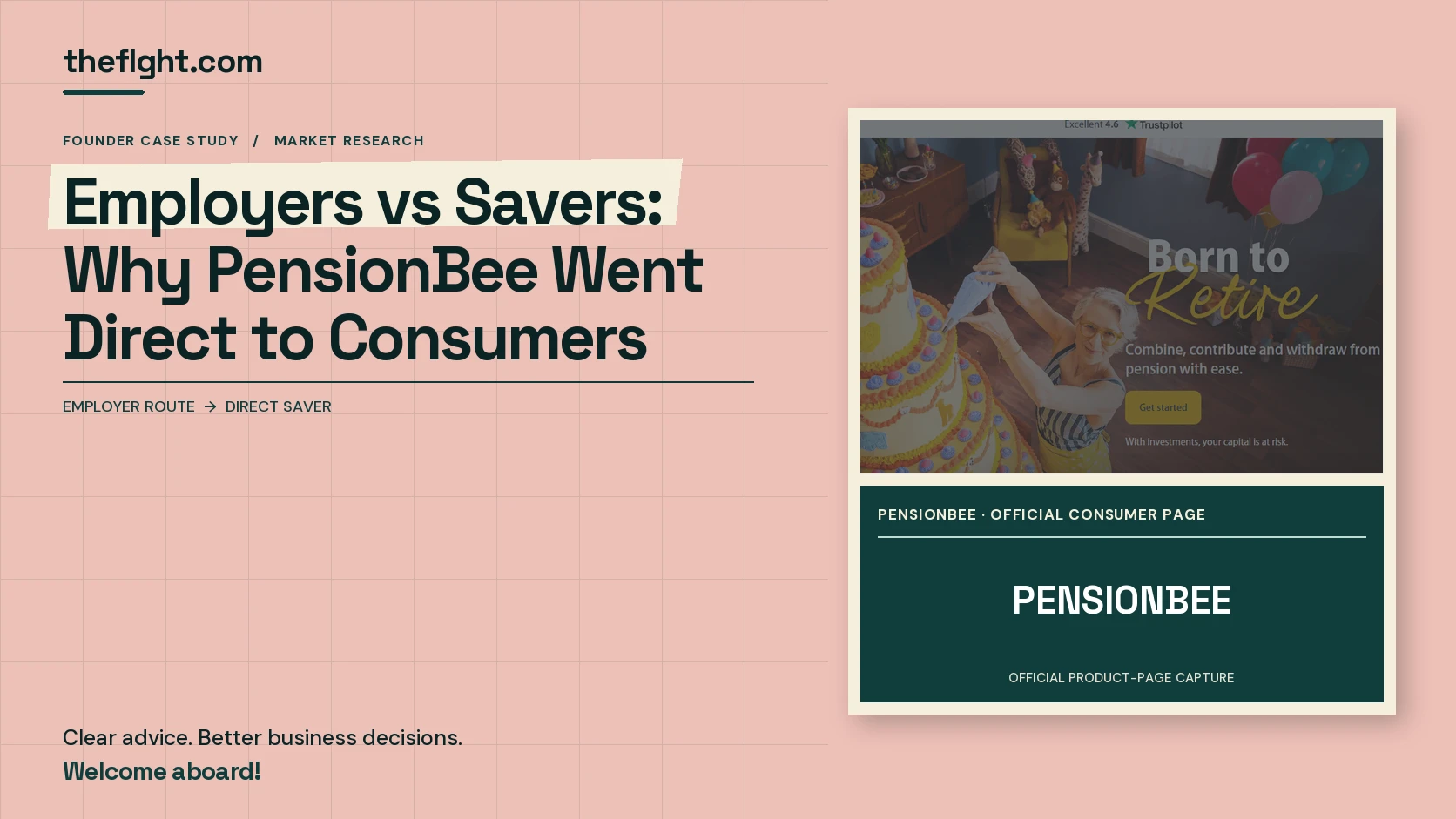
Employers vs Savers: Why PensionBee Went Direct to Consumers
Short answer: Sell direct to consumers when the individual owns the problem, can authorise the switch and gains value without an employer changing its systems. Choose B2B when the institution controls access, carries the duty or reduces acquisition enough to justify a longer sale. Before deciding, recruit 30 real prospects and require at least ten to complete the highest-friction step, not merely join a waiting list.
PensionBee chose the individual pension saver rather than beginning with employers or financial advisers. It combined a direct customer relationship with pension plans managed by established investment firms, allowing the young company to focus on transfer experience and account access.
The route looks obvious only in retrospect. Direct distribution offers control over the customer experience, but regulated acquisition, trust and support can be expensive. B2B can deliver groups of users, but the buyer may not feel the user's pain strongly enough to act.
Use the Buyer-Control Map
The Buyer-Control Map separates four roles that founders often collapse into “the customer”.
| Role | Question | Consumer pension example | |---|---|---| | Problem owner | Who experiences the loss or frustration? | Saver with scattered old pensions | | Decision owner | Who can authorise the change? | Usually the saver, subject to scheme rules | | Access owner | Who controls data, transfer or distribution? | Existing providers, employers or platforms | | Economic owner | Who pays and receives financial benefit? | Saver pays through product charges |
Choose the route that gives you a workable connection between all four. A consumer may own the problem but still face provider paperwork. An employer may offer access but have no reason to prioritise old pensions from previous jobs.
Why PensionBee selected the saver
Romi Savova founded PensionBee after experiencing difficulty moving an old pension. The company began work in 2015 and launched in 2016, positioning itself as a direct service for consumers who wanted to combine pensions and see them online. PensionBee's company history records the development and launch milestones.
An Oxford Saïd Business School case study describes Savova as the first customer, early recruitment through a waiting list and the use of established asset managers, including BlackRock and State Street, for investment plans. It reports that by the end of 2016 PensionBee had around 1,000 invested customers and £19 million in assets under administration.
Those are company-stage facts, not proof that DTC is cheaper than B2B in every financial category. PensionBee still depended on incumbent providers completing transfers and on consumers trusting a new interface with retirement savings.
My view is that founders should start with the problem owner when that person can legally decide and personally experiences the friction. Selling to an institution for “scale” can create a product bought by one party, used by another and prioritised by neither.
Test decision control, not interest
Build three short journeys: direct consumer, employer-sponsored and adviser or partner-referred. Keep the underlying outcome constant. For each, measure the time and number of approvals from first interest to the irreversible action, such as signing transfer authority or funding an account.
Waiting-list sign-ups measure reach and relevance. They do not test whether customers will provide identity evidence, understand charges, complete transfer forms and wait through administration. Your earliest cohort should attempt those steps under the lawful process.
| Route | Strong evidence | Common false positive | |---|---|---| | DTC | Consumer completes regulated onboarding | Email registration | | Employer | Buyer commits staff access and budget | Friendly HR meeting | | Partner | Referred customers activate repeatedly | Signed referral agreement |
Pensions, investments, transfers, promotions and advice are regulated differently by country. In the UK, use current FCA, The Pensions Regulator and government guidance, and obtain qualified legal, compliance and financial advice for the specific model.
Count the institutional dependencies
DTC does not mean independent. List every organisation that can delay or block the result: identity provider, old pension provider, asset manager, bank and regulator. Set a service measure for each dependency and communicate uncertainty honestly to the customer.
B2B adds employer procurement, security, payroll or benefits integration and internal sponsorship. It may reduce acquisition cost, but extend sales and implementation. Price the founder and compliance time consumed before the first active saver.
The correct comparison is contribution per activated customer over the same period, including failed transfers and ongoing support.
Worked example: NestPath Savings
NestPath is a fictional UK financial service testing two lawful distribution routes for a non-advised savings product. The DTC test spends £18,000 on compliant acquisition and support, reaches 600 qualified prospects and activates 90 customers. First-year net revenue after product costs is £210 per active customer, while servicing costs £55.
DTC contribution is:
90 × (£210 - £55) - £18,000 = -£4,050
The employer route costs £11,000 in sales, security review and implementation. Two employers give access to 1,200 staff, 120 begin onboarding and 72 activate. Employer-specific servicing costs £70 per active customer.
B2B contribution is:
72 × (£210 - £70) - £11,000 = -£920
B2B loses less in year one, but the employers take seven months to launch. NestPath then models year two. If 80% of DTC customers remain and require no repeat acquisition, their contribution is 72 × £155 = £11,160. If one employer contract ends, B2B activation can stop entirely.
The founder does not select B2B from the smaller initial loss. She runs a second DTC cohort with referrals and a second employer cohort, then compares two-year contribution, speed and concentration. The arithmetic turns a channel preference into a decision.
Use established institutions without surrendering the customer
A young regulated company rarely needs to build every layer. Established providers can supply investment management, custody, banking or administration while the new company owns a specific customer experience.
Define who holds assets, makes regulated decisions, communicates charges, handles complaints and owns the data relationship. The customer's perception does not change legal responsibility. Due diligence the partner and plan what happens if it exits.
Partnership can add trust, but name recognition is not a substitute for operational evidence. Test transfer times, error rates and support hand-offs with the first cohort before expanding acquisition.
What to do over the next 30 days
During week one, map problem, decision, access and economic owners for DTC, employer and partner routes. Remove any route that cannot lawfully deliver the outcome.
In week two, recruit 30 suitable consumers and three institutional prospects. Ask them to take the highest-friction real step using compliant materials.
During weeks three and four, measure completion time, support, failure and expected contribution. Do not choose B2B from meeting enthusiasm or DTC from sign-ups. Select the route with the shortest controllable path to an activated, retained customer, then limit the first channel investment until cohort evidence supports scale.
Related guides
Frequently asked questions
Is B2B always cheaper for acquiring financial customers?
No. One employer can provide access to many people, but sales, procurement, security review, integration and employee activation all cost money. Divide the entire route cost by customers who complete onboarding, not staff theoretically reached. A DTC route may look expensive per click yet activate faster and avoid employer concentration. Compare both over at least 12 months and include founder time. The answer depends on trust, regulation, product value and how strongly the institution benefits from solving the user's problem in practice.
How many waiting-list members prove consumer demand?
None prove completed demand by themselves. A waiting list helps recruit a cohort and test messages, but the meaningful evidence is customers completing identity, risk, payment or transfer steps under the real process. Set a funnel from sign-up to activation and report every loss. Thirty qualified prospects can expose the main friction, while a regulated consumer product will need broader evidence before scale. Do not publish the largest waiting-list number while hiding the small number who finish the regulated journey.
Can I sell direct and through employers at the same time?
You can, but early-stage teams often underestimate the different sales, onboarding and support systems. Run them as separate cohorts with separate economics. Avoid changing the product for each employer until the common consumer job is proven. If employer access lowers acquisition without changing the proposition, a second channel may be sensible. If it requires bespoke integrations and reporting, you are operating two models. Choose one primary route until each channel's contribution and responsibilities are clear enough to manage separately. Keep reporting distinct throughout the test.
Who is the customer when someone else pays?
Separate the buyer, user, beneficiary and regulated client. The employer may pay a fee, the employee may use the service and the product provider may hold the regulated relationship. Each has different rights and incentives. Write the promise, data flow, complaint route and revenue for every role. Never let a convenient sales label obscure legal duties. Employment, financial-services and data-protection requirements vary by jurisdiction, so have the real arrangement reviewed by qualified local professionals before launch. Reflect those roles accurately in every customer communication.
Does partnering with a known asset manager make customers trust me?
It can reduce one concern, but customers still judge your onboarding, communication, security and problem resolution. Explain the partner's exact role rather than borrowing its reputation vaguely. Verify service levels and escalation in practice. A recognised name can also create concentration and switching risk for you. Trust grows when responsibilities are clear and the whole journey works. Test that with real transfers or transactions before using the partnership as the centre of customer acquisition. Prepare an exit route before dependence becomes structural.
When should I add financial advisers as a channel?
Add advisers when the product fits their duties and client base, the referral economics work and your service does not create ambiguity between guidance and regulated advice. Advisers may bring qualified demand but will require due diligence, support and reliable administration. Start with a small group and measure activated clients, time and ongoing contribution. Do not assume a signed adviser agreement creates distribution. Rules governing inducements, promotions and advice vary, so obtain current compliance and legal advice before paying referrals.
What should make me switch from DTC to B2B?
Switch when repeated evidence shows that consumer acquisition or activation is uneconomic, while institutions can deliver qualified, activated users at better multi-year contribution without imposing unmanageable concentration or custom work. Require at least two independent institutional customers so one enthusiastic buyer does not define the model. Compare sales cycle, implementation, activation, retention and support. If B2B merely postpones the same consumer trust problem until after the contract, it has not solved distribution or reduced risk. Retest after the first renewal.
Comments (0)