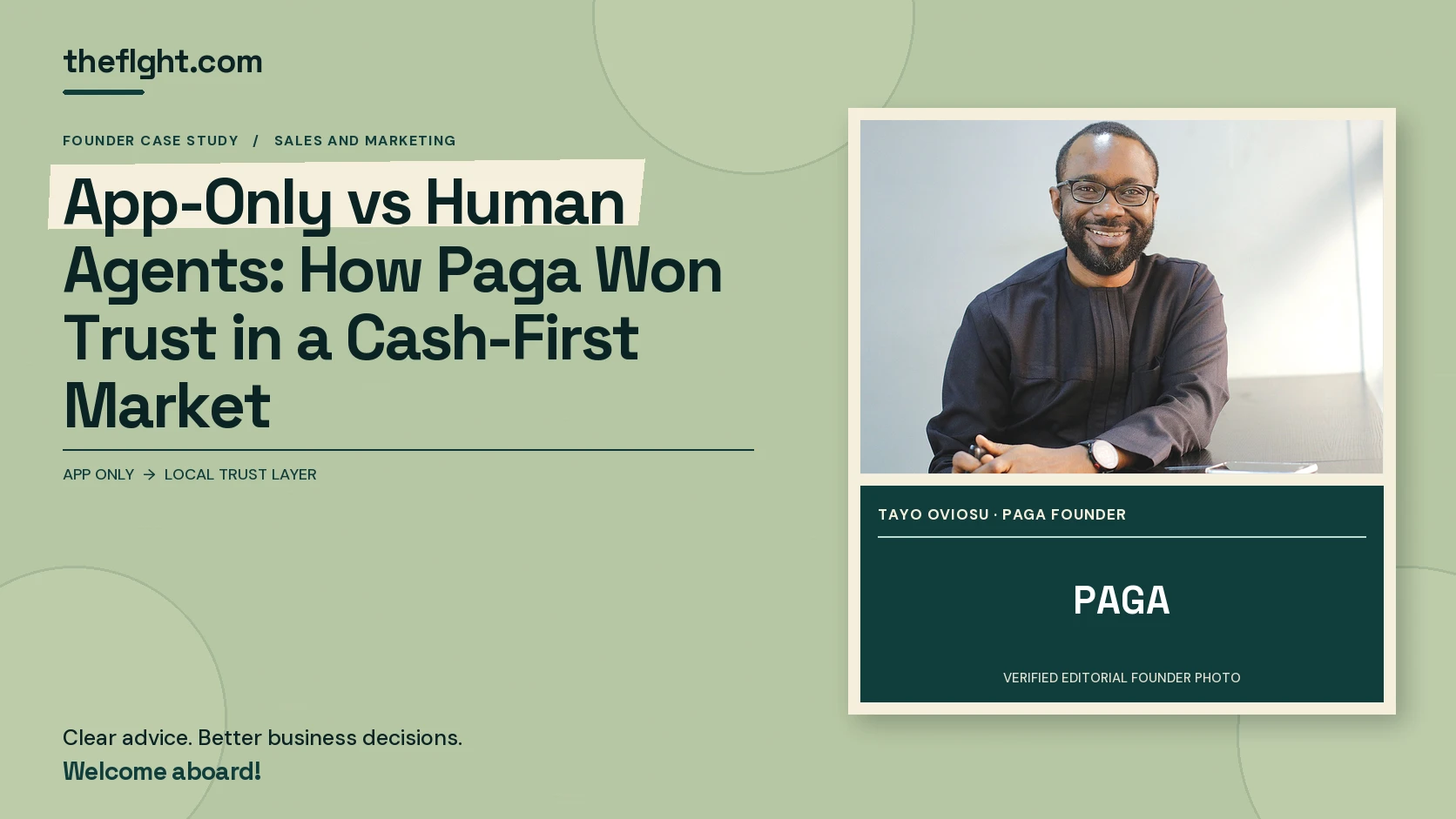
App-Only vs Human Agents: How Paga Won Trust in a Cash-First Market
Short answer: Use human agents when customers hold cash, need help completing the transaction or distrust a remote service, and when each location can earn enough contribution to keep cash and electronic value available. Start with ten agents in one dense area, measure successful transactions and liquidity failures daily, and add an app as a convenience layer. Do not expand the network until the median agent can operate without founder-funded float.
Paga launched in Nigeria with a digital payment product, but its physical agent network became central to adoption. Familiar retailers could explain the service, accept or dispense cash and give a new financial brand a local face.
Calling that model “offline distribution” understates it. An agent is a salesperson, service desk, cash point and balance sheet in one location. If any role fails, the customer's digital transaction fails physically.
Use the Trust-and-Float Ladder
The Trust-and-Float Ladder tests an agent channel in five ascending steps. You cannot skip liquidity and expect marketing to compensate.
| Step | Evidence | Failure means | |---|---|---| | Recognition | Customers know and can find the agent | Location or signage is weak | | Explanation | Customers understand the transaction and fee | Training or proposition is weak | | First completion | Cash and electronic value are available | Float design is weak | | Repeat | Customer returns without founder intervention | Trust or utility is insufficient | | Viability | Agent and company both earn contribution | The channel cannot sustain itself |
Measure the ladder by agent and transaction type. A network total can hide locations that fail customers repeatedly while one busy agent carries the figures.
What Paga's first agent demonstrated
Paga was founded by Tayo Oviosu to make it easier to send money and pay bills in Nigeria. The company combined mobile technology with a network of agents based in existing shops and other familiar locations. A Guardian profile of Oviosu and Paga describes the ambition to make financial services accessible beyond a conventional branch.
In a founder interview about Paga's beginnings, Oviosu recounted an agent who began with a cash float of about ₦25,000, ran out by the end of the day and then increased it to ₦50,000 and ₦100,000 as transactions grew. Treat those amounts as founder-reported evidence from an early location, not a network benchmark.
The useful signal was the agent's willingness to put more of his own working capital behind observed demand. Customer transactions consumed float, the location learned the rhythm and the operator increased capacity. That is stronger evidence than signing hundreds of inactive agents.
Paga's later scale does not mean agents are always superior to an app. Smartphones, identity systems and payment habits change. The early decision shows how a physical intermediary can reduce trust and conversion friction where digital reach alone is insufficient.
Decide which friction the agent removes
List every step from hearing about the service to resolving a failed transaction. Mark whether the customer can perform it alone, needs cash exchange, needs explanation or needs reassurance.
Use an agent only where the physical role is material. If an agent merely downloads an app that customers already understand, commission may add cost without value. If customers need to turn cash into electronic value, the location is infrastructure.
| Friction | App response | Agent response | |---|---|---| | Discovery | Advertising and referral | Visible trusted location | | Education | Onboarding screens | Live explanation in local context | | Cash | No direct solution | Cash-in and cash-out | | Failure | Remote support | Immediate first response |
My position is that trust should be bought with observable service, not brand advertising, in the first market. Ten agents who complete transactions reliably are more useful than national awareness for a service that fails at cash-out.
Price liquidity as a channel cost
An agent needs both cash and electronic balance, depending on transaction direction. A day dominated by cash-outs drains physical cash. A day dominated by deposits can drain electronic value. Rebalancing takes time, travel and sometimes bank fees.
Track failed transactions caused by insufficient float, the amount unavailable, time to rebalance and customers lost. Include the agent's capital cost in commissions or another explicit arrangement. If operators must lock up money without adequate return, they will ration transactions or leave.
Financial-services licences, anti-money-laundering duties, customer identification, safeguarding, consumer protection and agency rules vary by country. Obtain regulator guidance and qualified local legal and compliance advice before taking money or appointing agents.
Worked example: BridgePay Leeds
BridgePay Leeds is a fictional UK remittance start-up serving a neighbourhood where many customers prefer cash. It pilots ten approved agent locations. Each agent receives £350 for onboarding, equipment and training, costing £3,500. Monthly field support costs £1,800 and compliance monitoring costs £1,200.
In month two, the network completes 4,000 transactions at an average company net revenue of £1.40 after payment-provider fees. Agent commission is 55p per completed transaction.
Company contribution before general overhead is:
4,000 × (£1.40 - £0.55) - £1,800 - £1,200 = £400
If 280 attempted transactions fail because agents lack the right float, the completion rate is 4,000 ÷ 4,280 = 93.5%. Rebalancing support costing another £450 would eliminate an estimated 180 failures. If those complete at 85p contribution after commission, they add £153, so the intervention still loses £297 in that month.
BridgePay instead concentrates on the four busiest sites, aligns scheduled rebalancing with observed peaks and closes two persistently inactive locations. An agent network is not justified by transaction count alone. It needs density that makes liquidity support economical.
Recruit for behaviour, not footprint
Choose agents already trusted for repeated transactions, with secure premises, appropriate opening hours, record discipline and enough working capital. A prominent shop with weak cash controls is a liability.
Verify ownership, identity, licences where relevant, bank details and references. Train the person who will actually serve customers, not only the owner. Test fee disclosure, customer identification, transaction reversal, fraud escalation and complaints before going live.
Pay for completed compliant transactions, not registrations or attempted volume. Add quality conditions so commission does not reward splitting, mis-selling or bypassing controls. Audit through transaction data and physical visits.
What to do over the next 30 days
In week one, map the exact trust and cash friction, then recruit ten locations within a serviceable area. Complete legal, compliance and financial checks before activation.
In week two, train staff and fund a deliberately capped pilot. From weeks three to four, review daily completion, float failure, repeat customers, commission and support time by agent.
At day 30, retain agents that complete transactions lawfully and earn contribution. Repair one identifiable liquidity problem at promising sites. Remove inactive or unsafe locations. Expand only after the median retained agent, not the best one, can stay liquid and useful without constant founder intervention.
Related guides
Frequently asked questions
How many agents should I launch with?
Start with about ten in one compact area, enough to compare behaviour without overwhelming field support. That is a practical test size, not a regulatory or statistical rule. Include different but relevant location types and avoid spreading them so widely that rebalancing and visits become expensive. Measure each for at least one full customer cycle. A smaller number may suit complex regulated products, while simple transactions may justify more. Expansion follows active, compliant transactions and agent contribution, not signed contracts.
How much float does an agent need?
Set float from the expected mix and timing of cash-in and cash-out, then adjust from actual hourly data. Begin with a capped amount the agent and company can afford to lose, subject to safeguarding rules. Calculate the largest peak imbalance and how quickly rebalancing can occur. One agent's reported amount cannot serve as a benchmark across currencies or markets. Define who owns the money, who bears loss and how discrepancies are resolved. Financial regulation and insurance may constrain the structure.
Should agents be exclusive?
Usually not at the beginning. Exclusivity can increase commitment but also raises the commission required, restricts customer choice and may create competition-law or employment questions. A capable retailer may serve several providers and already understand cash controls. Instead, make service quality and economics attractive enough to earn attention. Consider limited exclusivity only where you finance substantial equipment or a protected territory, and document duration and exit. Obtain qualified local advice because the legal effect depends on the real relationship, not its label or heading.
Can an app replace agents once customers trust the service?
It can replace some education and routine transactions, but not necessarily cash exchange. Track which repeat customers migrate to self-service and which still need the location. Design the app and agent records so the customer can move between channels without losing history or support. Do not cut commission suddenly when the agent acquired and educated the user. A planned migration payment can align incentives. Keep agents where their continuing transaction, support or cash role produces contribution. Review that role quarterly as customer behaviour changes.
How do I stop agent fraud?
Reduce opportunity through identity checks, transaction limits, real-time receipts, customer fee visibility, reconciliation, anomaly monitoring and prompt investigation. Separate the ability to initiate, approve and reverse high-risk actions where practical. Train customers never to share credentials. No control removes all risk, so maintain a loss reserve and incident process. Anti-fraud measures can also exclude legitimate customers if designed poorly. Test them, document decisions and obtain current regulatory and data-protection advice for the countries involved before scaling transaction limits. Give customers a clear route to report agent misconduct.
What should agent commission cover?
It should compensate staff time, premises, cash and electronic float, rebalancing, transaction risk and the opportunity cost of serving your customer. Calculate the agent's contribution after these costs, not only the percentage you pay. A commission that works at 100 transactions may fail at 20. Different transaction types may need different amounts because cash handling varies. Keep the fee structure understandable and monitor whether it encourages unsafe behaviour. Pay predictably, since delayed commission undermines the trust you depend on and restricts the agent's available float.
When is app-only the better route?
App-only is stronger when customers already hold digital funds, understand the task, can complete identity checks remotely and resolve problems without a local cash point. It also avoids the fixed support and compliance burden of a physical network. Test the full journey with target customers, including failure and refund, not just registration. If assisted users convert but self-service users do not, the app is not yet replacing the agent. Choose the least costly channel that completes the real transaction reliably.
Comments (0)