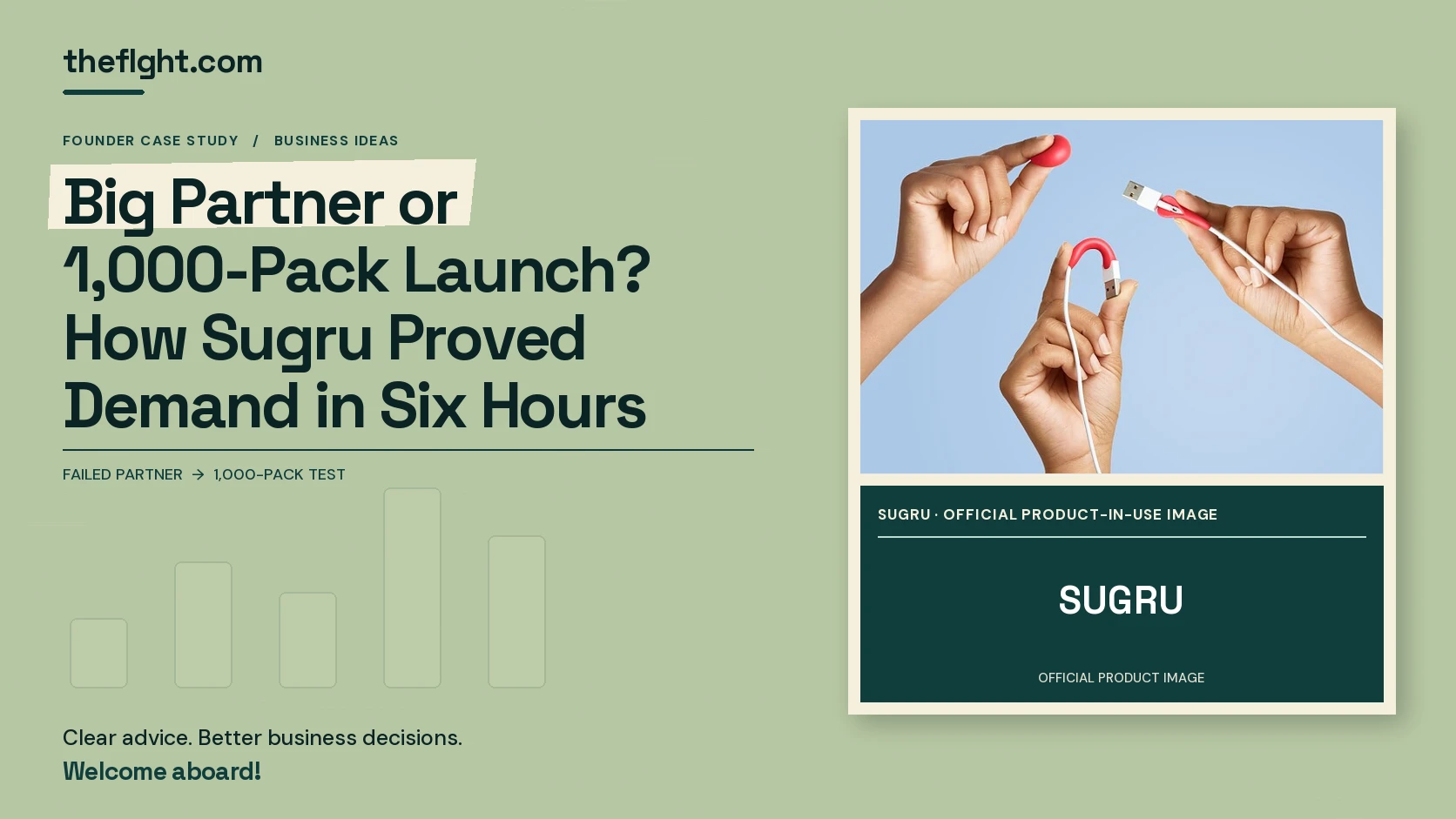
Big Partner or 1,000-Pack Launch? How Sugru Proved Demand in Six Hours
Short answer: Stop waiting for a large partner when you can lawfully make a small, consistent batch, reach identifiable early users and absorb a complete failure. Launch enough units to test payment, use, fulfilment and reorder intent, not enough to imitate national distribution. Keep partner conversations open, but make their value compete against customer evidence rather than allowing one corporate process to become the only route to market.
A large partner can bring manufacturing, credibility and distribution. It can also keep an invention in meetings while the founder learns nothing from a paying user.
An independent launch replaces corporate dependency with operating responsibility. The question is whether the smallest safe batch can produce better evidence than another six months of negotiation.
Use the Independent Launch Evidence Clock
The Independent Launch Evidence Clock gives a small batch four timed jobs. The batch is successful only when it produces evidence beyond a fast sellout.
| Clock period | Evidence sought | Measure | Misleading result | |---|---|---|---| | First day | Reach and willingness to pay | Full-price orders by source | Press traffic with no conversion | | First week | Fulfilment capability | Dispatch time, errors and support | Founder heroics hidden | | First use cycle | Product outcome | Successful use, failure and refund | Social praise before use | | Reorder window | Durable value | Repeat order or referral | Scarcity-driven first purchase |
My view is that founders should prefer a 100% controlled micro-launch to a 1% chance of a transformative partner when the product can already be supplied safely. A partner becomes more valuable after demand and use data reduce uncertainty.
What Sugru's first 1,000 packs proved
Jane Ní Dhulchaointigh spent years developing the mouldable silicone material that became Sugru. In a founder interview with The Great Discontent, she described exploring a partnership because a two-person company could not deliver the universal reach she imagined. The team then committed to an independent launch, raised £100,000 and made 1,000 packs for its first release.
In a founder interview with The Irish Times, Ní Dhulchaointigh says the team spent nearly three months making the packs in its laboratory and sold them all within six hours after a favourable technology-blog review. An Elite Business profile likewise reports a 1,000-pack launch that sold out in six hours.
The result established concentrated paid interest and gave the team customer contact. It did not prove mass-market demand, automated production or long-term profitability. The initial production pace, roughly 1,000 packs over several months, also exposed the next constraint immediately.
Set the question before choosing the batch
A first batch should answer a decision that changes the next commitment. Useful questions include whether target users pay the intended price, whether the product survives delivery, which use cases recur and whether support can be handled.
“Can we sell 1,000?” is incomplete. Selling to whom, at what price, from which source, with what refund and labour cost?
Choose a batch large enough to reveal repeated behaviour but small enough that every unit can be refunded or replaced. The number depends on unit value, safety, production consistency and audience. Fifty industrial devices can produce more evidence than 1,000 low-cost consumer packs.
Define a failure budget covering production, compliant packaging, delivery, payment fees, support, refunds and founder time. Do not use customer deposits to make a batch you cannot complete without them unless the terms, delivery risk and refund reserve are explicit.
Make the product safe and repeatable first
An invention does not become suitable for sale because a partner declined it. Complete product-specific safety, compliance, insurance, labelling and intellectual-property work before offering it. Requirements vary by market and use.
Freeze the batch specification and record inputs and process. Inspect a defined sample or every unit where appropriate. Give customers accurate instructions, limitations, storage and contact details. Novel products produce novel misuse, so collect failure reports systematically.
For chemical, electrical, children's, medical or food products, obtain qualified technical and legal advice. A “beta” label does not remove mandatory duties.
Build distribution around identifiable early users
Reach people who already perform the job the invention improves. Sugru's broad creative possibilities were attractive, but a first campaign still benefited from concrete repair and modification examples that showed what the material did.
Prepare evidence-rich demonstrations, not vague claims. Show the starting problem, application, curing or setup, finished result and limitation. Choose media, communities or retailers whose audience matches likely use. One relevant article can outperform mass exposure, but borrowed attention is volatile.
Use unique links or order-source questions to distinguish press, direct contacts, community posts and referrals. If 900 orders come from one article, you have proved that article can move one batch, not that monthly demand will repeat.
Worked example: Mouldwell Repair Compound
Mouldwell has a hand-formable repair compound ready for a controlled launch. A national hardware group is considering it, but its review has already taken nine months. The founder can make 600 compliant packs independently.
| Launch cost | Calculation | Amount | |---|---:|---:| | Compound and sachets | 600 x £3.10 | £1,860 | | Testing and compliant labels | Given | £2,400 | | Packing labour | 70 hours x £24 | £1,680 | | Postage subsidy and fees | 600 x £1.45 | £870 | | Refund and replacement reserve | Given | £900 | | Maximum cash exposure | Total | £7,710 |
The selling price is £12.50. If all 600 sell, revenue is £7,500, slightly below the full first-batch exposure. The batch is not designed to generate profit; testing and setup dominate it.
The founder sets decision gates: at least 360 full-price orders within 30 days, 95% dispatched within two working days, fewer than 5% product failures, and 25% of buyers either reordering or referring a paid customer within 90 days.
The launch sells 480 packs, but 350 arrive from one newsletter. Forty packs require replacement because curing instructions are unclear, an 8.3% failure rate. Mouldwell does not order 5,000 units from the headline sellout. It revises instructions, runs a 150-pack confirmation batch and measures whether failure falls below 5%.
The large retailer conversation now includes real use and fulfilment data. Independent evidence has improved the partnership decision, even though the first batch itself lost cash.
These figures are illustrative. Use product-specific compliance and cost advice.
Compare the partner against the evidence route
Ask a proposed partner for named milestones: technical review, commercial decision, pilot, contract and launch. Identify who owns each decision and the date it can occur. Endless interest without a funded next action has little option value.
Compare what the partner adds after your micro-launch:
| Partner contribution | Evidence to request | |---|---| | Manufacturing | Good-unit cost, capacity and quality record | | Distribution | Named channels and comparable launches | | Marketing | Approved budget and responsibilities | | Compliance | Exact work and liability allocation | | Capital | Payment timing and committed spend |
Do not grant broad exclusivity merely because the partner reopens talks after visible demand. Your new evidence has value. Use qualified advisers for licensing, manufacturing, intellectual property and competition terms.
Run the micro-launch in 30 days
In week one, state the decision question, batch cap and failure budget. Complete technical, legal and insurance checks before accepting orders. During week two, freeze the specification, prepare instructions and test the full fulfilment path.
Launch to one or two identifiable early-user sources in week three. Record full-price orders, dispatch, questions, failures and refunds. In week four, resist scaling from sales speed alone. Wait through the first meaningful use period, then authorise a confirmation batch, partner process or stop according to the clock.
Related guides
Frequently asked questions
How many units should be in a first product launch?
Use the smallest number that can expose repeated product, fulfilment and buying behaviour without risking the business. Start from the maximum loss you can afford, then divide by the full cash exposure per unit plus setup. Complex or high-value products may need dozens; low-cost consumer products may need hundreds. The 1,000 Sugru packs are a case fact, not a benchmark. Include replacements and your labour. If the batch can sell out through friends alone, it may be too small or poorly targeted to establish wider demand.
Does selling out prove product-market fit?
No. It proves that the offered quantity sold under one price, message, availability and source of attention. Scarcity, press or a founder's network may dominate. Product-market fit requires stronger evidence such as successful use, repeat purchase, referral, manageable support and acquisition beyond one launch event. Track where every order came from and wait through the normal use cycle. A rapid sellout can justify another controlled batch. It should not, by itself, justify a factory, national retailer commitment or large permanent team.
Should I tell a potential partner about the independent launch?
Usually yes, subject to confidentiality, contract and intellectual-property considerations. Explain the batch scope, what will be measured and that no conflicting rights are being granted. A serious partner may welcome lower demand uncertainty. If discussions include exclusivity, standstill or disclosure restrictions, obtain legal advice before launching. Do not share confidential partner information publicly or imply its endorsement. The aim is to create independent customer evidence, not pressure the company through publicity. Keep dated records of your product, claims and communications.
What if I cannot manufacture even a small batch myself?
You do not need to make it personally. A qualified development producer, contract manufacturer, fabrication service or laboratory may create a bounded run while you retain the brand and customer test. Verify capability, minimums, quality, rights and legal responsibilities. If no safe, lawful small-batch route exists, test earlier evidence such as a functional prototype with supervised users or conditional buyer commitments, but do not take orders you cannot fulfil. Some inventions genuinely require a partner or more capital before sale. Evidence must match the risk.
How should I price a micro-launch?
Use the intended value and realistic scaled economics, while clearly explaining any founding offer. Do not price at the inflated cost of hand production if that creates a misleading market signal, but do not subsidise so deeply that payment proves nothing. Show delivery and limitations accurately. Calculate contribution separately from one-off testing and setup, because a first batch can rationally lose money while a repeatable batch would not. Avoid lifetime promises or discounts that damage later pricing. Tax and consumer rules still apply to limited releases.
What should I measure after customers receive the product?
Measure delivery success, first use, time to outcome, failure mode, support minutes, refund, replacement, repeat use, reorder and referral. Ask what alternative the buyer would have used and whether the product replaced it. Record product version and batch so failures can be traced. Reviews and social posts are useful but incomplete, because unhappy silent users may never respond. Set a decision date based on the product's natural use cycle. A repair material may need weeks before durability can be assessed; a daily consumable can show repeat sooner.
When should I return to partnership talks?
Return when the independent batch has answered questions the partner could not, such as paid demand, dominant use case, failure rate or realistic unit economics. Present the complete result, including refunds and weak channels. Ask which remaining risk the partner removes and what it requires in return. You may discover that contract manufacturing is useful while licensing the whole brand is not. Do not confuse renewed corporate interest with a deal. Continue preserving runway and alternative routes until binding, professionally reviewed terms are signed.
Comments (0)