Small Batches vs Equity Crowdfunding: How Pip & Nut Financed Its First Retail Production Run
Short answer: Keep making small batches until paid sales establish price, repeat demand and a product worth scaling. Raise equity for a production run only when the minimum order and retailer payment delay create a cash gap that cannot be met safely from contribution, and when the capital funds a repeatable route beyond one batch. Model dilution alongside stock, fees and at least six months of working capital.
Small batches reduce cash exposure but keep unit costs high and founder capacity low. Crowdfunding can bridge the move into retail, but equity is permanent capital, not cheap inventory finance.
The mistake is comparing only the small-batch unit cost with the factory price. You must compare two complete routes to cash: how much each requires, when money returns and what happens when sales arrive slower than expected.
What Pip & Nut's raise made possible
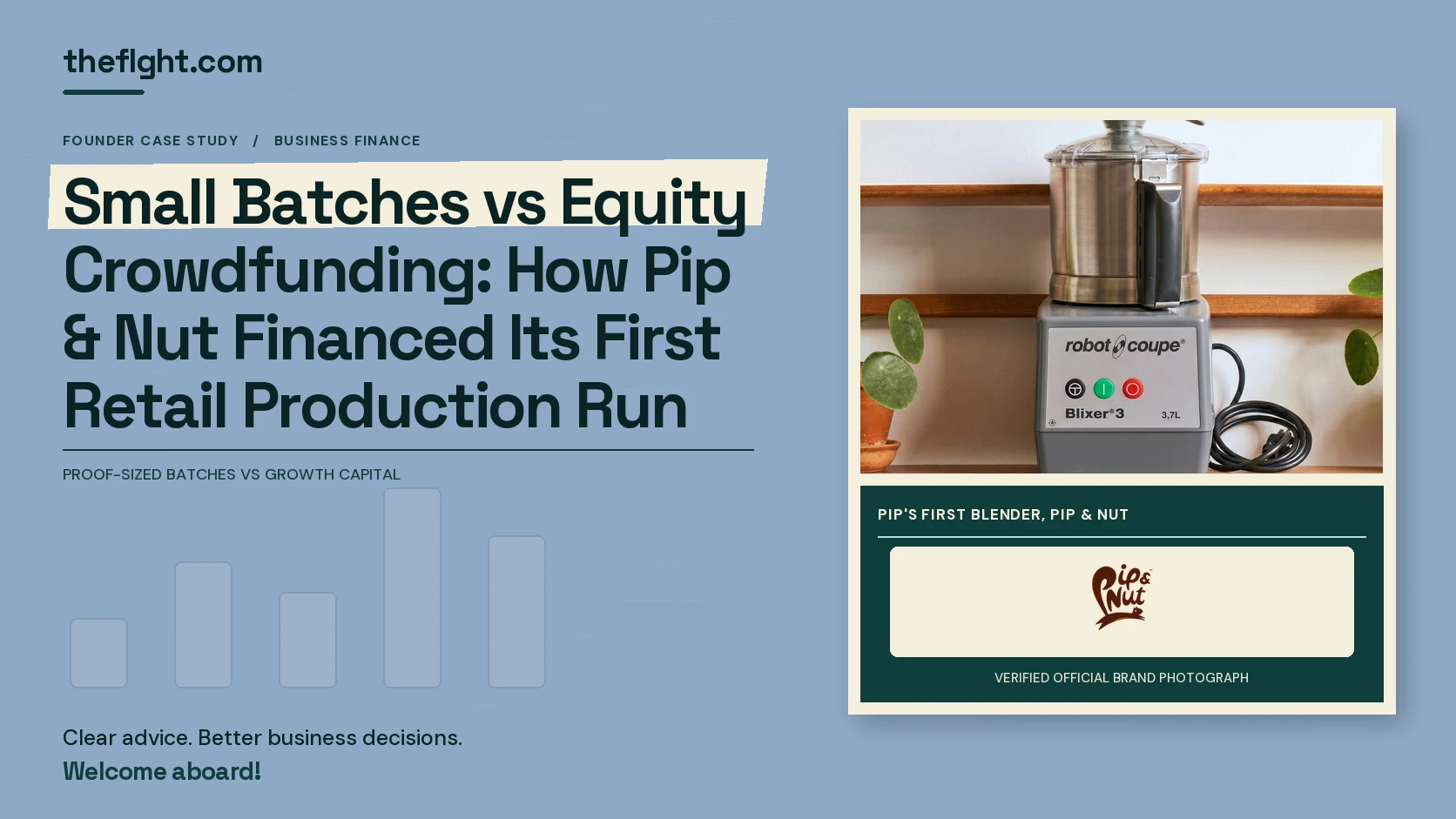
Pippa Murray tested nut butter at markets before moving into packaged retail production. She later raised £120,000 through Crowdcube, saying that much of the money funded packaging, raw materials and the first production run. Pip & Nut launched in January 2015, according to a contemporaneous Guardian profile.
Later sales and store counts show what happened after the decision. They do not prove that the raise was the only or inevitable choice. The decisive missing figures are valuation, dilution, production minimum, landed cost, retailer terms and the evidence gathered through small batches.
My position is that equity is usually too expensive for one speculative production run. It becomes more defensible when the capital also buys a route to repeated production, retail distribution and enough working capital to survive customer payment terms.
Use the First-Run Funding Bridge
The First-Run Funding Bridge has five spans. If one is missing, the founder may reach production but not collected cash.
| Span | Decision | Evidence required | |---|---|---| | Demand | Is the product wanted at the planned price? | Paid tests, repeat buying and retailer interest | | Production | What must be paid before goods exist? | Written minimum, deposit, packaging and test costs | | Sell-through | How much stock will move, and when? | Conservative channel forecast with returns allowance | | Collection | When does sale become usable cash? | Direct checkout timing and retailer payment terms | | Capital | Which funding source fits the gap? | Cost, dilution, repayment, contingency and runway |
Build the bridge in that order. Starting with a campaign target encourages you to fit costs to an attractive number.
Prove more than enthusiasm in small batches
Before raising, record units produced, full cost, selling price, selling time, repeats and waste. Separate market customers from friends and publicity traffic. Ask retailers for specific indications: expected opening quantity, wholesale price, payment terms, returns and promotional deductions.
A waiting list is useful but weaker than paid demand. A retailer conversation is weaker than a written purchase order, which can still be cancelled or delayed depending on its terms.
Set a scale trigger such as three consecutive batches selling 75% at full price within four weeks, with at least 20% of buyers repeating within the product's normal replenishment period. These are working thresholds, not universal food-sector benchmarks.
Calculate the retail cash gap
The production invoice is only the beginning. Include design changes, packaging minimums, ingredients, testing, storage, freight, listing costs, samples, promotion, returns and tax. Then place each payment and receipt on a weekly timeline.
Retail revenue may be recognised before the cash arrives. If you pay the manufacturer in week one, deliver in week six and receive retailer money 60 days later, the same cash can be tied up for more than three months. A second run may become due before the first is collected.
Model three cases: forecast sell-through, half-speed sales and one delayed retailer. The raise must survive the downside case without immediately seeking another round.
Compare funding by purpose
| Funding route | Best fit | Main cost or risk | |---|---|---| | Retained contribution | Gradual batches with positive cash generation | Slow growth and limited production size | | Customer pre-orders | Defined product with trusted delivery route | Refund and fulfilment obligations | | Supplier terms | Repeat relationship and credible orders | Personal guarantees or loss of supply | | Debt | Predictable repayment from established margin | Payments continue when sales disappoint | | Equity crowdfunding | Larger uncertain growth plan with investor interest | Permanent dilution, fees and shareholder administration |
Financing and investment promotion rules vary by country. Equity crowdfunding can involve regulated offers, disclosures, tax and shareholder rights. Obtain advice from a qualified accountant, solicitor and authorised platform before choosing terms. Do not treat crowd enthusiasm as a substitute for accurate risk disclosure.
Worked example: Oak Spoon Foods
Oak Spoon Foods is a fictional business; these figures are illustrative. It makes seed butter in a shared kitchen and sells 1,000 jars monthly at £6.50 direct. Small-batch cost is £3.10 a jar, while payment and fulfilment cost £1.05.
Monthly contribution is 1,000 × (£6.50 - £3.10 - £1.05) = £2,350 before fixed overhead and owner labour.
A co-packer offers a 20,000-jar run at £1.72 per jar. Packaging setup, tests and freight add £9,400. Total first-run cash is 20,000 × £1.72 + £9,400 = £43,800.
Two retailers propose 12,000 jars at a £3.60 wholesale price, paid 60 days after delivery. Oak Spoon expects to sell 8,000 direct over four months.
| First-run route | Calculation | Amount | |---|---:|---:| | Retail revenue | 12,000 × £3.60 | £43,200 | | Direct revenue | 8,000 × £6.50 | £52,000 | | Total revenue | | £95,200 | | Production and launch cash | | £43,800 | | Direct fulfilment and fees | 8,000 × £1.05 | £8,400 | | Retail promotion allowance | 12,000 × £0.25 | £3,000 | | Contribution before overhead | £95,200 - £43,800 - £8,400 - £3,000 | £40,000 |
The run looks attractive, but Oak Spoon must pay £43,800 before retailer cash arrives. It also needs £12,000 for four months of overhead and £7,000 contingency. The bridge requires £62,800, not £43,800.
The founder has £18,000 available, leaving a £44,800 gap. A £50,000 equity raise for 12% values the founder's surrendered stake against the whole future business, not merely this stock. If the company later becomes worth £2 million, that 12% represents £240,000.
Oak Spoon should first ask whether supplier terms, customer deposits or suitable purchase-order funding can cover production. Ordinary invoice finance advances eligible unpaid invoices, not unfulfilled orders, so it normally addresses the later collection delay. Obtain qualified advice on eligibility, cost and recourse. If equity is chosen, fund repeat production and distribution capability, not just the first invoice.
Decide how much equity is too much
Dilution is not automatically bad. A smaller share of a much stronger business can be valuable. The test is whether the capital and investors materially increase the probability and speed of a defensible outcome.
Model ownership after this round and at least one later round. Record voting, information and pre-emption rights, not only percentage. Budget platform, legal, accounting and campaign costs in addition to production.
Avoid setting valuation from the amount you want divided by the smallest percentage you feel comfortable offering. Valuation must withstand commercial evidence and comparable risks. Qualified professional advice is appropriate because terms affect control and future fundraising.
Protect the business if retail sales are slow
Agree the oldest date at which stock remains saleable and calculate weekly holding cost. Decide how much can move through direct channels without damaging retailer relationships or price perception.
Do not solve slow sell-through with repeated discounting unless the downside model includes it. Reduced price may preserve cash but weaken contribution and teach buyers to wait.
Release campaign funds in stages internally: production deposit, packaging, balance, launch and contingency. A successful raise can create pressure to spend quickly. Cash in the bank is not evidence that every planned activity deserves funding.
Make the choice in four weeks
In week one, reconcile the last three small batches and document repeat behaviour. In week two, obtain a written production quote and channel terms, then build the weekly cash bridge through collection.
During week three, compare retained cash, pre-orders, supplier terms, debt and equity against the same downside scenario. Obtain qualified advice on any external financing.
By week four, choose the smallest route that finances production, collection delay and contingency. If paid evidence cannot support the forecast, run another small batch. Scaling uncertainty with permanent capital does not remove it.
Related guides
Frequently asked questions
Is equity crowdfunding suitable for a first production run?
It can be, but only when the raise finances a wider growth system and the business can support permanent shareholders. Equity is usually expensive if the need is one short stock cycle that predictable sales will repay. Compare supplier terms, pre-orders, retained contribution and suitable debt first. If the production move also requires packaging, retail capability, staff and several runs before positive cash flow, equity may fit the risk better. Include campaign, legal and administration costs. Rules differ by jurisdiction, so use an authorised platform and qualified advisers rather than copying another founder's structure.
How much demand should I prove before approaching the crowd?
Prove paid demand at the intended price, not just social interest. Evidence should include several batches, sell-through time, repeat buying, returns and channel-specific margin. Retail letters of intent can strengthen the case, but inspect quantities and conditions. There is no universal sales threshold. Your evidence must be strong enough to support the production volume and forecast used in the offer. State uncertainty honestly. A large personal following may improve campaign reach while saying little about later supermarket sell-through. Investors need the distinction, and so do you.
Should I include founder wages in the amount raised?
Yes, if the plan requires the founder to work full time and the wage is reasonable, disclosed and included in runway. Omitting it can create an apparently lean plan that depends on personal savings or unpaid work. Separate production cash, operating overhead, founder pay and contingency. Explain how long each is funded and what milestone must be reached before cash runs low. Investors may challenge the amount, but hiding a necessary living cost weakens the plan. Tax and payroll treatment vary, so confirm the appropriate structure with a qualified accountant.
What if a retailer will not give a firm order?
Treat the opportunity as unconfirmed and reduce the production forecast accordingly. Ask what evidence, pricing, accreditation or lead time would make an order possible. A verbal expression of interest should not support a large factory commitment. You can test through independent shops, direct sales or a smaller production route while the national conversation develops. If the factory minimum only works with one uncertain retailer, concentration risk is too high. Model a version in which that customer orders nothing or pays late. If the business cannot survive it, delay or redesign the run.
Is a lower factory unit cost always worth scaling for?
No. Lower unit cost can be overwhelmed by unsold stock, storage, financing, retailer deductions and expiry. Compare cost per unit sold, not cost per unit produced. A 30% production saving is poor value when only half the larger batch sells at full price. Model sell-through speed and cash timing, then add downside discounts and waste. Small batches may be economically superior while demand remains uncertain, even at a higher unit cost. Scale becomes valuable when repeated evidence indicates the larger volume will move before quality or relevance deteriorates.
Can I use crowdfunding backers as my first retail customers?
Yes, but analyse them separately. Backers may buy because they know the founder, want campaign rewards or support the story, while ordinary retail customers encounter the product on a shelf. Track campaign contribution, delivery cost and repeat purchases at the normal price. Do not count an investor's share purchase as product demand. If backers also pre-order, record both transactions clearly and follow the platform's rules. The most useful evidence comes after fulfilment: whether customers consume, recommend and reorder without another exceptional campaign.
Comments (0)