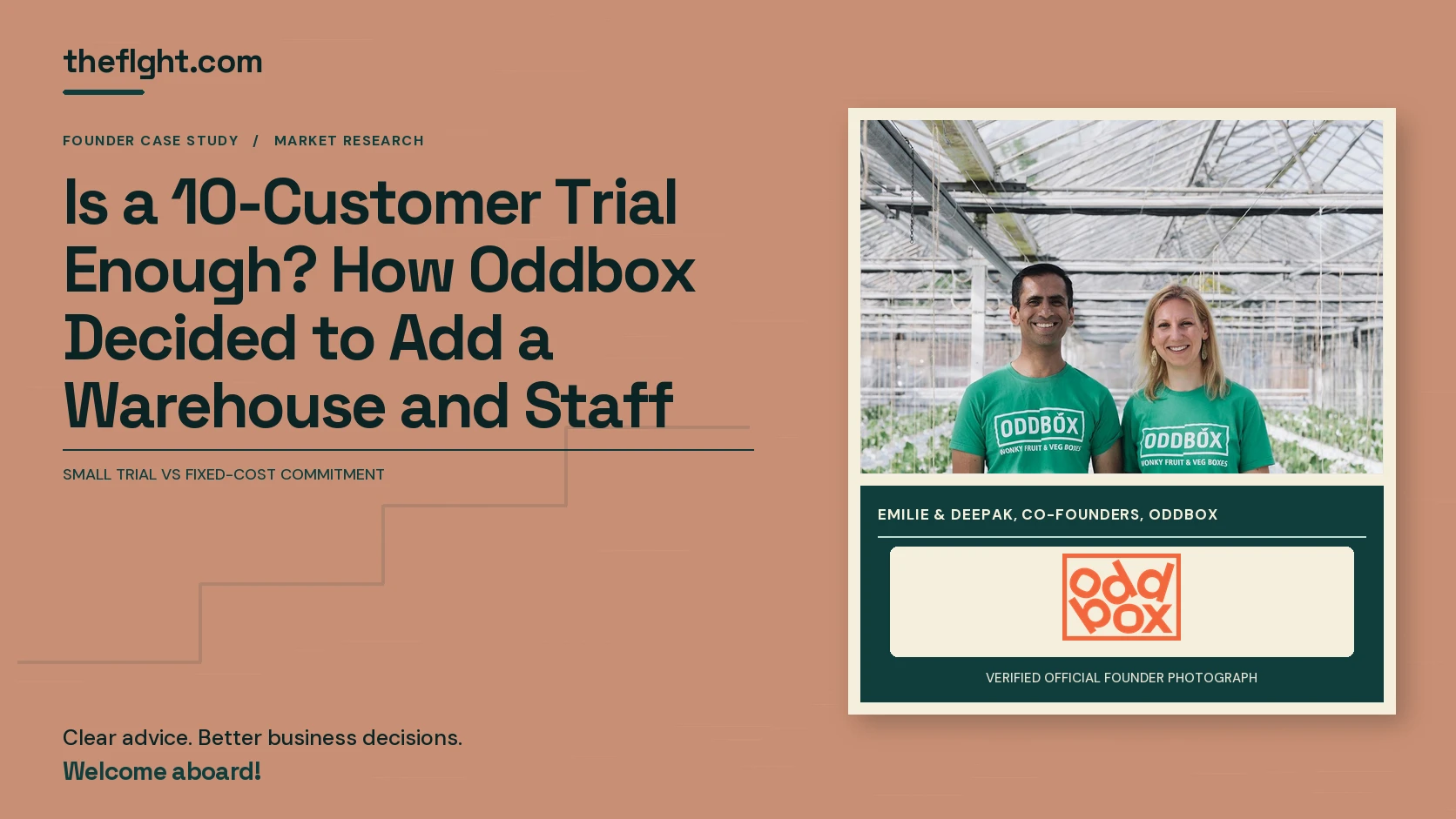
Is a 10-Customer Trial Enough? How Oddbox Decided to Add a Warehouse and Staff
Short answer: Ten paying customers can validate that the problem, offer and first delivery make sense. They cannot validate retention, route economics or the need for a warehouse. Run at least four paid cycles, require eight of the original 10 to remain or reorder, then repeat the result with 20 customers who are not friends or relatives. Add fixed premises or staff only when the next 12 weeks of conservative contribution covers the new commitment at least 1.5 times.
A tiny trial is useful because it exposes behaviour quickly. It is dangerous when you turn enthusiasm from people who know you into a lease, payroll and stock decision.
My view is that 10 customers are enough to earn the next test, not enough to prove the business. Validation should release risk in stages. It should not give you permission to jump from a kitchen table to fixed overhead.
Use the Ten-Customer Expansion Ladder
The Ten-Customer Expansion Ladder has five rungs. Each rung proves one claim and permits one larger commitment. You cannot skip a rung because the first delivery received compliments.
| Rung | What you test | Evidence to pass | Commitment released | |---|---|---|---| | 1. Payment | Will 10 people pay now? | Collected money, not promises | One manual delivery cycle | | 2. Use | Does the offer work after delivery? | Usage, complaints and waste recorded | Product adjustment | | 3. Repeat | Do customers buy through four cycles? | At least 8 of 10 remain or reorder | A larger customer test | | 4. Independence | Will 20 strangers behave similarly? | Paid acquisition and repeat data | Limited equipment or space | | 5. Density | Can the group produce positive contribution? | Route, labour and spoilage economics | Staff or premises commitment |
The numeric thresholds are working rules, not universal market benchmarks. A high-priced annual service will need a different observation period. Keep the principle: evidence must match the size and duration of the next irreversible cost.
What Oddbox's first 10 did and did not prove
Oddbox's founders, Emilie Vanpoperinghe and Deepak Ravindran, wanted to know whether cosmetic differences actually put people off buying fruit and vegetables. They found a grower and assembled a trial involving friends, family and some strangers.
In Oddbox's account of its early customer trial, the founders say they started with 10 people. Over the following six months, the company expanded, moved into a warehouse in West Norwood and hired staff, including an experienced head of operations. Two years after starting, it reported more than 25,000 home-box deliveries and 4,000 workplace-box deliveries.
The public story establishes a sequence, not the decision arithmetic. It does not disclose how many of the 10 paid, remained, referred others or produced positive contribution. It also does not show the warehouse rent, route density or spoilage. Those missing figures matter if you want to reproduce the decision rather than admire its outcome.
The first 10 could test acceptance of wonky produce. They could not alone prove that recurring collection, packing and delivery would work at scale. Oddbox's gradual expansion over six months is the more useful clue.
Make the first 10 real customers
Charge the price you intend to test. A free sample proves willingness to receive something, which is not the same as willingness to pay. If friends participate, prevent social support from distorting the result. Do not let them pay more, overlook failures or remain subscribed out of kindness.
Write down the pass criteria before recruiting. For a weekly box, you might require 10 paid starts, no more than one avoidable delivery failure, at least eight active customers after four deliveries and a clear reason for every cancellation. Track actual consumption or waste where it affects repeat demand.
Select customers from one geographic or behavioural segment. Ten unrelated buyer types produce anecdotes, not a usable pattern. A local delivery test might use households within two neighbouring postcode districts. A business service might use independent dental practices with two to five clinicians.
Test retention before you test scale
Subscription economics are made by the second, third and fourth purchase. Customer one may accept a messy delivery because the founder is present. By week four, novelty has faded and the buyer is comparing the offer with every other claim on their money.
Calculate customer contribution by cycle:
price minus product, packing, payment, delivery, expected replacement and variable support costs
Then calculate how many cycles recover acquisition and setup. If a customer contributes £9 per delivery and costs £27 to acquire and onboard, the third successful delivery only recovers those costs. A cancellation after two cycles destroys cash even though both boxes had a positive gross margin.
Do not conceal cancellation with discounts. If you need a permanent introductory price to keep buyers, that price is the one your model must support.
Worked example: Wonky Orchard Boxes
Wonky Orchard Boxes delivers surplus fruit to households in Worcester. Founder Leon runs a four-week test with 10 paying households in one compact area. Each box costs £18, including delivery.
The first-cycle economics look promising:
| Item per box | Calculation | Amount | |---|---:|---:| | Customer price | Collected payment | £18.00 | | Fruit from growers | Average purchase cost | £6.20 | | Box and packing | Direct cost | £1.35 | | Card fee | Average | £0.55 | | Delivery | 22 miles and 3 hours across 10 boxes | £4.80 | | Spoilage allowance | Observed waste | £1.10 | | Contribution per box | £18 minus direct costs | £4.00 |
After four weeks, eight customers remain. Across the trial, Wonky Orchard delivers 37 boxes because the other two customers cancel after two and three deliveries. Total contribution before Leon's acquisition effort and general overhead is 37 × £4, which equals £148.
A small warehouse unit would cost £780 a month, and a part-time packer would cost £1,050 including employer costs. Insurance and utilities would add £270. The fixed monthly commitment is £2,100. At £4 contribution per box, Wonky Orchard would need 525 boxes merely to cover it: £2,100 divided by £4.
That is about 132 weekly customers over four weeks. Ten customers do not support the lease.
Leon instead tests 30 non-friend households on a tighter route. Delivery cost falls by £1.60 per box, lifting contribution to £5.60. If 26 customers remain through four cycles, he will test a shared packing space paid by the session. He delays a lease until conservative 12-week contribution covers the fixed commitment 1.5 times.
The first trial passes the payment and repeat rungs but fails the density rung. That is useful validation. It prevents a premature fixed cost.
These figures are illustrative. Check food hygiene, labelling, insurance, employment, waste and premises requirements with qualified local professionals because rules vary by country, council and product.
Use strangers to remove the founder effect
Recruit the next 20 customers through the channel you expect to use normally. Record acquisition cost and time. Founder-led door knocking may be appropriate at first, but cost those hours and ask whether another person could follow the same process.
Keep the offer, price and service area stable. If retention falls sharply among strangers, investigate whether friends were unusually forgiving or whether the acquisition message attracted the wrong expectation. Do not average both groups. They answer different questions.
Ask departing customers for the primary reason in their own words, then code it as price, product, delivery, frequency, situation change or other. One comment is a clue. Repetition across several departures is a pattern worth testing.
Commit to fixed costs only after a downside forecast
Build a 12-week forecast using the lower of your most recent customer count or a conservative retained-customer estimate. Do not assume your best acquisition week repeats. Include deposits, notice periods, employer costs, equipment, insurance and any cash tied in stock.
Require forecast contribution to cover the new fixed commitment by at least 1.5 times. That buffer is a working guide, not a guarantee. It recognises that a 10-customer test cannot expose every supplier failure, seasonal change or staff absence.
If the commitment still fails, rent by the hour, share space, outsource one operation or cap the delivery area. Variable cost can look expensive per unit while being safer in total during learning.
What to do over the next six weeks
In week one, recruit 10 paying customers from one segment and record the pass thresholds. Deliver manually for four cycles without hiding errors. At the end of each cycle, update contribution, retention, service failures and customer waste or usage.
In week five, calculate how many customers your proposed premises or employee actually requires. In week six, recruit 20 strangers through one realistic channel. Commit only to the next rung the evidence supports. If the first group loves the offer but the numbers cannot carry fixed cost, preserve the offer and redesign delivery before expanding.
Related guides
Frequently asked questions
Do all 10 customers need to pay full price?
Yes, if full-price willingness is the claim you want to validate. A limited introductory price can test delivery and use, but it cannot prove demand at the intended price. If you discount, state the later price before customers join and ask them to make a real renewal decision at that price. Record discounted and full-price cohorts separately. Friends who insist on supporting you should receive the same terms as everyone else. Extra generosity makes the result less useful, because you cannot tell whether they bought the offer or the relationship.
What if one customer represents a very large contract?
Then customer count is the wrong main measure. For a high-value B2B offer, one paid pilot can generate substantial evidence about delivery, buying approval and economic value. It still cannot prove that the acquisition process repeats or that the customer is representative. Define the claims separately: one contract may validate willingness to pay, while three to five comparable organisations may be needed to test repeatable selling. Avoid building permanent capacity around one customer unless the contract term, margin and termination provisions support that commitment.
How long should a subscription trial run?
Run it long enough for novelty to wear off and for the customer to face at least one active renewal choice. Four weekly cycles are a useful minimum for a weekly household service, while monthly subscriptions may need three or four months. Annual products require other evidence, such as use, service demand and explicit renewal intent, because waiting a year may be impractical. The correct period depends on purchase frequency and cancellation rights. Observe actual payment and behaviour whenever possible, not only what customers say they will do later.
Should friends and family count as customers?
Count their money in cash flow, but label them separately in validation. They may tolerate mistakes, respond faster and buy to support you. Use them to test packing, payment and delivery, then reproduce the result with strangers from the intended segment. If friends are genuinely typical buyers, keep their behaviour in a separate cohort and compare retention. Do not discard useful feedback merely because you know them. Just do not let social obligation stand in for independent demand when you commit cash.
When is it safe to rent a warehouse?
Rent when conservative contribution covers the complete monthly commitment with room for demand and cost errors. Include deposit, rent, rates where applicable, utilities, insurance, equipment, travel, repairs and the notice period. Use a downside customer count, not the best week. A 1.5-times contribution cover is a useful working guide for an early test, but riskier inventory or longer leases may require more. Check planning, food, fire, lease and insurance requirements with qualified local advisers before signing, as obligations vary by premises and jurisdiction.
Should I hire an employee or use casual help first?
Use the arrangement that is lawful, reliable and proportionate to the proven workload. A contractor, agency worker or session-based service can preserve flexibility, but calling someone self-employed does not make them legally so. Compare total hourly cost, training, supervision, availability and quality. Hire when stable work and contribution support the commitment and when the role has a repeatable process. Employment status, minimum pay, pension, insurance and tax rules vary by country. Obtain qualified local employment and tax advice before choosing the arrangement.
What if customers like the product but the contribution is too low?
Do not scale yet. Test one economic variable at a time: price, product quantity, delivery density, supplier cost or frequency. Preserve the customer outcome while changing how it is produced. Quote a higher price to the next cohort and compare total contribution, not retention alone. A smaller group paying a sustainable price can be stronger evidence than a larger subsidised group. If no realistic configuration produces enough contribution, stop. Affection for the product does not obligate you to operate an uneconomic delivery system.
Comments (0)