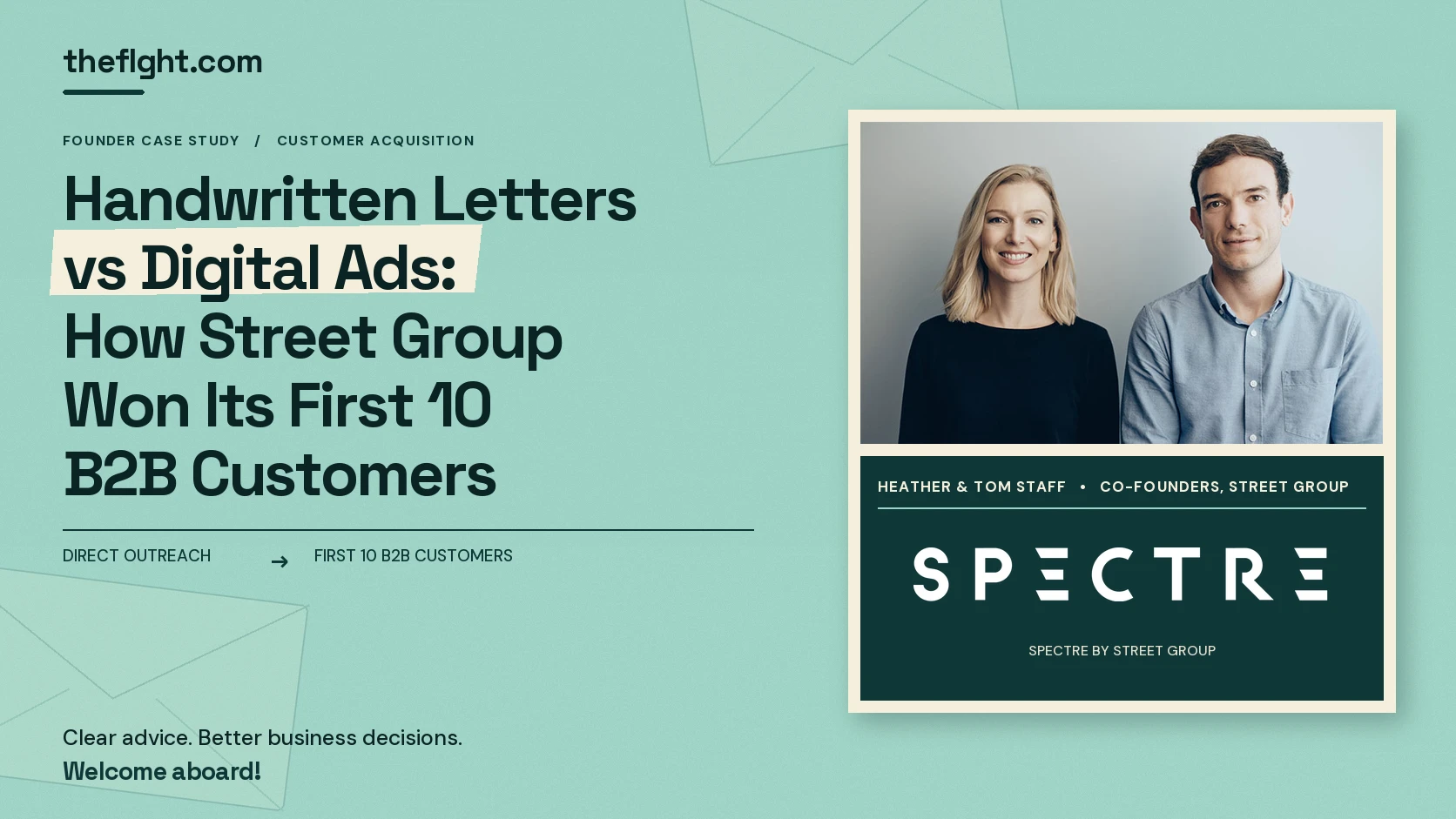
Handwritten Letters vs Digital Ads: How Street Group Won Its First 10 B2B Customers
Short answer: Use direct mail when you can name a small group of decision-makers, the problem is not being searched for online and one customer is worth at least ten times the fully loaded cost of contacting them. Send 50 tightly targeted letters first, track replies, qualified conversations and paid customers separately, then repeat only if customer contribution covers the entire campaign at least three times. Street Group reportedly received about a 5% response rate and reached its first 10 customers within two months, but your own paid-customer rate matters more than its headline result.
Handwriting is not the strategy. Reaching a known buyer through a channel competitors have neglected is the strategy. A beautiful letter sent to 500 poorly selected companies merely makes waste look personal.
Search ads are a weak default when buyers lack a recognised search term. Social and display ads can introduce unfamiliar products, but still need a credible audience. For your first 10 B2B customers, favour researched outreach when identifiable buyers and customer contribution justify the labour.
Use the Direct-Mail Proof Funnel
The Direct-Mail Proof Funnel separates a campaign into six measurable stages. Each stage answers a different question, so a weak result tells you what to change rather than inviting a vague verdict that direct mail does not work.
| Stage | What you measure | Evidence you need | Failure usually means | |---|---|---|---| | List | Letters delivered to suitable buyers | Named person, company and reason for fit | Targeting is too broad | | Attention | Replies of any kind | Reply tied to a unique code or record | Envelope or opening is ignored | | Relevance | Qualified conversations | Buyer confirms the problem and authority | Message describes you, not their problem | | Proof | Demonstrations or trials completed | Buyer sees the result in their context | Claim is not credible enough | | Purchase | Paying customers | Signed agreement and collected payment | Offer, price or risk is wrong | | Contribution | Cash retained after direct costs | Revenue minus fulfilment and acquisition costs | Sales are expensive or unprofitable |
Do not combine replies and sales. A polite response is not demand, and a demonstration is not revenue. Record the date, recipient, reply, qualification outcome, next action, sale value and acquisition cost for every letter.
Why Street Group chose letters
Street Group grew from software that Tom Staff built after seeing manual prospecting work inside his father's estate agency. Estate agents were not searching for a category that did not yet have a familiar name. Heather Staff says the founders therefore wrote directly to independent agents in north-west England, where a letter addressed to the owner could reach the decision-maker.
According to Staff's detailed founder interview about Street Group's first customers, the letters produced roughly a 5% response rate and the company signed its first 10 customers in two months. The founders charged from the start, initially meeting nearby respondents face to face. They priced the product at £39 per postcode sector each month, with a typical agent taking about 10 sectors, and collected payment monthly in advance.
Those details matter more than the later success story. Street Group had a defined industry, access to owners, an unfamiliar product that required explanation and recurring revenue worth several hundred pounds per customer each month. A £1 letter could therefore be economically sensible even if most recipients ignored it.
Treat the 5% response as one founder's reported result, not a benchmark. Your market, list quality and offer are different.
Decide whether direct mail fits before writing anything
Score the proposed campaign against four gates. Proceed only when all four pass.
First, you must be able to identify the person who owns the problem. “Marketing department” is not a buyer. “Operations director at an independent care provider with three to ten homes” is usable.
Second, the problem must have a visible trigger. Recent hiring, a new site, a regulatory deadline, an outdated booking process or a public customer complaint can justify contact. Without a trigger, your letter is speculation.
Third, expected first-year contribution must be large enough. If one sale leaves £80 after delivery, you cannot afford research, postage, calls and follow-up. If it leaves £2,400, you can.
Fourth, offer a conversation or demonstration taking no more than 30 minutes, not a 12-month commitment.
| Route | Choose it when | Main constraint | |---|---|---| | Personal letters | Named buyers justify individual research | Manual labour | | Search ads | Buyers already search for the problem | Existing search demand | | Social or display ads | You can demonstrate the problem to a defined audience | Wasted reach and creative testing |
Build a list small enough to research properly
Start with 50 organisations, not 5,000 purchased records. For each one, record the named buyer, business address, why it fits, the trigger you found and the probable cost of the problem. Remove any record you cannot justify in one sentence.
A local or industry directory can identify companies, but verify details against the organisation's own website and current public records. Job titles move. Trading addresses change. Returned mail should count as a targeting failure and remain in the campaign cost.
The letter itself needs four parts: the observed situation, the cost or friction it may create, the narrow result you provide and one next step. Keep it to one page. Personalise the first two lines with evidence, not flattery. “I saw that you opened a second clinic in Leeds” is useful. “Your impressive business caught my eye” is not.
Handwrite the whole letter only while the labour is justified. A personally signed printed letter in a hand-addressed envelope can preserve attention while reducing production time. Test the method rather than romanticising it.
Worked example: Northline CRM Consultancy
Northline CRM Consultancy helps independent recruitment firms remove duplicate records and missed follow-ups. Its owner, Aisha, selects 50 firms that have recently advertised for additional consultants. She addresses each letter to the managing director and offers a 25-minute review of the firm's lead-handling process.
The fully loaded campaign cost is:
| Cost | Calculation | Amount | |---|---:|---:| | Research and writing time | 8 hours × £35 | £280 | | Printing, envelopes and postage | 50 × £1.45 | £72.50 | | Follow-up time | 4 hours × £35 | £140 | | Total campaign cost | £280 + £72.50 + £140 | £492.50 |
Seven recipients reply. Five meet the qualification criteria, four attend a review and two buy a £1,200 clean-up project. Each project requires £360 of Aisha's delivery time and £60 of contractor and software cost. Contribution from the two sales before general overhead and tax is therefore:
(2 × £1,200) - (2 × £360) - (2 × £60) - £492.50 = £1,067.50
Northline's response rate is 7 divided by 50, or 14%. Its paid-customer rate is 2 divided by 50, or 4%. Customer acquisition cost is £492.50 divided by 2, which equals £246.25. The campaign returns £1,067.50 of contribution after acquisition costs, so Aisha can justify another controlled batch.
The surprising result is that the letters themselves cost only £72.50. Labour accounts for £420. If Aisha ignores her time, she will believe the campaign is far cheaper and more scalable than it is.
These figures are illustrative. Use your actual labour value, postage, delivery cost and tax treatment.
Compare the channel on contribution, not reply rate
Run one 50-letter batch before testing a material variation. If you change the list, envelope, message and offer simultaneously, you learn nothing about what caused the result.
After the full sales cycle, compare direct mail with any digital campaign using the same measures: qualified conversations, paying customers, acquisition cost and 90-day contribution. Impressions and clicks are diagnostic measures, not commercial outcomes.
Pause if fewer than 90% of letters reach the intended company. Repair the data. Rewrite the opening if letters arrive but fewer than two of 50 recipients respond. Reconsider the problem or segment if people respond but will not take a qualified conversation. Change the demonstration or offer if conversations occur but nobody pays.
Do not scale from one sale. One buyer may be an exception or a personal connection. Two sales from 50 contacts are enough to justify a second batch, not enough to declare a repeatable channel.
What to do over the next 10 working days
On day one, define one segment and one trigger. Build and verify 50 named records over the next two days. Write a one-page letter, show it to two people who know the industry and remove any sentence that could be sent unchanged to every business.
Post the letters in one batch and reserve three follow-up blocks in your diary. Respond to interested buyers within four working hours where possible. At day 10, calculate delivery, reply and qualified-conversation rates. Do not judge paid conversion until every live opportunity has reached a decision. Then repeat, revise or stop according to contribution, not enthusiasm.
Related guides
Frequently asked questions
Are handwritten sales letters legal in the UK?
Usually, addressed business mail is possible, but the rules depend on the recipient, the data used and what you are promoting. A named employee's details can be personal data, even when you found them publicly. You need a lawful basis for processing, accurate records, a clear identity and a practical way to respect objections. Rules differ for sole traders, corporate bodies, regulated products and other countries. Check current guidance from the UK Information Commissioner's Office and obtain qualified local advice for your campaign. This article explains channel economics, not legal compliance.
Should I include a price in the first letter?
Include a price when the offer is standardised and the number helps the buyer qualify themselves. Omit it when the scope genuinely depends on facts you cannot know before a conversation. Street Group could attach a clear price to postcode sectors because the charging unit was defined. A consultancy diagnosing a complex operational problem may instead give a bounded starting range. Do not hide a standard price merely to manufacture a sales call. Equally, do not quote a fixed fee for uncertain work and recover the risk through later changes.
How soon should I follow up after sending the letter?
Allow enough time for delivery and internal handling, then make the first follow-up after three to five working days. Refer to the specific problem and letter rather than asking whether they “had a chance to look”. A second useful follow-up five working days later is normally enough for a small campaign. Stop if the recipient declines or asks not to be contacted. Timing varies with postal service, seniority and sector, so record when replies actually arrive and use that evidence to schedule the next batch.
Should every letter be fully handwritten?
No. Full handwriting is worthwhile only when the extra attention it creates exceeds the labour cost. Test 25 fully handwritten letters against 25 personalised printed letters with the same audience, offer and posting date. Track paid customers, not compliments about presentation. Hand-addressed envelopes and real signatures may provide enough distinction without hours of copying. If handwriting limits you to too few contacts to observe a pattern, it has become a production ritual. Preserve researched relevance first, then decide how much manual presentation the economics support.
What response rate should I expect from B2B direct mail?
There is no dependable universal rate for your campaign. Street Group's founder reported roughly 5%, but that result came from a specific offer, industry and period. Use an initial batch to establish your own baseline. Separate total replies from positive replies, qualified conversations and paid customers. A 12% reply rate can still fail if nobody has authority or budget, while a 2% response can work when both respondents become high-contribution customers. Your decision threshold should be customer acquisition cost and contribution, not a borrowed response benchmark.
Can I send a gift or unusual object with the letter?
Only when it clarifies the problem and complies with the recipient's policies. Gifts can look manipulative, trigger anti-bribery rules or prevent mailroom delivery. A useful one-page observation usually carries less risk than a novelty object. If you test an enclosure, price the item, extra postage, assembly time and failed deliveries into the campaign. Public bodies and regulated sectors may impose stricter gift rules. Check the buyer's published policy and obtain qualified advice where necessary. Never make acceptance of a gift feel connected to a purchasing obligation.
When should I stop using direct mail?
Stop when two properly targeted batches fail the same economic gate after you have corrected the obvious weakness. If letters are delivered but no suitable buyer responds, the message or problem is weak. If conversations happen without sales, direct mail may be working while the offer fails. If sales occur but acquisition consumes their contribution, the whole route is uneconomic. Also stop when list quality deteriorates or manual work prevents delivery. A channel does not deserve loyalty. It deserves continued investment only while it produces profitable customers predictably.
Comments (0)