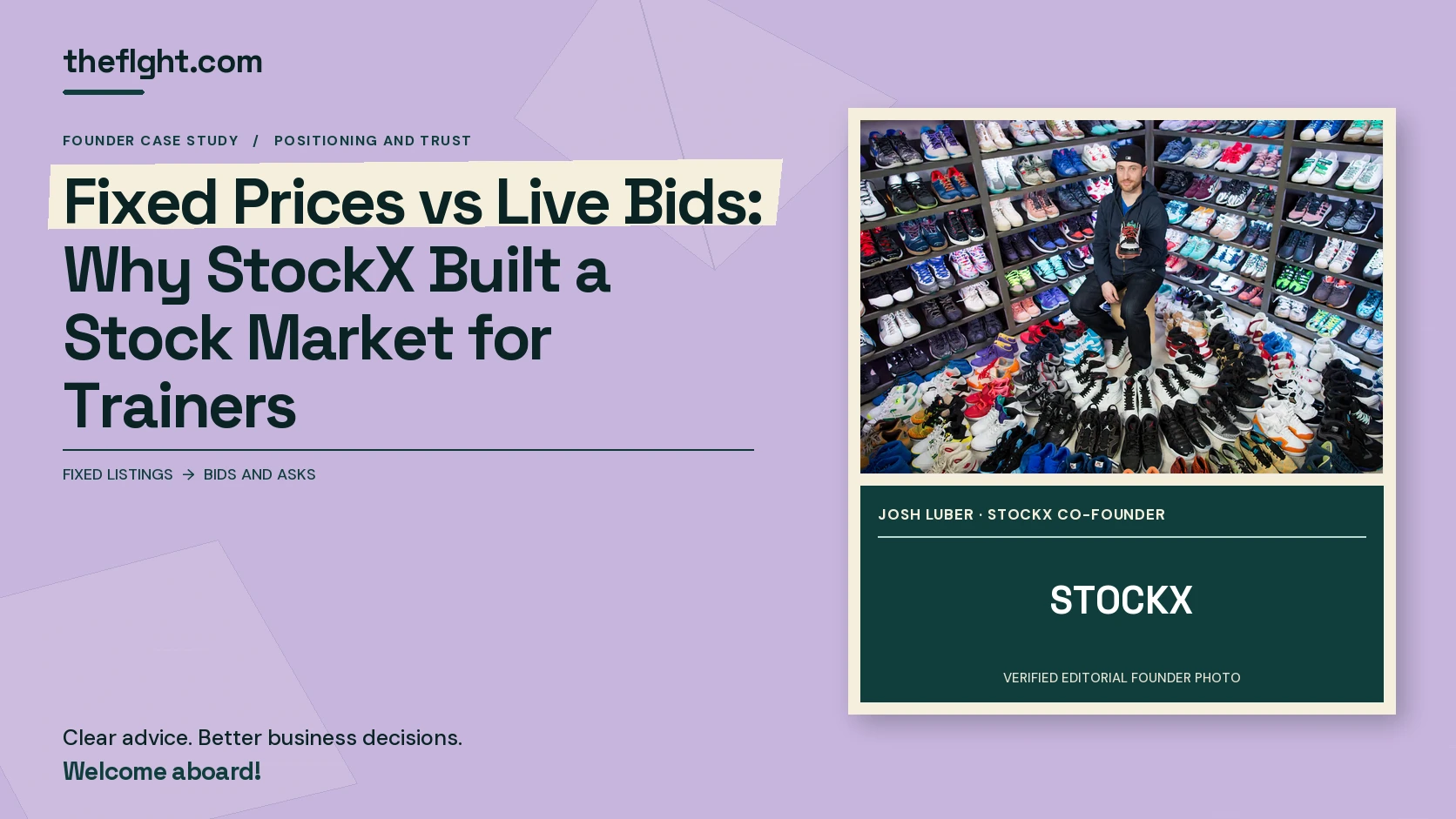
Fixed Prices vs Live Bids: Why StockX Built a Stock Market for Trainers
Short answer: Use live bids and asks when products can be standardised, prices move often and enough buyers and sellers exist to create a credible market. Use fixed listings when condition, service or configuration makes each offer materially different. Before building an exchange, prove that repeated trades can be grouped into one product page and that the spread closes often enough to produce completed sales.
A fixed-price marketplace gives every seller a shop window. It also forces the buyer to compare pages that may describe the same product with different photographs, claims and prices.
A bid-ask market promises a cleaner answer: what will someone pay now, and what will someone accept? That clarity only works when each unit is sufficiently interchangeable and the market is liquid.
StockX built the data before the exchange
Josh Luber began with Campless, a price guide for the trainer resale market. TechCrunch's detailed history of StockX's origins reports that Luber and 17 volunteers collected more than 13 million completed eBay transactions. The work was manual and imperfect, but it created a reference price where listings alone produced noise.
StockX then turned that information layer into a marketplace. At its 2016 launch, Luber described the model as matching buyers and sellers at a market price, with visible bids, asks and historical data. Instead of browsing many listings for the same trainer, a buyer could place a bid against a standard product and size. A seller could accept it or post an ask.
The important precursor was not the stock-market metaphor. It was standardisation. Trainers could be identified by model, colourway, size and condition rule, while authentication reduced the risk that two apparently identical units were not equivalent.
My view is that most early marketplaces should not start with live bids. A thin order book displays the absence of demand more clearly than a fixed listing does. Build bid-ask only when standardisation and trade frequency can make the price informative.
Use the Market-Clearing Design Test
The Market-Clearing Design Test has four parts.
| Test | Fixed listings favour | Live bids favour | |---|---|---| | Identity | Each item or service is meaningfully different | Units fit a common specification | | Frequency | Trades are occasional | Comparable trades recur | | Liquidity | Buyers will wait for a particular seller | Several buyers and sellers can meet | | Trust | Seller reputation explains quality | Verification makes units interchangeable |
Do not choose the interface first. Classify the transaction, then select the mechanism that helps it clear.
Standardise only what is genuinely comparable
A product page can combine offers only when buyers would accept any verified unit meeting the same specification. Model, size, edition and condition may all matter. For services, provider skill, timing and relationship usually prevent full standardisation.
Write an acceptance specification and test whether independent reviewers classify the same units consistently. Every disagreement creates inspection, refund and support cost.
Standardisation can improve trust because buyers know what a completed purchase means. It can also conceal variation. A used trainer with visible wear cannot be treated as identical to an unworn pair simply because the model number matches.
Measure liquidity by product, not marketplace total
Ten thousand users do not create liquidity if they want ten thousand different products. For each product and variant, record active bids, active asks, spread, trades per week and time to match.
The spread is the lowest ask minus the highest bid. A narrow spread suggests agreement about value. A wide spread can mean uncertainty, weak demand or unrealistic sellers. No spread exists when only one side is present.
Measure the proportion of product pages that complete at least one trade in a defined period. A few fashionable products can make total volume look healthy while most sellers wait indefinitely.
Decide how price priority works
A market needs deterministic rules. Usually the highest bid and lowest ask receive priority, with time breaking ties. State when money is authorised, when the seller must dispatch, what inspection occurs and what happens if verification fails.
Avoid adding negotiation features that undermine the main mechanism. If buyers can privately bargain after placing visible bids, displayed prices cease to represent real commitment.
Marketplace payments, consumer rights, counterfeiting liability, tax and seller classification vary by jurisdiction. Obtain qualified local advice before holding funds, authenticating goods or setting cancellation rules.
Worked example: SoleVault
SoleVault is a UK marketplace for unworn collectible trainers. These figures are illustrative.
It begins with fixed seller listings. One model in size nine has 30 listings priced from £190 to £270. During a month, 1,200 buyers view the listings, 48 start checkout and 18 purchases complete. Completion per viewer is 18 divided by 1,200 = 1.5%. Sellers wait a median of 24 days.
SoleVault tests one standard product page with bids and asks. It verifies every pair to the same condition rule. At the end of week one, the highest bid is £208 and the lowest ask is £226, so the spread is £226 - £208 = £18, or 8.7% of the £208 bid.
By week four, 54 buyers have placed funded bids and 22 sellers have posted asks. Thirty sales complete at an average £218. SoleVault charges 7% of the sale price, so marketplace revenue is 30 x £218 x 7% = £457.80.
Authentication, payment and support cost £10.80 per completed sale, or 30 x £10.80 = £324. Contribution is £457.80 - £324 = £133.80.
| Measure | Fixed listings | Bid-ask page | |---|---:|---:| | Completed monthly sales | 18 | 30 | | Median seller wait | 24 days | 11 days | | Contribution per sale | £5.10 | £4.46 | | Monthly contribution | £91.80 | £133.80 |
The exchange clears more trades and produces more total contribution, even though inspection lowers contribution per sale. SoleVault does not roll it out to every product. It sets a gate of at least ten comparable monthly sales, five funded bids and five verified sellers per variant. Rare products remain as fixed listings until they reach that density.
Treat verification as part of pricing
Visible prices are useful only when a completed trade delivers what the page promised. Authentication, inspection, grading and return handling are therefore part of the market design, not back-office extras.
Price the false-acceptance and false-rejection risk. A counterfeit that passes inspection creates customer loss and reputational damage. A genuine item incorrectly rejected wastes shipping and seller time.
For a young marketplace, narrow the catalogue to products your process can classify well. Breadth without reliable verification creates more apparent inventory and less actual trust.
Keep fixed listings where the story matters
Live bids are poor for commissioned work, unique vintage goods, property and services where each offer carries distinct attributes. A detailed listing lets the seller explain those differences and lets the buyer choose more than a price.
Hybrid designs can work. Standard products use the exchange, while unusual condition or bundles use fixed listings. Keep the paths visibly separate so prices from unlike goods do not contaminate the reference history.
Run a six-week liquidity pilot
In week one, select five products with repeated historical trades and write a strict identity standard. Recruit existing buyers and sellers, but do not manufacture orders.
For four weeks, measure funded bids, verified asks, spread, time to trade, failed inspection, refund and contribution. Compare each product with similar fixed listings.
In week six, keep the exchange only for products that clear repeatedly with an acceptable spread and positive contribution. Return thin products to fixed listings. A sparse order book is evidence to narrow the market, not a design problem to conceal.
Related guides
Frequently asked questions
How many buyers and sellers create enough liquidity?
There is no universal number because willingness to trade matters more than registrations. Five funded buyers and five credible sellers around a narrow price can be more liquid than 100 people far apart. Define a product-level test, such as ten completed trades in 30 days, a median sale within 14 days and a spread below a chosen percentage. Replace those indicative thresholds with your market evidence. Count committed bids and verified stock, not email sign-ups or people who viewed the page.
Is a bid-ask marketplace the same as an auction?
No. In a conventional auction, buyers generally compete over a particular item for a limited period. In a bid-ask market, buyers and sellers post continuing price commitments for standardised units, and a trade occurs when prices meet. An auction can suit a unique object, while bid-ask suits interchangeable products with recurring trades. Fixed listings suit offers whose differences matter to the buyer. Choose from the underlying transaction structure rather than using the formats interchangeably merely because all three display prices.
Should bids require payment details?
They should represent credible commitment. A card authorisation, deposit or verified balance can reduce bids that disappear when a seller accepts. The mechanism must explain when funds are held, captured and released. Unfunded expressions of interest can still be shown separately, but should not determine a price presented as immediately executable. Payment-provider rules, safeguarding and consumer law vary by country and payment method. Obtain qualified advice and model failed authorisations, refunds and disputes as direct transaction costs from the outset.
What if sellers refuse the market price?
Let them post an ask and wait, provided the inventory is genuine and the rule is clear. Do not describe the latest sale as the only correct value. It is one transaction at one time. A persistently wide gap between bids and asks shows that the market is not clearing. You can improve information, recruit the missing side or leave the product as a fixed listing. Artificially subsidising both sides may create apparent volume that disappears when the subsidy ends.
Does price transparency reduce marketplace margins?
It can reduce sellers' ability to exploit uninformed buyers, but it may also increase completed transactions, trust and repeat use. Model total contribution, not the fee on one sale. Transparent history can also attract professional sellers who value faster turnover. Conversely, displaying thin or volatile data may confuse customers. Show the number and date of genuinely comparable trades, not a precise-looking estimate unsupported by activity. The marketplace earns its margin by improving execution and trust, not by preserving avoidable uncertainty.
Can services use live bids and asks?
Rarely in a pure form, because provider identity, timing, scope and quality make services difficult to standardise. A tightly specified commodity service may support quotes or capacity bidding, but the specification and remedy for poor delivery must be unusually clear. Test whether buyers genuinely regard different providers as interchangeable. If relationships and judgement affect the outcome, structured fixed offers or requests for proposal are likely to work better. Never force unlike services into one price merely to make the marketplace appear active.
Comments (0)