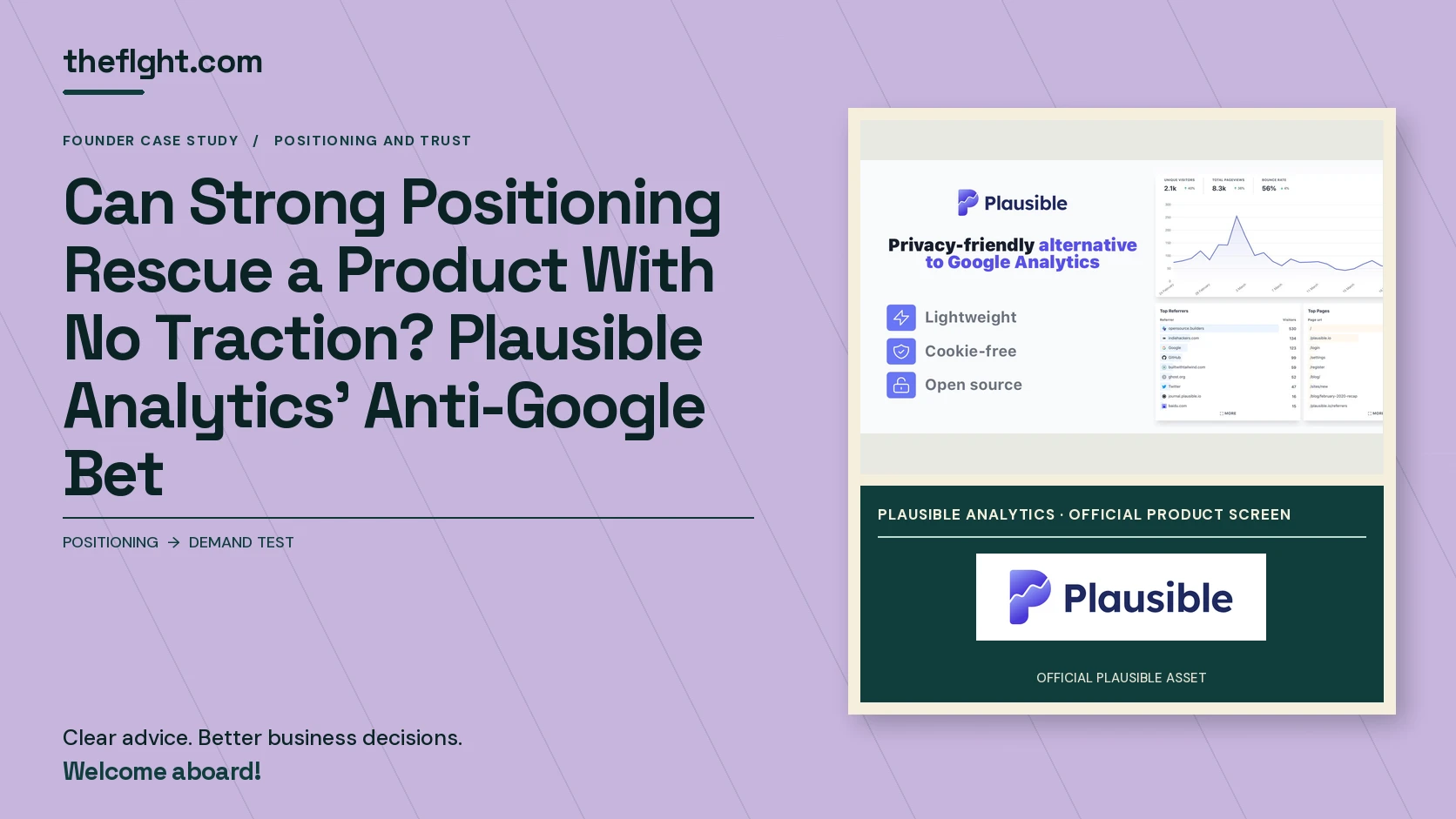
Can Strong Positioning Rescue a Product With No Traction? Plausible Analytics' Anti-Google Bet
Short answer: Strong positioning can rescue a useful product that buyers overlook, but it cannot rescue poor outcomes or a market with no urgency. Run a 30-day message test that changes the audience, problem and contrast while leaving the product and price stable. Continue only if qualified visits convert to activated trials and paid retention, not merely if a provocative article attracts traffic.
Weak traction is often labelled a marketing problem because that diagnosis is emotionally cheaper than questioning the product. Sometimes the label is right. Buyers may see a competent product but no reason to choose it now.
Positioning works by making a choice legible. It is not a slogan, and attention is not proof of commercial demand.
Plausible's positioning inflection
Plausible Analytics initially struggled to gain traction. Its founder account says it took 324 days from the first paid subscriber to reach about US$400 in monthly recurring revenue. The product then adopted a sharper contrast with Google Analytics around privacy, simplicity and open source software.
A founder-written article arguing that sites should stop using Google Analytics drew more than 50,000 readers within days and produced 166 trials in its first week, more than the previous four months combined. Plausible's bootstrapping account says revenue moved from roughly US$400 to US$10,000 MRR in nine months. Its marketing retrospective explains the reliance on content rather than paid acquisition.
The founders also disclosed using more than US$50,000 of personal savings between them. That matters. Positioning did not remove financial risk, and the viral article alone does not disclose trial-to-paid conversion or cohort retention.
My argument is that a young business should make a falsifiable enemy of the default, not attack a company for attention. The contrast must explain a customer trade-off. “Unlike the default, we remove X so you gain Y” is useful. Outrage without an operating difference is theatre.
Use the Positioning Traction Turnaround
The Positioning Traction Turnaround diagnoses four stages in sequence. Changing the message is justified only when the product produces value for at least a small set of users.
| Stage | Question | Measure | Meaning of failure | |---|---|---|---| | Value | Do successful users get a specific result? | Completed outcome and retention | Product or segment problem | | Recognition | Does the target buyer recognise the problem? | Qualified response rate | Weak urgency or wording | | Contrast | Do buyers understand why you differ? | Message-to-trial conversion | Indistinct position | | Proof | Do trials activate, pay and remain? | Activation and cohort retention | Claim outruns experience |
Do not skip the value stage. Interview five retained customers and ask what changed after adopting the product, what alternative they replaced and what nearly stopped them buying. Their behaviour supplies the raw material for positioning.
Identify the default and its cost
A position becomes useful when it names what the buyer would otherwise do. The default may be a dominant product, a spreadsheet, a manual process or doing nothing.
Describe the cost without exaggeration. For Plausible, the contrast involved a simpler analytics experience and a privacy-led model. A different analytics buyer may prefer the incumbent's breadth and integrations. Good positioning repels customers whose priorities do not fit.
Use the guide on [why customers choose one business over another](/positioning-and-trust/why-customers-choose-you/) to state the choice in the buyer's terms. Avoid unprovable claims such as “best” or “most trusted”.
Build three testable messages
Keep product, audience, channel and price stable while testing the central contrast. Create three message versions:
- Outcome led: the result and time or effort saved.
- Default contrast: what you deliberately remove or change.
- Risk led: the operational, privacy or financial exposure reduced.
Send each version to a comparable audience. A small founder can use three landing-page variants across sequential outreach batches of 30 qualified prospects. Record replies, visits, trials, activation and payment. Do not call a version the winner from clicks alone.
Claims involving privacy, security, environmental impact, health or regulated performance need evidence and may be governed by advertising and sector rules. Requirements vary by country. Obtain qualified local legal advice before publishing material comparative claims.
Connect attention to retained revenue
A strong opinion can produce a traffic spike from people who agree but will never buy. Build a chain from source to cash:
Qualified readers x trial rate x activation rate x paid conversion x 90-day retention x monthly price.
Tag each campaign or ask sign-ups how they found you. Compare the positioned cohort with the previous baseline. If trials increase fivefold but activation halves and retention collapses, you have attracted curiosity rather than customers.
Also watch support language. When prospects begin repeating your contrast accurately, recognition is improving. When support tickets reveal expectations the product cannot meet, narrow the claim.
Worked example: ClearMetrics Analytics
ClearMetrics Analytics sells privacy-conscious website reporting at £24 a month. These figures are illustrative.
Its neutral message receives 2,400 qualified visits in a month. Seventy-two visitors start a trial, 29 activate, 12 pay and nine remain after 90 days. The visit-to-trial rate is 72 divided by 2,400 = 3%. Retained monthly revenue is 9 x £24 = £216.
The business tests a direct contrast: essential website decisions without visitor profiles or a complex reporting suite. It receives only 1,600 visits, but 112 trials, 67 activations, 31 payments and 26 retained customers.
| Measure | Neutral | Positioned | |---|---:|---:| | Trial rate | 3.0% | 7.0% | | Trial activation | 40.3% | 59.8% | | Paid conversion | 16.7% of trials | 27.7% of trials | | 90-day retained MRR | £216 | £624 |
Positioned retained MRR is 26 x £24 = £624, despite fewer visitors. The useful gain is not attention. It is £408 more retained monthly revenue from a better-matched cohort.
ClearMetrics next checks why five paying customers left. Three expected advanced attribution that the message implied indirectly. It removes that implication before scaling distribution. Strong positioning becomes trustworthy by stating who the product is not for.
Know when positioning is not the problem
Stop message work when qualified prospects understand the offer but reject the outcome, trials fail at the core task or retained users would not be disappointed if the product disappeared. Those are product, segment or urgency signals.
Likewise, a working position cannot compensate for an inaccessible channel. If prospects respond positively but acquisition costs exceed expected contribution, investigate distribution and price. The guide on [how a new business should market itself](/sales-and-marketing/how-should-a-new-business-market-itself/) helps separate message from route.
Run a 30-day turnaround
In week one, interview five retained customers and five lost trials. Write their default, desired outcome, objection and proof. In week two, create three contrasts and test each with 30 qualified prospects.
During week three, use the strongest version on one controlled channel. Track the full chain through activation and payment. In week four, review customer quality and support expectations. Keep the position only if it increases activated, paid demand without lowering fit. Otherwise return to the value stage or choose a narrower segment.
Related guides
Frequently asked questions
Is naming a large competitor a good positioning strategy?
It can clarify the default quickly, but it also borrows the competitor's frame and creates legal and credibility risks. Compare verifiable differences that matter to a defined customer, not motives or vague quality. You can often say “for teams that need X without Y” without putting the rival in every headline. Comparative advertising and trade-mark rules vary by jurisdiction, and claims must be supportable. Obtain qualified local advice for a campaign built around another brand. The test is whether the contrast helps a buyer choose, not whether it produces reactions.
How many customers do I need before changing positioning?
Five retained, engaged customers can provide enough qualitative material for a first test, but not enough to declare the market solved. Speak to lost trials and non-buyers as well, because happy users may overlook confusion that blocks acquisition. Look for repeated language about the default, trigger and result. Then test the message on at least 30 comparable prospects per version. In a high-value enterprise market, smaller samples may be unavoidable, so require stronger behavioural evidence such as a scheduled evaluation or paid pilot rather than opinions.
Can I reposition without changing the product?
Yes, and keeping the product stable initially makes the test easier to interpret. Positioning selects and explains existing value. It does not need a redesign. However, a sharper promise often exposes product gaps. Record them rather than adding every requested feature. If the best-fit segment consistently needs one missing capability to reach the promised outcome, schedule a separate product test. If each prospect wants something different, the position may still be too broad. Change one major variable per test whenever practical.
What if a controversial article gets traffic but no sales?
Treat it as failed commercial evidence, even if it succeeds as media. Inspect whether the readers were qualified, whether the article connected the argument to the product and whether trials activated. A low trial rate suggests curiosity or weak relevance. Strong trials with poor activation indicate an experience problem. Good activation with no payment points to price, urgency or the wrong buyer. Do not keep escalating the controversy to recover the result. Rewrite the contrast around an observable customer consequence and test it through direct outreach.
How long should a positioning test run?
Run it until the normal buying and activation cycle can occur, subject to a pre-agreed maximum. Thirty days is adequate for many low-cost self-serve products. A considered business purchase may need 60 to 90 days. The calendar matters less than reaching enough qualified exposures and observing payment or a meaningful commitment. Do not end early because clicks look encouraging. Also avoid running indefinitely with tiny traffic. If you cannot reach 30 qualified prospects, the immediate problem may be channel access rather than positioning.
Should my position exclude potential customers?
Yes. A useful position helps some buyers decide faster by making the trade-off clear, which necessarily makes the product less attractive to others. Exclusion is not hostility. State the situation in which the alternative is a better fit. Plausible's simpler approach will not suit every analytics requirement, and saying so strengthens trust. Monitor whether the excluded group was actually subsidising the business, referring customers or providing essential revenue. If narrowing threatens cash, stage the change and compare contribution by segment before removing an established offer.
Comments (0)