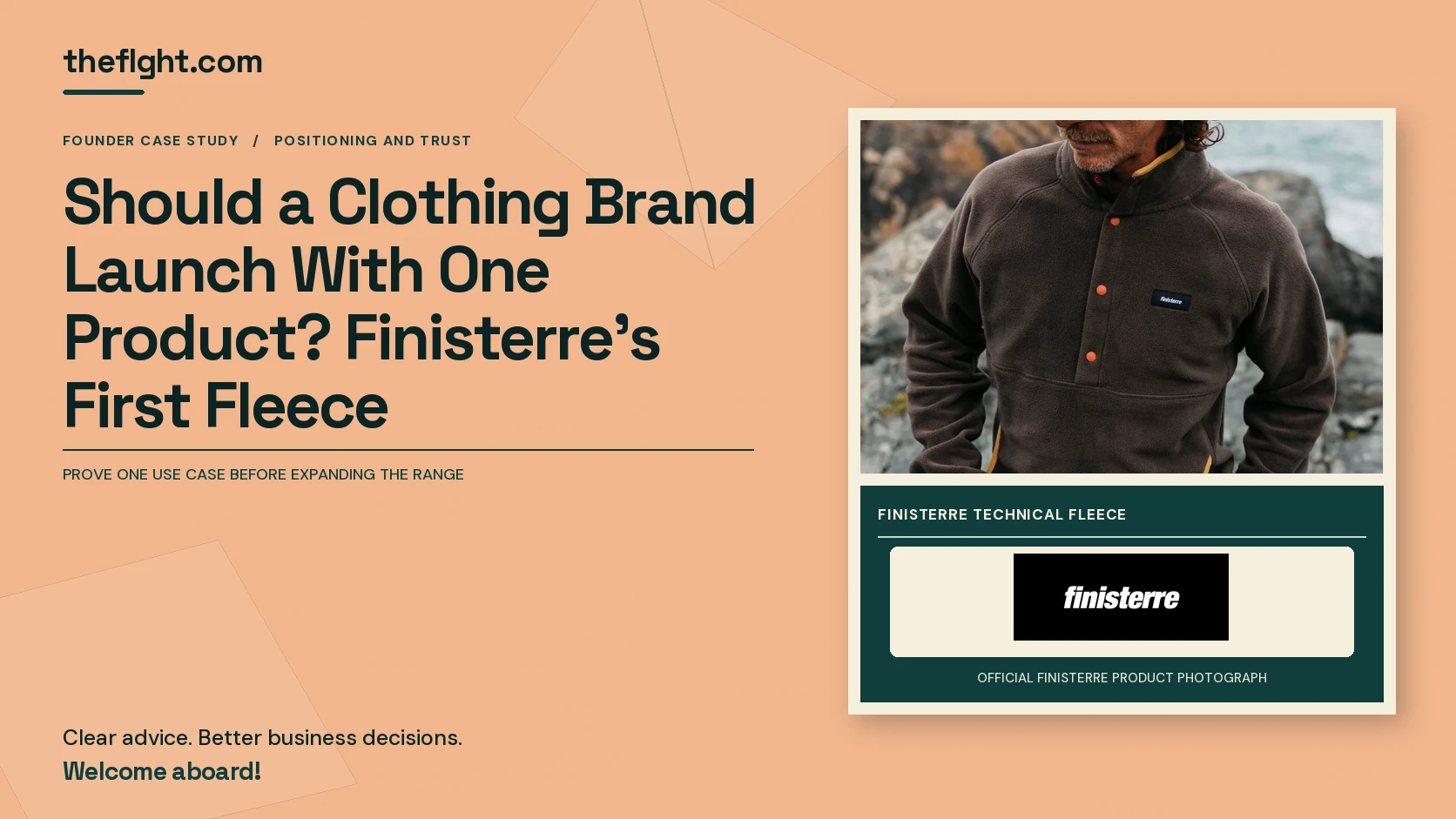
Should a Clothing Brand Launch With One Product? Finisterre's First Fleece
Short answer: Launch with one clothing product when it solves one recognisable use case, has enough sizes or fit information to serve the target buyer, and can achieve positive contribution at a small production volume. Add a second product only after 30 to 50 normal-priced sales reveal who buys, which variants move and why customers choose you. A collection is justified only when products must be combined to make the first purchase credible.
Clothing founders often mistake breadth for legitimacy. Six styles can make a website look established while multiplying samples, size stock, photography, quality checks and cash tied up in slow variants.
Finisterre says it began in 2003 with one technical fleece, developed to warm cold-water surfers, from a flat above a surf shop in St Agnes. Founder Tom Kay has said he had no business or design background and explained the product through a three-page website. Finisterre's own history describes the fleece and early site. In a later founder interview, Kay described believing there was room for a brand built around that functional need and said that 7 out of 10 certainty was enough for a decision.
This is evidence of a focused launch, not proof that one product works in every apparel category. The decision depends on whether one item can carry a distinct promise.
Use the One-Product Positioning Wedge
The One-Product Positioning Wedge tests whether a single item can enter a crowded market sharply enough to be noticed and bought.
| Edge of the wedge | Question | Pass condition | |---|---|---| | Specific wearer | Who faces the problem? | One identifiable first segment | | Specific moment | When is existing clothing inadequate? | Frequent or costly situation | | Product proof | What construction solves it? | Benefit can be demonstrated honestly | | Small-run economics | Can a limited batch contribute? | Positive contribution after full variable cost | | Expansion signal | What would justify product two? | Repeated paid request or complementary use |
My position is that most first-time clothing founders should launch one product, not a collection. The exception is a coordinated category where the purchase makes little sense alone, such as a uniform or matched technical system. Buyers do not trust a new label because it has more stock. They trust a precise promise, credible evidence and reliable fulfilment.
Define the moment, not the demographic
"Clothes for active people" is too broad. Finisterre's first fleece had a situation: a cold body emerging from the sea into wind. The use case guided fabric, function and story.
Write the moment in this form:
When [specific situation], the wearer needs [measurable or observable outcome] because current options [specific failure].
That sentence should rule out many people. If it does not, it will not guide design. Use [specialist versus generalist positioning](/positioning-and-trust/specialist-versus-generalist-positioning/) to test whether the focus is commercially meaningful.
Avoid performance claims you cannot substantiate. Warmth, waterproofing, durability, sustainability and health-related language may require technical evidence or careful qualification. Product, textile-labelling, environmental-claim, consumer and safety rules vary by market. Check current official guidance and obtain qualified advice for your materials and claims.
Count variants as products for cash purposes
One fleece in five sizes and three colours creates 15 stock-keeping units. A 20-unit minimum for each means 300 garments, not one simple product.
Start with the fewest variants that can serve the defined customer fairly. Use pre-production fit sessions with people whose bodies represent intended buyers. Publish accurate measurements and explain the cut. Do not exclude a significant part of the target segment merely to make inventory convenient.
Choose colour after the function, and distinguish preference from paid demand. A poll can spread votes across ten colours while real purchases concentrate in two. If a manufacturer permits it, test colour through samples or refundable pre-orders before a full run.
Prove the product at normal price
The first 30 to 50 sales should answer four questions: who buys, which size and variant moves, what objection delays purchase, and whether contribution survives exchanges and returns.
Calculate:
product contribution = selling price minus garment, inbound freight, duty, packaging, payment, outbound delivery, expected returns and variable support
Do not leave returns until later. Fit-sensitive categories can move cash out and stock back weeks after the order. Use a provisional allowance, label it as such and replace it with actual cohort data.
One product makes this learning cleaner. With six styles, you may not know whether poor sales reflect positioning, silhouette, price, colour or divided traffic.
Worked example: ColdTide Fleece
ColdTide develops one pullover for sea swimmers. It offers four sizes and two colours, eight variants in total. The manufacturer accepts 12 units per variant, so the first batch is 96 fleeces.
| First-batch item | Calculation | Amount | |---|---:|---:| | Garments | 96 x £31 | £2,976 | | Inbound freight and inspection | fixed | £480 | | Photography and fit samples | fixed | £420 | | Packaging | 96 x £1.50 | £144 | | Cash committed before sales | total | £4,020 |
The retail price is £82. Per sold order, payment, outbound delivery and return allowance total £12.50. Allocated garment, inbound and packaging cost is (£2,976 + £480 + £144) ÷ 96 = £37.50. Contribution per sale is £82 - £37.50 - £12.50 = £32.
The fixed photography and fit cost requires £420 ÷ £32 = 13.1, so 14 sales to recover. If 50 units sell at normal price, contribution before general overhead is 50 x £32 - £420 = £1,180. If one colour accounts for 80% of sales, ColdTide should rebalance the second batch rather than launch three new garments.
These figures are illustrative, not apparel benchmarks. ColdTide must also reserve cash for unsold sizes and exchanges.
Make one page carry the argument
A three-page website was sufficient for Finisterre's early story, but the lesson is not to imitate its page count. Give the buyer enough information to judge the product: the use case, construction, fit, price, delivery, returns, care and evidence for material claims.
A single product page should answer why this item exists and why it is preferable for the defined moment. Avoid filling the absence of range with vague lifestyle language. Show the garment being used under the conditions it was designed for.
New brands without reviews can build trust through specifications, founder accountability, clear policies, honest limitations and responsive service. Read [how a new business builds trust](/positioning-and-trust/how-to-make-customers-trust-you/) before spending on a polished campaign.
Add product two from evidence
Do not add the second item because the first launch is complete. Add it when one of these signals repeats:
- buyers need a complementary item to achieve the same outcome
- a profitable customer group requests the same adjacent job
- sales are constrained by a genuine seasonal counterpart
- the first product's repeat cycle is too long and an adjacent item has paid demand
Estimate whether product two attracts new buyers, increases order value or improves retention. If it merely divides the same budget, it may add complexity without growth.
Launch the wedge in 30 days
In week one, define the wearer and moment. In week two, obtain small-run quotes and calculate contribution across every size and colour. In week three, test fit and the evidence behind product claims. In week four, seek normal-priced orders for the smallest credible batch. Review after sale 10, 30 and 50. Reorder the winning variants first. Add another product only when customer behaviour names the next job more clearly than your mood board does.
Related guides
Frequently asked questions
Will one product make my brand look too small?
It will make the business look focused if the product page, fit information, policies and fulfilment are credible. A broad range does not create trust when stock is shallow and quality varies. Explain why the item exists and show enough evidence for buyers to judge it. You can present forthcoming ideas without taking payment, but do not imply a range is available when it is not. Customers usually care more about whether this garment suits them, arrives as promised and can be returned than whether the navigation contains six empty categories.
How many colours should the first product have?
Offer the minimum that serves the target use case and creates a commercially workable batch. Two colours are often easier to interpret than five, but there is no universal number. Multiply every colour by sizes and manufacturer minimums before deciding. Use samples and paid pre-orders where appropriate, not preference polls alone. If colour is the core differentiator, you may need more breadth, but cap the quantity per option and measure sell-through. Reorder winners rather than forcing slow colours into discounts that damage margin evidence.
Should I use pre-orders for the first clothing run?
Pre-orders can test size, colour and price while reducing stock exposure, provided the product is sufficiently specified and the delivery terms are honest. State the expected date, cancellation and refund rights, and what happens if minimum volume is not reached. Do not use pre-order cash twice or spend it without retaining fulfilment capacity. Long production lead times raise refund and trust risk. Consumer rules vary by country, so check current official guidance and obtain qualified advice before taking payment for goods not yet available.
What if my manufacturer requires a large minimum order?
Compare another supplier, fewer variants, stock fabric, a higher unit price for a smaller run or a made-to-order test. A low unit price does not compensate for cash trapped in unsold sizes. Ask whether the minimum applies per style, colour or total order and obtain written terms. Check samples, quality controls and remedies before paying a deposit. If every credible supplier requires more cash than you can risk, the product is not yet financeable at that specification. Change the construction or continue testing without committing the full run.
When should I discount unsold sizes or colours?
Discount only after you understand why stock is slow and what the lower price will teach. A size may appear slow because traffic did not include that customer, or because the fit is wrong. A colour may need better photography. Calculate contribution at the discounted price and avoid training early buyers to wait for reductions. Exchanges, bundles or a controlled archive sale may be better than permanent discounting. Record the discount separately so it does not inflate evidence that customers accepted the intended price.
Can one product generate repeat customers?
Yes, but the natural replacement and additional-purchase cycle may be long. Measure referrals, second colours, gifts and replacement timing rather than assuming monthly repeat behaviour. Product quality can deliberately reduce replacement frequency, which is good for the customer even if it slows revenue. Build the model around honest demand. An adjacent product can increase repeat purchase only when it solves a related paid problem. Do not weaken the first garment or manufacture artificial novelty simply to create a faster cycle.
Comments (0)