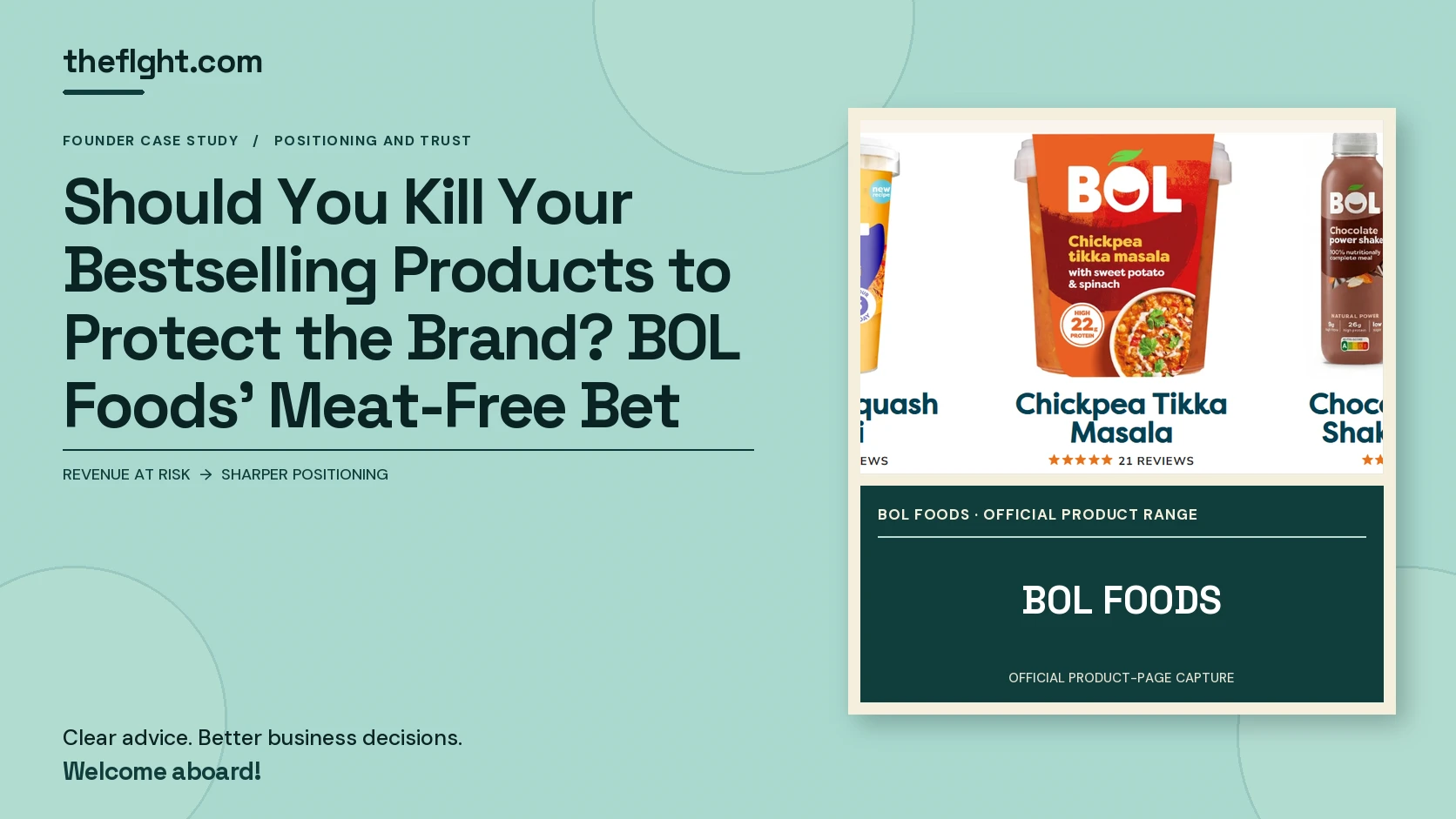
Should You Kill Your Bestselling Products to Protect the Brand? BOL Foods' Meat-Free Bet
Short answer: Discontinue a bestseller only when keeping it blocks a more valuable and defensible business, not because it feels inconsistent with a new slogan. Calculate the product's 12-month contribution, identify which customers and stockists it brings, test credible replacements, and, as a working guide, keep enough cash to survive a downside case in which only half the lost contribution returns within a year. If you cannot name the strategic conflict or fund the transition, improve the range before you remove it.
A bestseller is evidence of demand. It is not automatically evidence that the product belongs in the business you intend to build.
The dangerous mistake is to treat discontinuation as a branding exercise. Removing revenue does not sharpen positioning by itself. It creates a hole in cash, shelf space and customer habit, and your replacement range has to fill that hole.
Use the Revenue-at-Risk Positioning Test
The Revenue-at-Risk Positioning Test forces one decision through five checks: conflict, contribution, customer transfer, replacement capacity and survival cash. A product should leave only when the strategic gain passes all five.
| Check | Question | Evidence required | Stop signal | |---|---|---|---| | Conflict | What valuable promise does the product prevent you making? | Buyer feedback, range logic or operating evidence | Only the founder dislikes it | | Contribution | What cash does it actually leave? | Revenue less variable product and channel costs | Revenue is mistaken for profit | | Transfer | Will its buyers purchase an alternative? | Paid trial, substitution or basket data | Interest without purchasing | | Capacity | Can replacements be produced and distributed? | Costed supply plan and retailer agreement | No reliable supply or shelf route | | Survival | Can the business withstand a slow recovery? | Monthly downside cash forecast | Payroll or tax cash is exposed |
My view is deliberately strict: do not keep a bestseller merely because it sells, but do not kill it merely because a cleaner brand story would look good in a presentation. Remove it when the product makes your intended position less believable and a financed replacement path already exists.
What BOL Foods actually put at risk
Paul Brown launched BOL Foods with a range that included meat and fish. As he became more involved in production, he concluded that the range conflicted with the environmental direction he wanted the company to take. BOL's own five-year account says the business removed every meat and fish recipe in 2017 and halved in size overnight through the immediate sales decline.
Brown has described the decision as purpose-led in a founder interview about the change. The Independent later reported that BOL had generated £6.2 million of retail sales in 2016 and that roughly half came from products it subsequently dropped. These are retrospective public accounts, not a product-level management ledger, so they should not be treated as audited margin data.
The useful part is the choice. Brown did not remove an experimental side line. He knowingly exposed a material share of sales to make the product range support one position. That created a test which vague purpose statements avoid: would customers and retailers accept plant-based replacements strongly enough to rebuild the business?
Prove that the bestseller creates a real conflict
Write the position you want the business to own in one sentence, then identify the action the bestseller makes impossible. “It no longer feels like us” is not enough.
A meat product creates a direct conflict if the company wants every item to be plant-based. A low-price service creates a conflict if it consumes the same scarce specialists required for a guaranteed premium response. An entry product does not create a conflict merely because it has a lower margin or attracts beginners.
Look for conflict in four places:
| Area | Useful evidence | |---|---| | Customer belief | Buyers misunderstand what the company stands for or cannot predict what belongs in the range | | Operations | The product requires a different supplier, process, skill or compliance system | | Channel | Retailers place the product in a category that blocks the intended range | | Capital | Stock, equipment or marketing for the old product prevents investment in the next offer |
If none is material, retain the product and communicate the range more clearly. Positioning should organise profitable demand, not punish it.
Calculate contribution at risk, not sales at risk
Begin with the last 12 months by product and channel. Deduct ingredients or materials, packaging, production labour, freight, retailer deductions, sales commission, refunds and any marketing spend attributable to that product. The result is product contribution before shared overhead.
Next, measure basket effects. A bestseller may pull a second product into the order, help a retailer justify shelf space or create the first purchase that later becomes a subscription. Removing it can therefore destroy contribution outside its own line.
Build three figures:
- Direct contribution from the product.
- Contribution from other purchases reasonably attributable to it.
- Avoidable fixed costs that genuinely disappear after removal.
Do not count rent, salaried management or systems as savings unless they will actually be removed. A discontinued line can reduce revenue tomorrow while leaving most overhead unchanged for a year.
Test transfer before announcing the decision
You need evidence that customers will move, not a survey saying they support the principle. Introduce one or two replacement products while the bestseller remains available. Offer both at normal prices to a defined customer or store cohort and measure paid substitution.
Track the share of bestseller buyers who try the replacement, repurchase it and preserve their total basket contribution. Ask non-buyers what they bought instead. A customer who approves of your decision but moves to a competitor is not retained demand.
Retailers need their own test. A replacement that works on your website may turn slowly on a supermarket shelf. Agree a limited store or time trial, record weekly sell-through and define the minimum reorder rate before expanding. The article on [how to test a business idea before spending money](/business-ideas/test-your-idea-before-spending/) explains why payment and repeat behaviour outrank stated enthusiasm.
Worked example: Harbour Bowl Foods
Harbour Bowl Foods sells chilled lunch pots through independent shops. Its chicken grain bowl is the top seller, but the company wants a fully plant-based range because separate meat handling adds production complexity and weakens its proposition to specialist retailers.
Over 12 months, the chicken bowl produces:
| Item | Calculation | Amount | |---|---:|---:| | Wholesale revenue | 48,000 pots x £3.20 | £153,600 | | Ingredients and packaging | 48,000 x £1.38 | (£66,240) | | Production and delivery | 48,000 x £0.62 | (£29,760) | | Promotions and retailer deductions | 8% x £153,600 | (£12,288) | | Direct contribution | £153,600 - £108,288 | £45,312 |
Basket analysis suggests the bowl supports £7,800 of annual contribution from side dishes bought in the same orders. Removing it would eliminate £9,600 of meat-specific certification, cleaning and chilled-storage cost. Net annual contribution at risk is therefore:
£45,312 + £7,800 - £9,600 = £43,512
A 12-shop trial of a mushroom bowl shows that 58% of former chicken buyers switch. Their average contribution is 8% higher, but the cautious forecast assumes only 50% transfer and no benefit from the higher margin. Harbour Bowl expects to recover £43,512 x 50% = £21,756 in year one, leaving a £21,756 contribution gap.
The company also needs £14,000 for recipe work, packaging plates and the first production run. Its funded transition requirement is £21,756 + £14,000 = £35,756, before tax and any wider contingency. With only £18,000 available, it should not remove the chicken bowl across every channel. It can phase the change by retailer, build cash and rerun the transfer test.
The surprising result is that the bestseller's £153,600 revenue is not the amount at risk. The relevant amount is £43,512 of contribution plus £14,000 of transition cash.
These figures are illustrative. Use your own product, channel and tax data.
Make the decision over the next 30 days
During week one, calculate product and basket contribution for the last 12 months. In week two, write the exact strategic conflict and cost every saving that would really follow removal. Reject any saving that lacks an owner and a date.
In week three, run a paid replacement test with a bounded group of customers or stores. Measure trial, repurchase, basket contribution and operational failure. In week four, build base and downside cash cases, then choose immediate removal, phased withdrawal or retention. Do not announce the decision until supply, retailer communication and customer remedies have named owners.
Related guides
Frequently asked questions
Should I discontinue a bestseller if its margin is low?
Not automatically. A low-margin bestseller may introduce profitable customers, increase basket size or keep production capacity used. Calculate its direct contribution and the contribution it causes elsewhere before removing it. Then test whether a price increase, pack change, minimum order or supplier change can repair the margin without losing the strategic role. Discontinue it when the complete customer and cash effect is unattractive, not when its gross-margin percentage merely looks weaker than another product. The exception is a line that creates safety, compliance or trust risk, where financial optimisation should not delay necessary action.
How much cash should I hold before removing a major product?
Hold enough to fund the transition cost and survive a downside recovery period without using payroll, tax or committed supplier money. As a working guide, model at least 12 months in which only half your expected replacement contribution arrives, then add the one-off development, packaging and stock cost. The right amount depends on order timing, retailer payment terms and fixed overhead. A business paid at the till needs a different buffer from one waiting 60 days for wholesale invoices. Use a monthly forecast and get qualified financial advice where borrowing, solvency or tax is involved.
Should I tell customers the real reason for the change?
Yes, when the reason can be stated accurately and supported by what you are doing. A direct explanation helps customers understand that the removal is intentional rather than a stock failure. Avoid inflated claims about environmental, health or social impact that you cannot evidence. State what is leaving, when it leaves and which alternative performs the same job. Some customers will disagree, and your plan should allow for that loss. If the change concerns allergens, safety, regulated claims or contractual supply, obtain qualified sector and legal advice before publishing the wording.
Can I move the bestseller into a separate brand?
You can, but separation works only when customers, operations and capital are meaningfully distinct. A different logo does not remove shared production complexity, retailer confusion or management time. Cost the second brand's packaging, website, sales work, minimum production quantities and stock separately. Then ask whether an outside buyer or licensee could operate it more effectively. A separate brand is useful when the product serves a valuable but incompatible segment and can support its own acquisition and overhead. It is a hiding place when the same team still makes every compromise.
What if retailers refuse to stock the replacement?
Treat that as commercial evidence, not a communication problem. Ask each buyer which measure fails: expected rate of sale, margin, category fit, shelf life, supply confidence or customer demand. Run a smaller store test where possible and agree the success measure in advance. You may need to keep the existing product in that channel temporarily while proving the replacement elsewhere. Do not manufacture a national quantity on the assumption that a values argument will secure listings. Retailer terms and competition rules vary, so review contracts and obtain qualified advice before changing committed ranges.
How long should a phase-out take?
Use the shortest period that lets you fulfil commitments, transfer customers and avoid unnecessary write-offs. For a simple direct-to-consumer product, one or two replenishment cycles may be enough. A seasonal or wholesale line may require six to twelve months because buyers plan ranges early and suppliers impose production minimums. Set a final order date, last production date and customer cutover date. Avoid an indefinite phase-out in which the old line continues consuming attention. If the replacement misses its agreed contribution gate, pause and diagnose rather than quietly extending both ranges forever.
What if sales fall more than expected after the change?
Follow the stop rule you set before launch. Separate failure to transfer existing buyers from failure to acquire new ones, then check price, availability, product performance and channel placement in that order. A temporary fall is survivable only inside the cash limit you approved. Do not defend the decision indefinitely because it expressed your values. You can revise the replacement, slow the rollout or restore a compatible product without recreating the original conflict. If cash threatens solvency, speak promptly with your accountant or an appropriately qualified restructuring professional.
Comments (0)