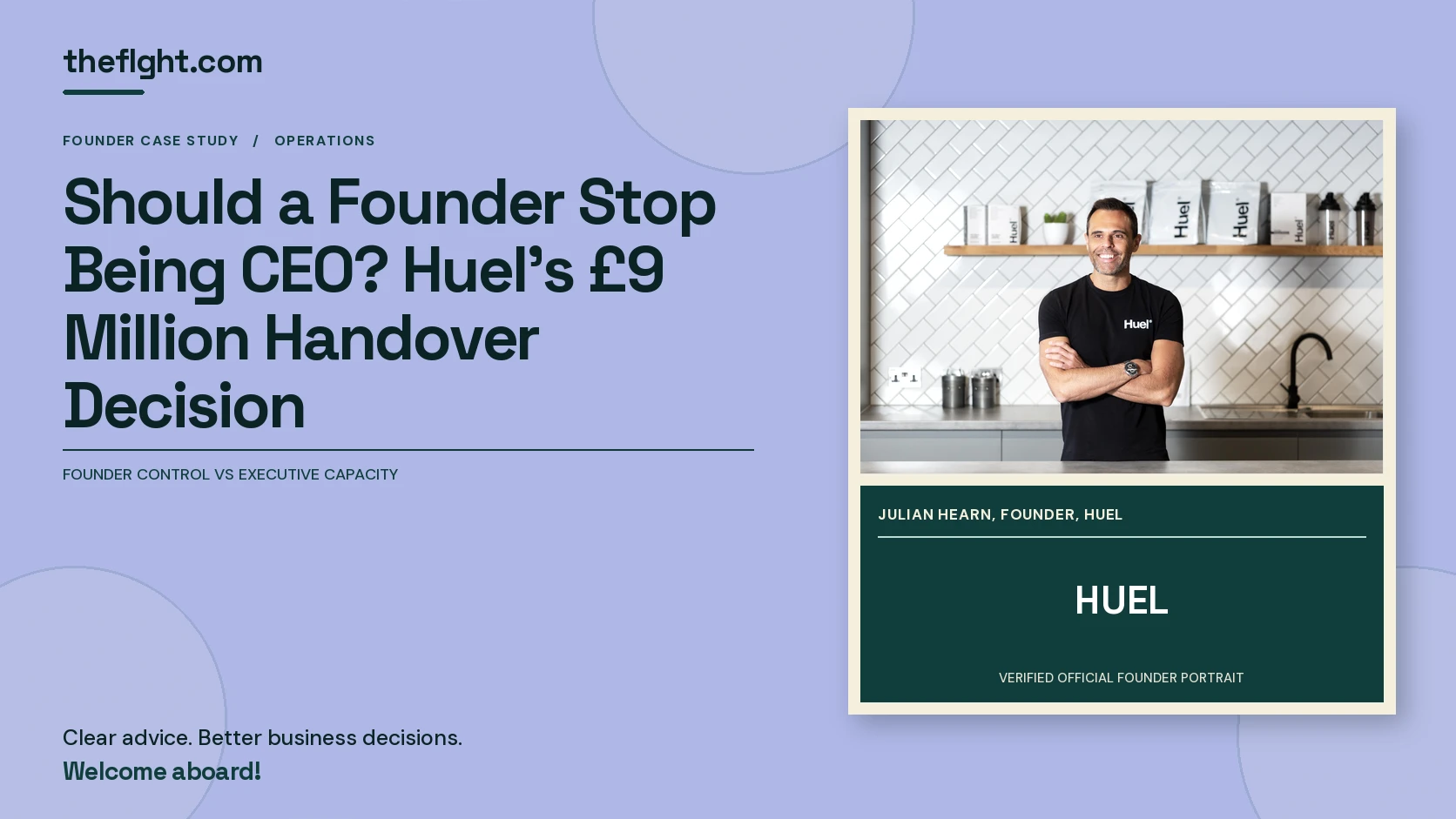
Should a Founder Stop Being CEO? Huel's £9 Million Handover Decision
Short answer: Consider hiring a chief executive when the business repeatedly needs operating decisions you are poorly placed or unwilling to make, and those gaps are costing more than the hire. Do not hand over because you feel busy. First define who will own strategy, people, cash and execution, then test the arrangement for 90 days with no shared veto over routine decisions. Keep the title if responsibilities can be fixed with a narrower hire. Give it up if the company needs a different full-time job from the one you can perform.
Founders often treat the CEO title as a prize for starting the company. It is a job specification. The work changes as a business adds employees, jurisdictions, stock, regulation and management layers, even if the founder does not change with it.
My view is that a founder should hand over earlier than pride normally permits when the mismatch is clear. Waiting until the organisation is damaged makes the eventual hire harder, more political and more expensive.
Use the Founder-Role Transfer Grid
The Founder-Role Transfer Grid separates four jobs that small companies frequently bundle into one person. Score each by the company's next 18-month need, your demonstrated ability and your desire to do the work. Evidence must come from results and diary records, not personality labels.
| Responsibility | Evidence the company needs more | Evidence you should keep it | Evidence it should transfer | |---|---|---|---| | Direction | Conflicting priorities and repeated reversals | Your choices produce focused investment | You avoid trade-offs or change them weekly | | Demand | Weak positioning, acquisition or product pull | You create repeatable demand efficiently | Customer work receives little of your time | | Operations | Missed deliveries, stock failures or unmanaged expansion | Systems improve under your ownership | Complexity grows faster than control | | Organisation | Poor hiring, unclear accountability or unresolved conflict | Managers make better decisions around you | Every decision returns to you |
The grid can point to four outcomes: remain CEO, hire a functional leader, appoint a chief operating officer, or transfer the CEO role. The last option is appropriate only when several company-wide responsibilities need another owner. Do not use an expensive CEO to solve one weak function.
What Huel's handover demonstrates
Julian Hearn founded Huel with nutritionist James Collier and initially led the company. In a founder account of the later handover, Hearn says revenue grew from zero to £9 million in two years. He also says HR, legal and finance meetings were crowding out the brand and marketing work where he believed he added more value.
Hearn did not recruit a generic corporate executive. He made a list of 40 brands he respected and approached James McMaster, whose previous work included operating roles at growing food brands. McMaster became chief executive in 2017. Hearn retained founder and marketing responsibilities, describing the boundary simply: McMaster ran the business and Hearn ran the brand. Contemporary coverage also records that Hearn felt spread too thin and that the two sometimes disagreed, while maintaining separate lanes. The Standard's Huel founder profile provides that useful counterweight to a friction-free succession story.
Later growth does not prove that the CEO change alone caused the result. Product demand, capital, timing and the existing team also mattered. The transferable lesson is narrower: Hearn diagnosed a role mismatch, chose a person with stage-relevant experience and retained a defined job rather than hovering above the new chief executive.
Diagnose the job before searching for a person
Review your previous six working weeks. Put every block of at least 30 minutes into one grid category, then add a fifth category for administration that should disappear or be delegated. Mark which blocks only you could perform and which were done badly, late or reluctantly.
Next, list the five business outcomes that matter during the coming 18 months. They might include opening one country, reducing stock-outs, building a management team, reaching positive operating cash flow or improving repeat purchase. Write the decisions required for each outcome.
If most critical decisions sit in one function, recruit that leader. If they span capital allocation, senior hiring, priorities and cross-functional execution, you may need a chief executive. If you cannot state the coming outcomes, the problem is not yet the candidate. It is strategic ambiguity.
Being tired does not prove a CEO mismatch. Exhaustion may come from understaffing, poor delegation or too many products. Fixing those can be cheaper and less disruptive than replacing the role.
Compare the full cost with the cost of keeping the gap
A senior appointment costs more than salary. Include employer National Insurance, pension, recruitment, equity, travel, onboarding time and the possibility of a failed hire. Also model the founder's new role. Paying two people to make the same decisions is not succession. It is duplicated cost with slower execution.
Estimate the cost of the current gap from observable events: expired stock, missed launches, avoidable agency fees, unfilled roles, excess founder time and delayed decisions. Do not justify the hire with the company's total revenue. A £9 million business can be unable to afford a chief executive, while a £2 million high-margin business may benefit from one.
Worked example: FieldJar Nutrition
FieldJar Nutrition is a fictional breakfast-pot business with £2.4 million annual net revenue. Founder Mara owns marketing and acts as CEO. These illustrative six-month figures separate cash from opportunity value:
| Cost of the gap | Six-month evidence | Amount | |---|---:|---:| | Expedited freight after late stock decisions | Supplier and courier invoices | £38,000 | | Retail launch delayed by eight weeks | 8 weeks × £6,500 forecast contribution | £52,000 | | Mara's operational time | 18 hours a week × 26 weeks × £65 | £30,420 | | Combined exposure | £38,000 + £52,000 + £30,420 | £120,420 |
The board considers a chief executive costing £145,000 in salary, £19,000 in employer pension and payroll costs, and £16,000 in recruitment and onboarding during year one. The first-year cash cost is £180,000.
Only £38,000 is recorded extra cash expense. The £52,000 is forecast contribution and £30,420 values Mara's time, not wages the hire would remove. Even if freight failures recur twice yearly and the CEO prevents 60%, annual cash savings are £38,000 × 2 × 60% = £45,600. Savings alone do not fund the hire.
FieldJar also needs ownership of its second production partner and retail launches. The board's 12-month threshold combines £45,600 cash savings with £164,400 additional launch contribution: £210,000. This is a target, not an established benefit. It excludes Mara's time valuation and requires a separately evidenced launch forecast.
Mara keeps brand, product and customer research. The CEO owns budget, people, operations and execution. FieldJar proceeds only after writing those rights into the role and agreeing how board decisions will work.
The £2.4 million revenue figure says little about affordability. Approval requires cash to fund the £180,000 appointment while its £210,000 benefit target remains unproven.
These figures are illustrative. Employment costs, equity, tax and director duties vary. Obtain qualified local legal, tax and employment advice before appointing or removing a director or chief executive.
Set decision rights before the start date
Write a one-page authority map. The new CEO should know what they decide alone, what the founder decides alone, what requires board approval and what needs consultation. Cover annual budget, hiring, dismissals, pricing, brand, product roadmap, fundraising and public statements.
Avoid “joint ownership” wherever possible. Consultation can be joint. One person must decide. If the founder can reverse routine choices informally, capable candidates will either leave or stop deciding.
Use the first 90 days to test operating behaviour, not demand instant transformation. Agree baseline measures before the start date. Review decision speed, forecast accuracy, management accountability and the specific outcomes behind the hire at days 30, 60 and 90. Keep strategic changes within the authority map.
Practitioners disagree on whether an incoming CEO should spend months observing or act quickly. My view is that observation should be short where cash, safety or service is at risk, but structural changes should follow evidence. A 30-day diagnostic with named urgent exceptions is a sensible working arrangement.
What to do in the next 14 days
During the next two days, audit six weeks of your diary and complete the transfer grid. By day five, define the five outcomes the business needs over 18 months and identify which role should own them. Calculate the full first-year employment cost and the documented cost of leaving the gap.
By day 10, write the authority map and your own job after the appointment. Test both documents with your board, adviser or senior team. By day 14, decide whether you need a functional leader, an operator or a CEO. Do not begin candidate conversations until you can explain what they will own and what you will stop owning.
Related guides
Frequently asked questions
Does hiring a CEO mean I have failed as a founder?
No. Founding and leading a scaled organisation require overlapping but different abilities. The failure would be protecting a title while known gaps damage customers, staff or cash. A handover is still a poor decision if it avoids a problem you could solve through delegation or development. Judge it against the role the company now needs, not an idealised founder identity. You also need a meaningful job afterwards. If you cannot define your continued contribution and boundaries, the appointment may create conflict rather than capacity.
Should I hire a chief operating officer before a CEO?
Hire a chief operating officer when direction, capital allocation and senior accountability should remain with you, but execution across functions needs a stronger owner. Hire a CEO when those company-wide decisions also need to transfer. Titles differ between businesses, so compare actual authority rather than labels. A COO who is expected to run everything while the founder retains every veto has an impossible role. Conversely, calling a functional operations hire “CEO” can create unnecessary cost and confusion. Write the outcomes and decision rights first, then choose the title.
How much revenue should a business have before hiring a CEO?
There is no reliable revenue threshold. Affordability depends on gross margin, cash, operating complexity and the value of the problem being solved. Hearn reports a £9 million handover point at Huel, but that is evidence about Huel, not a benchmark for you. Calculate the first-year cash cost, add a contingency for failure, and compare it with measurable avoided loss and added contribution. Preserve enough runway to replace the hire or reverse the structure. A high-revenue, low-margin company may have less room than a smaller, cash-generative one.
Can the founder and incoming executive be co-CEOs?
They can, but most early businesses should avoid it. Co-CEO structures work only when authority divides cleanly, disagreements have a rapid resolution route and staff know whose decision governs each area. Otherwise every difficult choice rises to two people and political lobbying replaces accountability. A temporary transition period may justify the arrangement, with an explicit end date. If you use it permanently, publish a decision map covering people, budget, product, customers and investors. Shared status does not require shared control of every decision.
What should I ask a CEO candidate from a larger company?
Ask for examples from the stage immediately ahead of yours, not from the mature organisation they eventually joined. Explore what they built without established teams, how they handled poor data, which decisions they personally made and what went wrong. Give them a real operating case using your current constraints. Someone who managed a £200 million division may not know how to create a weekly cash forecast or recruit the first functional heads. Check references from direct reports and peers as well as former bosses, with the candidate's permission.
How much control should I keep after stepping aside?
Keep the rights attached to your formal role, shareholding and board position, but do not retain an informal veto over work assigned to the CEO. Founders often continue to own brand, product or long-term vision. That can work when scope is explicit and the CEO controls company execution. Reserved shareholder and board matters vary by company documents and jurisdiction. Review them with qualified local legal advisers before the appointment. Operationally, agree which decisions require approval, consultation or notification and follow the agreement when you dislike an individual choice.
What if the new CEO does not work out?
Protect the company before the hire. Set probation or review arrangements where lawful, document performance outcomes, preserve access to systems and maintain board visibility over cash. Plan who can hold authority during a replacement search. Do not undermine the executive in anticipation of failure, because that can cause the failure you fear. Employment, director-removal and equity rules vary by jurisdiction and contract, so obtain qualified advice before agreeing terms. If the appointment ends, review whether selection, scope, authority or performance caused the problem before repeating it.
Comments (0)