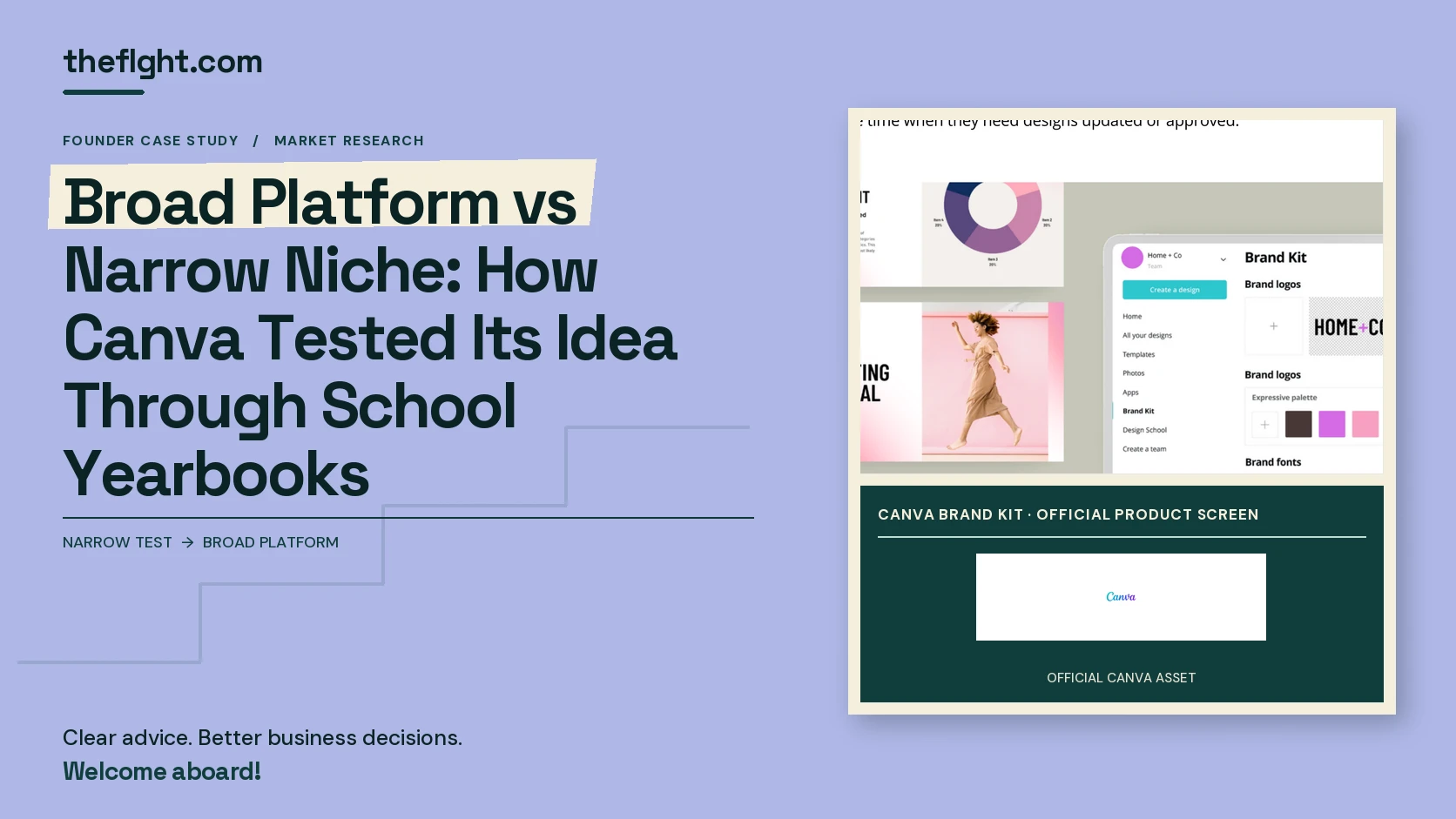
Broad Platform vs Narrow Niche: How Canva Tested Its Idea Through School Yearbooks
Short answer: Test a broad platform through one narrow market when that market has an urgent, repeated job and forces you to exercise the product's core capabilities. Stay in the niche until at least five customers complete the full job, pay enough to cover its direct delivery cost and reveal a repeatable buying route. Expand only when the evidence transfers beyond the niche without requiring a different product.
A narrow launch is not merely a smaller version of a broad launch. It is a controlled environment in which you can observe one customer, one deadline and one complete workflow.
The danger is choosing a niche because it is easy to reach, even though its needs teach you nothing about the larger market. A good first market compresses learning. A bad one traps you in custom work.
What Canva learned through Fusion Books
Melanie Perkins' ambition was broader than yearbooks: make design software easier for non-designers. She and Cliff Obrecht first pursued that idea through Fusion Books, a collaborative online system for school yearbooks. In a founder account published by Canva, Perkins says the first web customer arrived in March 2008 and paid a $100 deposit for an order of roughly 200 to 250 yearbooks.
The sales evidence was not uniformly encouraging. An education expo failed to produce the expected result. Calling schools and sending a physical sample worked better. That contrast mattered because it identified both the user problem and a viable route to the buyer.
Development consumed nearly all available capital. Perkins says an A$20,000 bank loan and Australia's research and development tax concession helped the company continue. Those facts do not prove that every platform should begin in a niche. They show why a bounded market can produce operational evidence before a founder attempts a much larger proposition.
My view is that a founder should not launch a general platform first unless customers already understand the category and can reach value without extensive help. Breadth multiplies messages, workflows and support problems at exactly the point when evidence is weakest.
Use the Niche-to-Platform Expansion Gate
The Niche-to-Platform Expansion Gate asks whether the first market is producing transferable evidence. You pass five gates in order. Failure at an early gate means you should not use later interest as an excuse to broaden.
| Gate | Evidence to collect | Pass condition | Warning | |---|---|---|---| | 1. Urgent job | Trigger, deadline and consequence | Buyers act within one buying cycle | Interest has no deadline | | 2. Complete workflow | Steps from input to finished result | Five customers finish the core job | Founder completes hidden manual work | | 3. Paying economics | Price, direct cost and support time | Positive contribution before founder salary | Deposits fund loss-making delivery | | 4. Repeatable route | Contacts, replies, demonstrations and sales | One channel produces three sales | Every sale comes from a personal favour | | 5. Transferable core | Features used across adjacent segments | At least 70% of the core workflow transfers | Expansion needs a new product |
The thresholds are working guides, not universal standards. A high-value industrial sale may need fewer observations and a longer cycle. A low-cost consumer service may require dozens. The principle is to choose the threshold before enthusiasm changes your judgement.
Gate 1: find a deadline, not a demographic
“Schools” is a demographic description. “Yearbook committees that must collect, lay out and approve hundreds of pages before a fixed print date” is a job with pressure.
Interview people immediately before, during and after that job. Ask what starts the process, which step creates delay, who approves spending and what happens when the deadline slips. Do not ask whether they like your broad vision. Ask them to show the last attempt and its consequences.
The most useful niche often has an awkward existing process, a visible output and a buyer who can authorise a trial. That combination makes behaviour observable. The guide on [finding problems people pay to solve](/business-ideas/problems-people-pay-to-solve/) explains why frustration alone is weaker evidence than an existing spend or costly workaround.
Gates 2 and 3: complete the job and expose the economics
Early users will tolerate rough edges, but their tolerance can disguise an incomplete product. Record every intervention required to get from sign-up to finished result. Separate product use from founder rescue work.
Then calculate contribution for each customer:
Revenue minus fulfilment, support, payment, production and acquisition costs = contribution.
A deposit demonstrates willingness to pay. It does not demonstrate viable delivery. If a £400 deposit leads to £1,100 of design support and rework, the experiment has proved demand for a service, not economics for a platform.
Use the same definition of direct cost for every customer. Include the founder's delivery hours at a realistic replacement rate, even if no salary is being drawn. Otherwise the niche appears healthier precisely because you are subsidising it.
Gate 4: prove one route can repeat
Fusion Books' expo result and its calling-plus-sample result are more useful together than either is alone. The failed channel narrowed the sales problem. The working route gave the founders something they could repeat.
Track a simple channel chain: qualified contacts, conversations, trials, deposits and completed purchases. Ten friendly introductions cannot tell you whether cold outreach works. One viral post cannot tell you whether next month's pipeline exists.
For a young business, three sales through the same defined route are enough to justify another measured cycle. They are not enough to forecast a national market. Keep the claim proportional to the evidence.
Gate 5: separate the transferable core from niche baggage
List every capability the niche required. Mark each as core, niche-specific or manual. For yearbooks, collaborative editing and simple layout may transfer broadly. School calendars, class permissions and print coordination may not.
Only expand when the core creates the value. If buyers mainly pay for the niche-specific layer, moving outward removes the reason they chose you. Before building for an adjacent market, run five interviews and a paid pilot using the current product. The method in [testing an idea before spending](/business-ideas/test-your-idea-before-spending/) helps keep that test behavioural.
Worked example: Schoolbook Studio
Schoolbook Studio wants eventually to sell collaborative design software to clubs, charities and small companies. It first serves independent schools producing annual magazines. These figures are illustrative.
Over eight weeks it contacts 60 qualified schools. Eighteen accept a call, eight request a sample and five pay £2,400 each for a project. Revenue is 5 x £2,400 = £12,000.
| Direct cost | Calculation | Amount | |---|---:|---:| | Printing and delivery | 5 x £920 | £4,600 | | Customer support | 90 hours x £24 | £2,160 | | Sales and samples | 60 x £12 | £720 | | Payment and software costs | 5 x £88 | £440 | | Total direct cost | | £7,920 |
Contribution is £12,000 minus £7,920 = £4,080, or £816 per school. All five schools complete the workflow, so the niche passes both the completion and paying-economics gates, but support consumes 18 hours per customer.
The team reviews 42 product actions. Thirty-one transfer to a charity publication workflow, so transferability is 31 divided by 42 = 74%. It runs two paid charity pilots without adding features. Both finish, but each needs only eight support hours. That evidence supports a controlled adjacent-market test.
Notice what Schoolbook Studio has not proved. Five schools and two charities do not validate a universal design platform. They justify the next bounded experiment.
Run the decision in 30 days
During days 1 to 5, define one pressured job, one buyer and the five pass conditions. In days 6 to 12, interview ten people using evidence from their last attempt. By day 15, make a paid offer with a completion date.
Use days 16 to 25 to deliver no more than five pilots. Log every manual intervention, support minute and direct cost. On day 26, classify features as core, niche-specific or manual. During the final four days, choose one action: repeat the niche, repair its economics or test one adjacent segment. Do not announce a broad platform because the first niche sounded interested.
Related guides
Frequently asked questions
Does starting in a niche make the eventual market look too small?
No, provided you chose the niche to test a transferable job rather than to define your permanent ceiling. Estimate the broad market separately, but make the first operating decision from observed behaviour. A niche of 300 buyers can still be a useful laboratory if its workflow closely resembles thousands of adjacent buyers. The caveat is product architecture: if every early feature encodes one sector's terminology or regulations, expansion becomes expensive. Review the transferable core after every five completed customers and stop adding niche-only features unless they improve contribution enough to justify staying specialised.
How narrow should the first customer segment be?
Narrow enough that you can name the buyer, trigger and current workaround in one sentence. “Small organisations” is too broad. “UK charity communications managers producing a quarterly donor report without an in-house designer” is testable. You should be able to assemble a list of 30 plausible buyers and expect them to recognise the same problem. If the list is smaller, the niche may not support repeated learning. If interviews reveal different triggers, budgets and approval routes, split the segment before you build or price anything.
Should the niche version have a different brand?
Usually not at the start. A separate brand adds naming, trust and migration work before you know whether the niche will endure. Use a clear product description and keep the underlying identity flexible. A separate brand can make sense where the niche carries regulatory, reputational or channel constraints that would confuse later customers. Check trade marks, domains and consumer-facing claims in the jurisdictions where you operate. Brand and company-name requirements vary, so obtain qualified local advice where protection or regulated wording matters.
What if customers want services around the product?
Sell limited services when they help customers complete the core job and reveal what the product must do. Price and record them separately. If setup, data preparation or training consumes six hours, show that cost rather than hiding it inside a software fee. Services become dangerous when every buyer receives a different solution and the team mistakes project revenue for product validation. Set a maximum service allowance per pilot, then see whether the next customer can succeed with less. Repeated service tasks are candidates for documentation, product changes or an explicit premium service model.
When should I test a second niche?
Test one adjacent niche after the first passes the complete-workflow, paying-economics and repeatable-route gates. You do not need perfect retention data, but you do need evidence that the current offer creates a finished result without unsustainable founder intervention. Choose an adjacency that shares the same core job but changes one dimension, such as buyer type or output. Changing customer, problem and channel at once produces an unreadable test. Run two to five paid pilots and compare activation, support hours, contribution and feature requests against the first niche.
Can a failed niche test disprove the broad idea?
Sometimes, but not automatically. A failure can come from the job, the segment, the offer, the channel or execution. Diagnose which link broke. If buyers acknowledge the problem but will not pay, inspect urgency and budget. If they pay but cannot finish, inspect the workflow. If the core features are unused, the broad product thesis is in trouble. One poorly chosen niche should not kill a platform, but three well-chosen niches rejecting the same core value are strong evidence to stop or materially change the idea.
Comments (0)