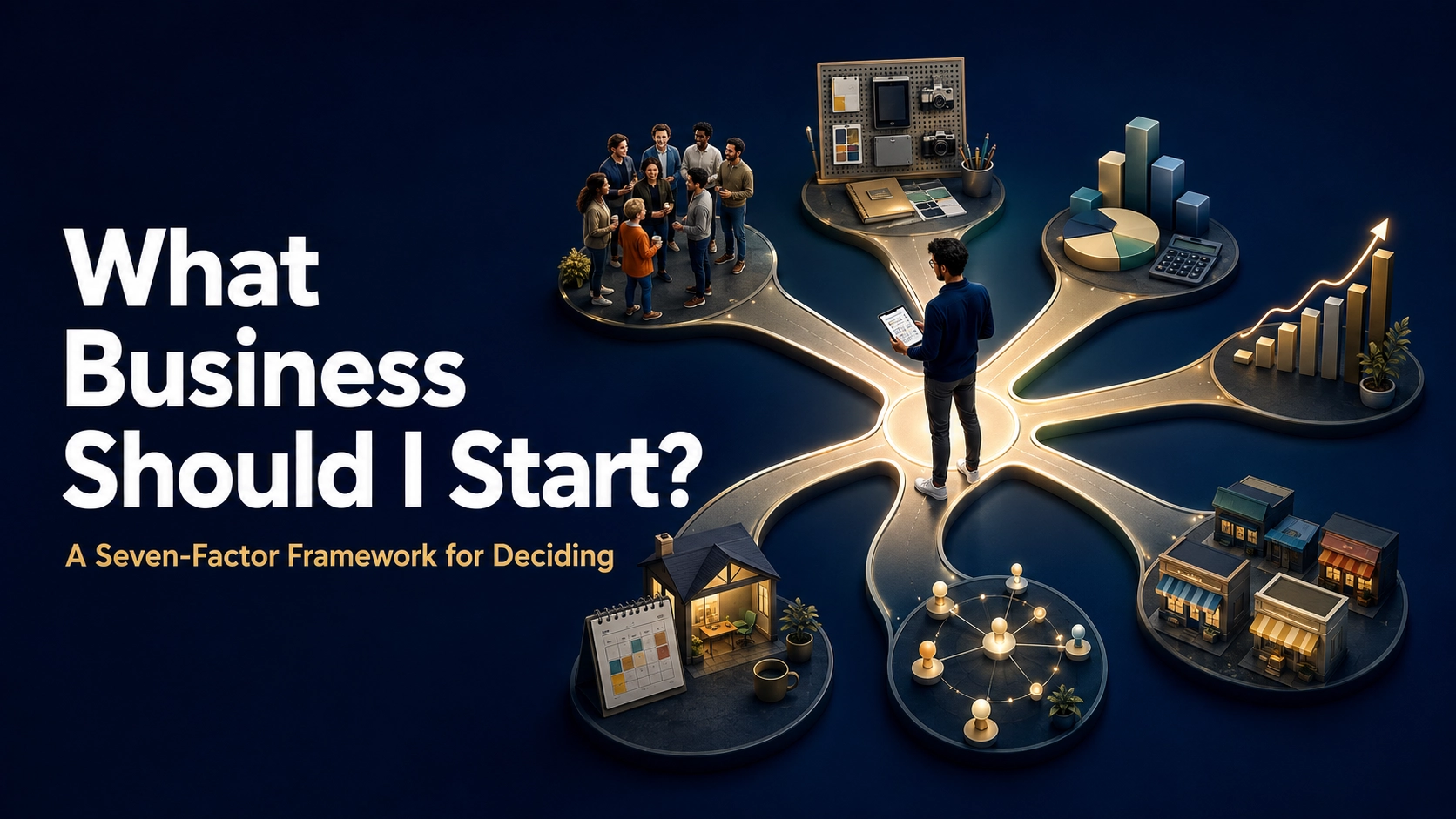
What Business Should I Start? A Seven-Factor Framework for Deciding
Short answer: start the business that scores highest across seven factors — demand evidence, willingness to pay, access to customers, unit economics, defensibility, capital fit and your own endurance. Not the one you find most exciting. Of everything on that list, excitement is the weakest predictor of survival, and access to customers is the most consistently underrated.
Most answers to this question hand you a list of ideas. Lists are close to useless, because the same idea is a goldmine for one person and a slow bankruptcy for another. A mobile car valeting business run by someone with four hundred contacts across a corporate office park is a completely different business from the identical one run by a stranger who moved to town last month. Same idea. Wildly different odds. So this guide gives you a scoring system instead of a list.
Why “what should I start?” is usually the wrong opening question
The question quietly assumes the answer lives out in the world — that somewhere there is a correct business, and your job is to locate it.
It doesn’t work like that. The answer lives at an intersection: things people already pay for, that you can reach, at a price that leaves margin, funded with money you actually have, doing work you’ll still be doing in three years when the novelty has worn off.
A more useful version of the question is this: which of my candidate ideas survives contact with evidence?
That reframing has a practical consequence. You need candidates. If you have fewer than three, you aren’t choosing between options — you’re building a case for the one you’d already decided on. Generate three to six before you score anything.
Where good candidates come from
Four productive sources, roughly in order of quality:
- Problems you have already been paid to solve. Employment is market research somebody else funded. What did colleagues, clients or customers keep coming to you to fix?
- Problems adjacent to money that is already moving. Follow existing spend. If local restaurants pay for deep cleaning, someone nearby is also paying for extraction ducting, pest checks and grease disposal.
- Friction you personally put up with. This only counts if you can find twenty other people who put up with it too, and at least one who has paid to make it go away.
- Unglamorous sectors with ageing owners. Plant hire, industrial cleaning, bookkeeping, specialist repair. Real demand, thinning supply, very little competition for attention.
Three sources to treat with suspicion: trend articles, “top ten businesses for 2026” round-ups, and anything you first heard about through an advert. If an advert introduced you to the opportunity, you are the market, not the operator.
The seven factors that predict survival
Score each candidate from 0 to 10 on the factors below, multiply by the weight, and total to 100. The weights are not decoration. They reflect what kills small businesses first, in roughly the order it usually kills them.
| # | Factor | Weight | The question it answers |
| 1 | Demand evidence | 20 | Are people already spending money on this problem? |
| 2 | Willingness to pay | 15 | Will they pay your price, not just any price? |
| 3 | Access to customers | 15 | Can you reach buyers repeatedly without paying a fortune? |
| 4 | Unit economics | 15 | Does one sale leave money behind after everything it costs? |
| 5 | Defensibility | 15 | What stops the next person doing this to you? |
| 6 | Capital fit | 10 | Can you fund it and survive until it turns a profit? |
| 7 | Personal endurance | 10 | Will you still do this on a bad Tuesday in year three? |
1. Demand evidence — weight 20
The only demand that counts is demand somebody has already paid for. Interest is not demand. Compliments are not demand. “I’d definitely use that” is not demand.
- 0–3: You believe there’s a need. Nobody has spent money on it in front of you.
- 4–6: Competitors exist and appear to be trading. Search and marketplace activity is visible.
- 7–8: You have found specific people describing this problem in their own words and naming what they currently pay to deal with it.
- 9–10: Someone has offered you money, or paid a deposit, before you built anything.
There is a full method for gathering this evidence in How to Know If There Is Demand for Your Business Idea.
2. Willingness to pay — weight 15
This is scored separately from demand because the gap between the two is where a lot of businesses die. People sincerely want cheaper childcare, better mental health support and faster planning permission. None of that means they will pay a brand-new provider a price that sustains a business.
Score high when the buyer already has a budget line for this, when the cost of not solving it can be put in numbers, and when the person deciding is also the person paying.
Score low when the buyer is an individual, paying out of post-tax discretionary income, for something they could plausibly do themselves on a Saturday.
3. Access to customers — weight 15
The single most underweighted factor in this entire exercise. There’s a fast test for it. Ask yourself: if I opened tomorrow, who are the first fifteen people I would contact? If you can name them, score 7 or above. If your honest answer begins “I’d run some ads,” score 3.
Cheap access looks like an existing audience, a trade you’re already inside, a referral partner who meets the same customer slightly earlier in their journey, a physical location with the right kind of footfall, or a community you have genuinely contributed to for years.
Expensive access looks like cold paid acquisition in a category where large, well-funded incumbents are already bidding on every keyword.
4. Unit economics — weight 15
You need a rough answer to three questions: what does one sale bring in, what does it cost to deliver, and what does it cost to win? If contribution margin after delivery sits below 30%, every other factor has to be exceptional to compensate.
There is a fuller treatment in Can This Business Actually Make Money? — but for scoring purposes, if you can’t produce those three numbers even approximately, score the idea 4 or below. Not knowing is itself a finding.
5. Defensibility — weight 15
Ask what month eighteen looks like when three competent people have copied you. For a small business, defensibility is almost never patents. In practice it tends to be:
- Relationships that took years to build
- Physical execution in one specific place
- Accumulated reputation and review volume
- A process or dataset you generated yourself
- Regulatory or licensing barriers you have already cleared
- Switching costs baked into the way the customer works
Score low if the whole proposition is “I will do the obvious thing competently.” Competence is the entry fee, not the moat. Why Would Customers Choose You Over Everyone Else? works through how to build a difference that lasts.
6. Capital fit — weight 10
Not “what does it cost” but “can you fund it and eat while it matures.” A business that needs £40,000 when you have £12,000 scores a 2, however good the idea is. That’s not a bad idea. It’s a bad idea for now, which is a different and more hopeful diagnosis. How Much Money Do You Actually Need to Start? breaks down what the true figure includes.
7. Personal endurance — weight 10
The honest version of this question: could you do the least glamorous 20% of the job, every week, for three years? For a cleaning business that’s chasing invoices. For a consultancy it’s selling when you’d rather be delivering. For e-commerce it’s returns and customer service.
It’s deliberately weighted at only 10. Passion matters, but it belongs in the tiebreaker column, not the qualifying round. Plenty of people have failed at things they loved.
The scoring sheet in practice
Here’s a worked comparison of three ideas from one person: a project manager with £15,000 saved and a strong network across construction.
| Factor | Wt | A. Sitephotography drone service | B. Artisan candle e- commerce | C. Bookkeeping for small builders |
Demand evidence | 20 | 6 | 5 | 8 |
| Willingness to pay | 15 | 6 | 3 | 8 |
| Access to customers | 15 | 8 | 2 | 9 |
| Unit economics | 15 | 7 | 4 | 7 |
| Defensibility | 15 | 4 | 2 | 6 |
| Capital fit | 10 | 5 | 7 | 9 |
| Personal endurance | 10 | 8 | 6 | 5 |
| Weighted total | 100 | 62.5 | 38.0 | 75.5 |
The candle business was the one they were most excited about. It scores 38 — no access, no willingness to pay at a defensible price, no moat of any kind. The bookkeeping business was the one they described as dull. It wins by a wide margin on the strength of a single factor: they already know the customers, and those customers already pay somebody for this.
This is the most common result of the exercise. The idea you’re excited about is usually weak on access and willingness to pay. The idea you dismissed as boring is usually strong on both.
Reading your score
75 and above. Strong candidate. Move to demand validation and a paid test.
60 to 74. Viable, with one specific weak spot. Find the lowest-scoring factor and design a test that attacks only that factor. 45 to 59. Needs reshaping rather than launching. Usually the idea is sound and the customer is wrong.
Below 45. Don’t fund this. Go back to candidate generation.
One rule about totals: never read the score without reading the rows underneath it. An idea averaging sevens across the board is far safer than one carrying three tens and a two. The two is what ends it.
Four related questions this framework quietly answers
“What business fits my skills and experience?” Skills show up in factors 3, 5 and 7.
If your experience doesn’t translate into customer access, defensibility or endurance, it isn’t commercially relevant experience — however impressive it looks on a CV.
“What can I start with no special qualifications?” Look for high scores on factors 1 and 3, and accept a modest score on 5. Service businesses in unregulated categories qualify. You’ll be competing on trust and responsiveness rather than credentials, which means factor 3 has to be exceptional rather than adequate.
“Can I start part-time?” Part-time viability is a function of delivery timing, not effort. Businesses that work part-time have flexible delivery windows — consulting, weekend services, made-to-order — or asynchronous delivery, like digital products. Businesses that don’t work part-time need you available synchronously during business hours. Score factor 7 against the hours you actually have, not the optimistic version.
“Will I still want this in five years?” Turn it around: will the market still want it in five years, and will you still be able to charge for it? Personal enthusiasm reliably fades and gets replaced by professional identity, which is fine. The bigger risk is that the work itself becomes commoditised. That’s covered in Will AI Destroy — or Grow — This Business?.
What to do in the next seven days
- Write down four to six candidate ideas, drawn from the four sources above.
- Score each one across the seven factors. Force yourself to justify every score above 7 with a specific piece of evidence you could show someone.
- Take the top two and, for each, write out the fifteen names you would contact in week one. If you can’t fill fifteen lines, your access score was fiction. Rescore it.
- Take whatever survives into demand validation.
The framework’s job is elimination, not prediction. It won’t tell you an idea will succeed — nothing will. It will reliably tell you which ideas to stop spending your evenings on, and for most people that alone saves a year.
Frequently asked questions
What if all my ideas score low?
That’s the framework working, not failing. When every candidate lands in the same low band, it’s usually one shared weakness dragging the whole set down — most often access to customers or willingness to pay. Fix the input rather than the ideas. Go back to candidate generation and deliberately source from problems you have already been paid to solve, since those start strong on access by definition.
What if my top two ideas score almost the same?
Don’t average your way to a decision. Read the rows. Pick the one whose lowest score is cheapest and fastest to test in the next two weeks. A tie on totals is really a question about which weakness you can disprove soonest, and disproving something cheaply is worth more than another fortnight of deliberation.
I have no business experience. Do I just score low on everything?
No. Experience only shows up in three of the seven factors, and life experience counts as much as employment. The question isn’t whether you have a CV for this. It’s whether you can reach these customers and stick with the unglamorous parts. Plenty of people who score above 75 have no formal background in the sector at all.
How honest are my scores, really?
Probably inflated on demand evidence and access — those are the two everyone flatters themselves on. The correction is the fifteen-names test. If you can’t write down fifteen real people you’d contact in your first week, your access score is aspiration rather than evidence, and it needs to come down. It also helps to have somebody who knows the sector score your candidates independently, then compare.
Should I ever start a low-scoring business I’m passionate about?
Only if the low score sits on endurance or capital fit. Never if it sits on demand evidence or willingness to pay. Passion carries you through boring Tuesdays and cash-flow gaps. It cannot make people pay for something they don’t want, and no amount of commitment converts an indifferent market into a paying one.
How many ideas should I score before deciding?
Between four and six. Fewer than three and you aren’t really choosing. More than eight and the exercise turns into procrastination dressed as diligence — at that point you’re generating options to avoid committing to one.
How often should I rescore?
After every piece of real evidence: a paid test, a sales conversation, a quote someone accepted or turned down. The score isn’t a one-time verdict, it’s a live instrument. If real-world signals aren’t moving your numbers, you’re not scoring honestly.
Does this framework work for online businesses too?
Yes, and it’s arguably more useful there, because online businesses are where access to customers is most often assumed rather than earned. “I’ll build an audience” is the digital equivalent of “I’d run some ads” — score it a 3 until you can name the specific channel, community or partner that will put you in front of buyers.
Can I use this to decide between buying a business and starting one?
You can, with one adjustment. An established business usually scores high on demand evidence and access because both are already proven, so the decision moves to capital fit and defensibility. Score the acquisition on the same seven factors, then ask whether the premium you’re paying is buying you genuine strength on factors 1 and 3, or simply somebody else’s tired assets.
Comments (2)
THANKS A LOT FOR THIS GUIDE
we appreciate you.