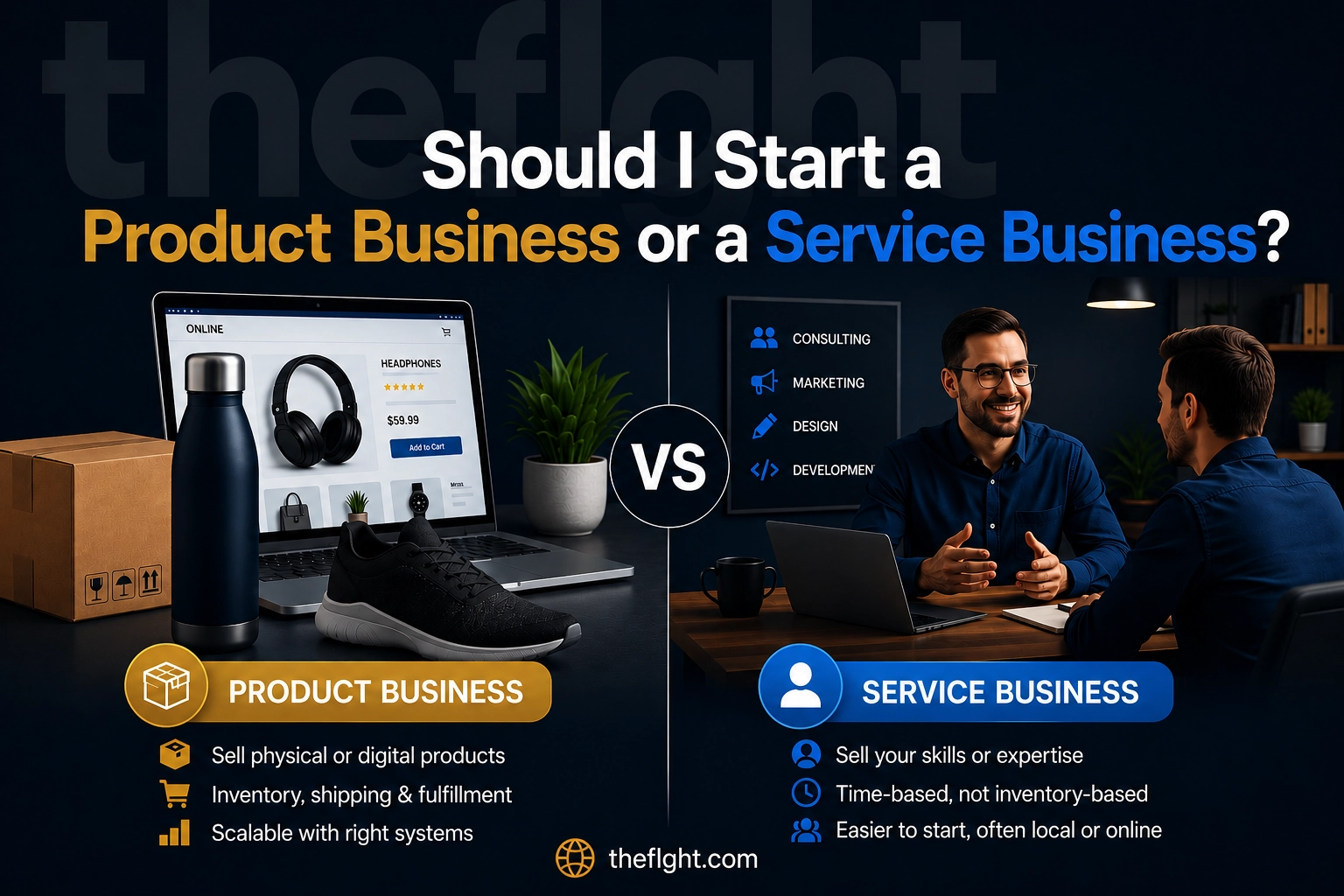
Should I Start a Product Business or a Service Business?
Short answer: Start a service business if you have limited cash, need evidence within 30 days, or can already solve a customer problem yourself.
Choose a product business only when you can fund the first batch without needing its sale proceeds for living costs, can test demand before committing to stock, and accept that fulfilment will consume cash before it produces it. For most first-time founders, a service is the better first commercial test, even when a product is the longer-term ambition.
The obvious answer is that products scale and services trap you into selling time. That comparison starts too late. A business cannot scale until customers buy, delivery works and each sale contributes enough cash to fund the next one.
A service usually exposes a weak idea faster because you must speak to a buyer and ask for money. A product can let you spend six months designing, ordering and polishing before the market gives you an honest answer.
Use the Four-Constraint Model Test
The Four-Constraint Model Test compares the models at the stage you are actually in, not at the size you hope to reach. Score each option from 1 to 5 on cash, proof, delivery and scale. A score of 5 means the option fits your current circumstances well.
| Constraint | Product question | Service question | What a strong score means |
| Cash | What must you pay before one unit can ship? | What must you pay before completing one job? | You can absorb the cost without relying on immediate sales |
| Proof | Can a customer commit before the product is made? | You can obtain credible buying evidence within 30 days | |
| Delivery | Can you source, store and replace units reliably? | Can you deliver consistent work within available hours? | Ten sales would be manageable, not chaotic |
| Scale | Can contribution fund the next batch? | Can the work later be standardised, delegated or priced higher? | Growth improves economics instead of merely adding workload |
Do not weight scale more heavily because it sounds ambitious. At the beginning, cash and proof should carry twice the weight of theoretical scale. A model with excellent future economics and no affordable route to the first ten customers is not your better option today.
Compare cash before revenue, not headline startup cost
For a product, include samples, minimum order quantities, packaging, freight, damaged units, storage, payment fees and returns. The relevant figure is the cash committed before enough customers have paid you, not the manufacturing cost printed on a supplier quote.
For a service, include insurance where appropriate, travel, sale-specific materials, specialist qualifications and the time required to win and prepare each job. A laptop you already own has no new cash cost, but your delivery time still has an economic cost.
This is why “products earn while you sleep” is poor starting advice. Stock absorbs cash while it sits still. A product business becomes attractive when demand is repeatable and unit contribution can finance replenishment. Before then, inventory is a wager.
Decide how quickly you need the market to answer
A service can often be reduced to a clear result, buyer, price and delivery date. You can offer that package directly to ten suitable prospects and know whether anyone will enter a paid conversation. The work may be manual, but the evidence is clean.
Product evidence has more layers. A customer may like a drawing but reject the finished quality. They may join a waiting list but refuse the final price. They may buy once but never reorder.
You need to separate evidence about the problem, the design, the price and repeat demand.
If you need an answer this month, favour the option with the shortest route to a paid commitment. That is usually the service. Interest is useful for learning, but payment or a properly documented order is the stronger signal.
Treat delivery risk as part of the idea
Product delivery depends on other businesses. A late supplier, failed quality check or unexpected return rate can turn a profitable spreadsheet into a cash shortage. You also carry obligations concerning product safety, descriptions, refunds and consumer rights.
Service delivery concentrates risk in you. Illness, poor estimating and inconsistent judgement can damage several jobs at once. The defence is a narrow scope, a clear acceptance standard and enough time between jobs to correct mistakes.
Requirements vary by country and sector. Product safety, licensing, insurance, tax and consumer-law decisions should be checked with the relevant local authority or a qualified professional before you trade.
Do not confuse a service with permanent self-employment
Some practitioners argue that a product should come first because a service cannot grow beyond the founder’s hours. They are right about an unstructured service sold by the hour. They are not right about every service.
A service can progress through fixed scope, repeatable delivery, higher prices, trained staff and recurring contracts. A product can also remain dependent on its founder through buying, customer support, content, packing and cash management. Neither model removes work by itself.
Your first model only needs to produce paid learning and acceptable contribution. You can change the delivery mechanism later. Starting with a service can reveal the language, priorities and edge cases needed to design a better product.
Worked example: Ruth's home-office business
Ruth is choosing between a physical desk organiser and a home-office decluttering service. Her supplier requires 150 organisers at £9.40 each. Samples and photography cost £280, and packaging design and setup cost £210.
| Calculation | Product | Service |
| Cash before first sale | £1,900 | £25 for travel and supplies |
| Calculation | Product | Service |
| Selling price | £29 per unit | £180 per visit |
| Variable cost per sale | £25 | |
| Cash contribution per sale | £15.40 | £155 |
The product contribution is £29 minus £9.40 unit cost, £1.20 payment and packing cost, and a £3 postage subsidy. The £9.40 stock cost is already inside the £1,900 paid before launch, so it must not be deducted twice when Ruth asks how quickly cash returns to her bank. Each delivered sale releases £29 minus £1.20 minus £3 = £24.80 of new cash. Restoring the full £1,900 requires £1,900 divided by £24.80 = 76.61, rounded up to 77 sales.
For economic break-even, the £15.40 contribution recovers the £490 of samples, photography and packaging setup that is not held as saleable stock. That requires £490 divided by £15.40 = 31.82, rounded up to 32 sales. The two answers differ because one measures bank cash restored while the other recognises the value of unsold inventory.
The service produces £155 cash contribution per visit. If each visit and its administration take four hours, and Ruth values her time at £25 an hour, the economic profit is £155 minus £100, or £55. Eight visits create £1,240 of cash contribution and £440 after valuing her time.
The service is less scalable today, but it gives Ruth eight detailed customer conversations without tying up £1,900. My view is that she should sell the service first and use repeated requests to decide whether an organiser deserves a product test.
Make the choice in seven days
Write down one product offer and one service offer aimed at the same type of buyer. Then act in this order:
- Calculate cash committed before the first sale and contribution after every sale-specific cost.
- Set a 30-day evidence target, such as three paid service trials or five documented product orders.
- Describe how you would fulfil ten sales in one month, including your own hours and supplier dependencies.
- Score both options with the Four-Constraint Model Test, counting cash and proof twice.
- Spend the next seven days seeking paid commitments for the higher-scoring option before making irreversible purchases.
Do not choose the model with the grander story. Choose the one that can earn a reliable answer while a wrong decision is still cheap.
Frequently asked questions
Is a product business more profitable than a service business?
Not automatically. A product may have a higher revenue ceiling, but profit depends on contribution per unit, returns, unsold stock, acquisition cost and the cash required for replenishment. A service may produce strong contribution with little upfront spending, although the founder's available hours restrict capacity.
Compare profit after all sale-specific costs and a fair cost for your own time. Then calculate how much cash growth consumes. A product becomes financially attractive when repeatable demand and reliable fulfilment outweigh its inventory risk, not simply when its gross margin percentage looks impressive.
Does a digital product have the same risks as a physical product?
No. A digital product removes manufacturing, storage and postage, but it does not remove the cost of creation or the difficulty of proving demand. Its marginal delivery cost may be low, while customer acquisition, support, refunds and continual updates remain substantial. It also competes with free information and easy substitutes.
Treat the hours spent creating it as an investment and set a minimum sales target before building the complete version. Rules covering tax, intellectual property, privacy and consumer rights still vary by jurisdiction, so check the requirements that apply to your buyer and delivery method.
Is a service business just buying myself another job?
It can be, especially if every job is custom, every quote starts from zero and customers pay only for your hours. That is a design problem rather than an unavoidable feature. Define a result, restrict the scope, use a fixed price where uncertainty is controlled and record the steps that produce acceptable work.
Once demand is stable, you can raise prices, train another person or separate expert judgement from routine delivery. The exception is a service whose value depends entirely on your personal reputation or licensed expertise. In that case, capacity will remain tied closely to you and the price must reflect it.
Can I start with a service and add a product later?
Yes, and this is often the lower-risk sequence. Service work shows you which problems recur, what customers call them, what they already use and where they will pay for consistency. Those observations can support a physical product, a standard package or another repeatable form of delivery.
Keep the service narrow enough that you can notice patterns instead of accepting unrelated work. Do not build a product merely because clients mention it. Look for repeated requests from similar buyers and seek a paid commitment before committing to production. The later product should remove a proven delivery constraint, not create a new audience from scratch.
What if I have no specialist skill to sell as a service?
Start with a specific, observable result you can deliver competently, not a claim to expertise you do not have. Useful services can involve coordination, cleaning, assembly, basic administration or research, provided customers value the result and you meet any legal or professional requirements. Test whether the work earns enough after travel, preparation and your time.
If the service requires a regulated qualification, safety-critical judgement or access to sensitive information, do not improvise. Obtain the required competence and permissions first. You may also decide that an adjacent skill is faster to develop than funding and learning a product supply chain.
Should I run a product and a service at the same time?
Only if one model directly teaches or sells the other and you can state which one has priority. Two unrelated models split prospecting, cash and attention before either has produced a clear signal. A sensible combination might be a paid assessment that reveals demand for a standard product, or a product whose installation is a defined service.
Set separate contribution figures and evidence targets so one does not conceal the other's weakness. If you have fewer than ten hours a week, run one paid test first. Add the second model after the first reaches its target or fails against a pre-set stopping rule.
Comments (0)