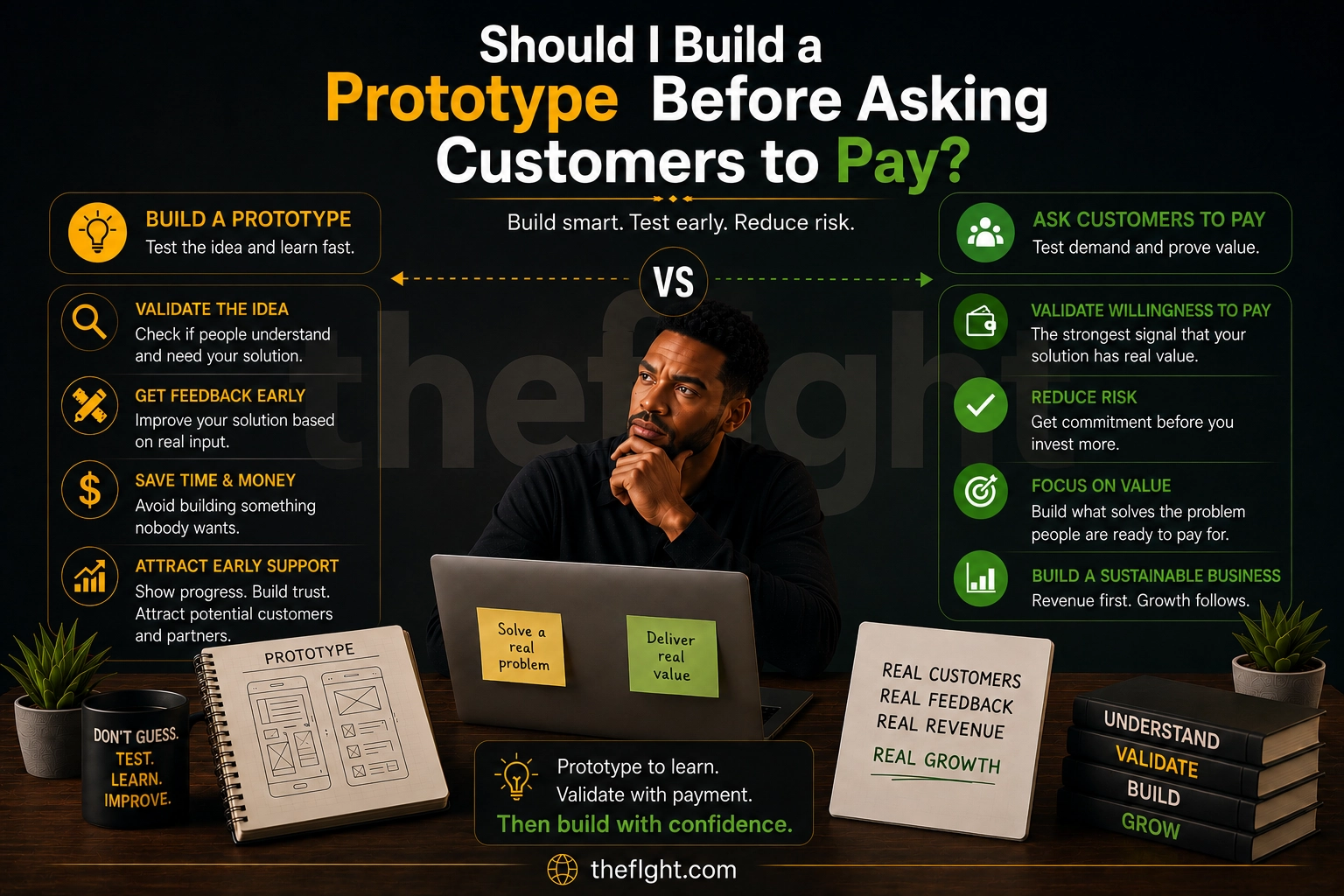
Should I Build a Prototype Before Asking Customers to Pay?
Short answer: Do not build a finished prototype merely to test whether people want the idea. Show the lowest-depth representation that lets customers understand the result, state the intended price and ask for a conditional paid order or deposit under clear terms.
Build a functional prototype first when safety, fit, performance or legal compliance cannot be judged responsibly without one.
Increase prototype depth only when the previous evidence has passed.
A polished prototype answers “Can this be made?” It may not answer “Will enough customers buy at a viable price?” Founders often spend heavily on the first question because fabrication feels more controllable than selling.
The right prototype depends on the uncertainty. A scale model can test size, but not durability. A functional unit can test performance, but one delighted tester does not prove repeat demand. Build for the next decision, not for a launch photograph.
Use the Build-Depth Rule
The Build-Depth Rule matches each business risk with the least expensive credible evidence. Do not move to a deeper build until the earlier commercial question survives.
| Risk to test | Lowest useful evidence | What it cannot prove |
| Problem | Customer's last event, consequence and current alternative | Desire for your design |
| Demand | Finished performance | |
| Size and fit | Scale drawing, physical mock-up or material sample | Strength and production consistency |
| Core performance | Final appearance and manufacturing yield | |
| Safety and compliance | Production-intent unit tested to the required standard | Market size or repeat purchase |
The sequence can overlap. A customer may need to handle a material sample before making a meaningful commitment. What matters is that you can name the question each pound of prototype spending answers.
Ask for commercial commitment before cosmetic completion
Explain what exists, what remains unproven, the intended specification, price, delivery condition and refund terms. Do not present an image or mock-up as a finished product.
A conditional order can state that production proceeds only if specified performance, safety and minimum-demand conditions are met.
Customer money may need to remain available for refunds rather than funding development. The appropriate arrangement depends on consumer, contract and payment rules in your jurisdiction.
My view is that fear of asking early is not a reason to fabricate more. If a buyer understands the outcome and price but will not make even a properly protected commitment, a more polished surface may create admiration without improving demand.
Payment is not always the first suitable action. For a medical, child-safety, structural or other high-consequence product, a customer should not be asked to rely on an unverified claim. Use qualified professional advice and the required testing before offering delivery.
Set a prototype spending cap
Calculate expected contribution per sale before approving build spend:
Contribution per unit = selling price minus manufacturing, packaging, payment, delivery and sale-specific support costs
Then calculate:
Prototype recovery sales = prototype spend divided by contribution per unit, rounded up
This does not mean those sales will occur. It shows how much demand the prototype must eventually support. If one prototype requires 80 sales to recover and your test can reach only 20 plausible buyers, reduce depth or reconsider the product.
Include design, specialist review, fabrication, materials, failed attempts and testing. Your own hours should appear separately so a cash-cheap build does not hide months of unpaid work.
Set the cap before requesting quotes. A supplier's preferred process may answer more questions than you need and consume the budget accordingly.
Test one technical risk at a time
A complete prototype combines fit, appearance, mechanism and material. When it fails, you may not know which part caused the failure. Build a focused test for the assumption most likely to kill the product.
| Technical uncertainty | Focused prototype | Pass rule example |
| Product does not fit the intended space | Full-size low-cost mock-up | Fits 90 per cent of measured target spaces |
| Mechanism is too difficult to operate | Intended users complete the action safely | |
| Material will not withstand use | Representative material sample | Independent test meets the required standard |
| Assembly takes too long | Small production run | Median assembly time supports unit economics |
Any percentage or standard must suit the actual product. Safety and regulated requirements cannot be replaced by your own convenient pass rule. Confirm them with the relevant authority and qualified professionals.
Worked example: Owen's balcony planter product
Owen is designing a modular balcony planter. A polished production-intent prototype would require £1,400 of specialist design work and £1,850 of fabrication, totalling £3,250.
He intends to sell the planter for £240. Estimated manufacturing is £110, packaging and delivery are £22, and payment and sale-specific support cost £8. Contribution per unit would be:
£240 minus £110 minus £22 minus £8 = £100.
The polished prototype would require:
£3,250 divided by £100 = 32.5, rounded up to 33 sales to recover its cash cost.
Instead, Owen separates fit from structural performance. A full-size low-cost fit model costs £90. A focused load and drainage prototype, built with appropriate specialist input, costs £390. Total early proof spending is £480.
He shows the intended design, specification, price and unproven conditions to suitable buyers. Eight place conditional orders with £60 refundable deposits, producing £480 of customer commitment. Owen keeps the money available under the stated refund terms rather than treating it as profit.
The deposits do not prove safety, production quality or enough demand for a full batch. They do show that several buyers accept the intended price subject to the named conditions. Prototype recovery at £100 contribution becomes:
£480 divided by £100 = 4.8, rounded up to five completed sales.
Owen should now complete the necessary technical and compliance work, obtain production quotes and confirm whether eight orders support the supplier minimum. If structural testing fails, he must not reinterpret deposits as permission to deliver.
Do not let testers redesign the product by committee
Prototype feedback can produce a long list of preferences. Separate defects, required outcomes and personal taste. A change deserves attention when it blocks use, safety or purchase across the intended segment.
Ask testers to complete a task rather than review features. Observe where they hesitate, what they misunderstand and whether the product produces the promised result. Then ask whether they will proceed at the stated price.
Do not add every requested variation to the next prototype. Variation increases manufacturing, stock and support risk. A customer can dislike a colour while still buying; another can praise every detail and decline payment.
Choose the next build in ten days
Write the product's five risks: problem, demand, fit, core performance and safety or compliance. Mark the evidence you already have and the cheapest responsible test for the first unproven risk.
Then act in this order:
- Calculate intended contribution and prototype recovery sales.
- Set a cash and founder-hour cap for the next build.
- Present the intended offer and commercial terms to qualified buyers.
- Build only enough to answer the first technical question that payment cannot answer.
- Stop, revise or deepen the prototype according to the pre-set pass rule.
Do not commission the polished unit until demand and the preceding technical evidence justify the questions it will answer.
Frequently asked questions
Will customers pay before they can see a finished prototype?
Some will when the problem, proposed result, price, conditions and refund protection are clear enough. Others reasonably need to test fit or performance first. The purpose is not to pressure payment but to discover what evidence a real purchase requires. Present limitations honestly and ask for a conditional commitment appropriate to the risk.
Friends paying to support you provide weaker evidence than intended buyers. The exception is a high-consequence or regulated product where accepting money against an unverified claim may be inappropriate or unlawful. Obtain qualified local advice before structuring early orders.
Does a drawing count as a prototype?
It can count as a representation for testing comprehension, appearance or stated interest. It cannot prove physical fit, strength, usability or manufacturing quality. Call it what it is and tell customers which conditions remain untested.
Match the form to the question: a full-size card model can reveal dimensions that a detailed drawing hides, while a working component can test a mechanism without final appearance.
The exception is a product whose value is mainly visual, where a drawing may answer more, but payment and production evidence are still separate. Never imply certification or performance that the representation has not demonstrated.
Can I use a competitor's product as a technical reference?
You can study a lawfully obtained product to understand customer expectations, materials and trade-offs, but do not assume that copying its construction, branding or protected features is permitted. Record what buyer problem each feature solves, then develop and test your own specification. A competitor's compliance marks or supplier claims do not transfer to your product.
Intellectual property, product safety and reverse-engineering rules vary by country and category, so obtain qualified local legal and technical advice before using detailed design information. The exception is an open standard or licensed design whose terms expressly allow the intended use.
Should prototype deposits be refundable?
They often should be when delivery depends on unproven conditions, but the correct treatment depends on the offer, contract, payment method and local consumer law. State the condition, deadline, refund trigger and handling of customer money before accepting it. Do not spend refundable deposits in a way that prevents prompt repayment.
A non-refundable design or customisation fee may be possible when the customer knowingly receives defined work, but that is different from a deposit for an undelivered product. Obtain qualified local legal and accounting advice for the arrangement rather than copying another business's terms.
What if a manufacturer requires an expensive prototype?
Ask which production question it answers and whether a lower-cost specialist test can precede it. Manufacturers may need production-intent files or samples to quote accurately, but you do not have to reach that stage before testing problem, price and conditional demand.
Obtain more than one suitable quote and compare ownership of designs, revisions, tooling and failed units.
Do not ask a supplier to compromise required safety or production standards. The exception is a process where the first credible unit genuinely requires full tooling. In that case, stronger paid demand and more capital are necessary before proceeding.
How do I stop someone copying my idea during early testing?
Limit disclosure to what a buyer needs for the decision, keep dated records and obtain advice on appropriate intellectual-property protection where the idea is genuinely protectable.
Confidentiality agreements may help in some commercial discussions but can deter ordinary customers and are not a substitute for execution. Most early risk comes from building something nobody buys, not from a stranger reproducing a vague concept.
The exception is a novel technical invention where public disclosure could affect protection options. Speak to a qualified intellectual-property professional before revealing enabling details, because rules and deadlines vary by jurisdiction.
Comments (0)