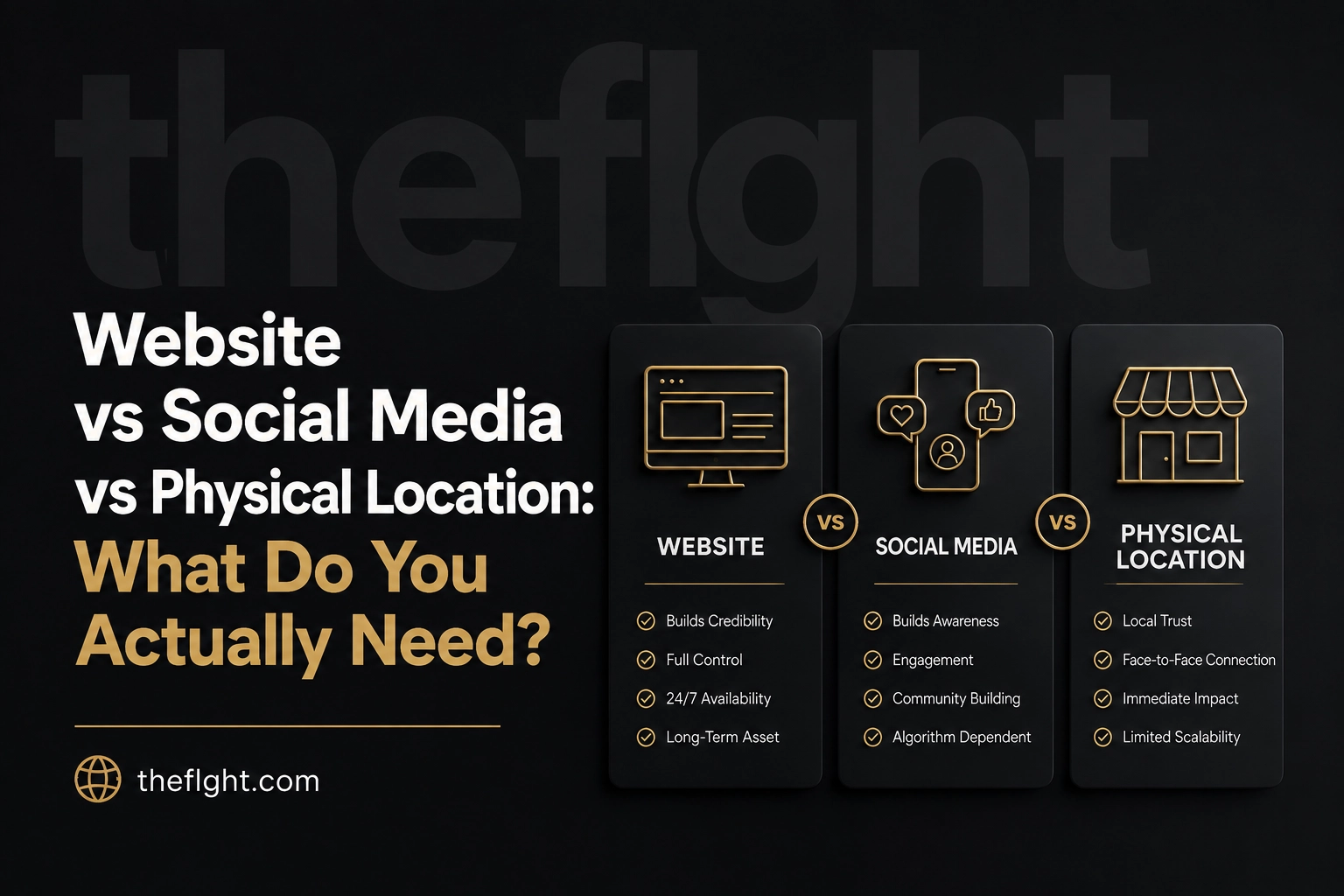
Website vs Social Media vs Physical Location: What Do You Actually Need?
Short answer: almost every business needs a small website it owns, not for traffic but because it’s the only place you control what’s said about you, and it’s what every other channel, review platform and AI assistant checks to verify you exist and are what you claim.
Social accounts are optional and depend entirely on where your customers are. Physical premises are the most expensive commitment in business, and should be the last thing you take on rather than the first.
The real question isn’t which of the three. It’s what minimum presence makes a stranger confident enough to contact you.
Three kinds of presence, and who controls them
| Owned: | Rented: social, | ||
website, email list | marketplaces, directories | Physical: premises | |
Who controls it | You | The platform | You, under a lease |
| Cost to start | £50 to £1,000 | £0 | £5,000 to £50,000 and up |
| Ongoing cost | Low | Time, or commission | High and fixed |
| Reach without effort | Low | Medium | Depends entirely on location |
| Can it be taken away? | No | Yes, overnight | Only by ending the lease |
| Converts strangers? | Yes, if built for it | Sometimes | Very effectively, given the right footfall |
The strategic point underneath that table: rented presence gives you reach, owned presence gives you conviction, and physical presence gives you proximity. Most businesses need reach and conviction from day one. Very few need proximity from day one.
The website question
Why it matters more than the visitor numbers suggest
Founders judge a website by visits, which is the wrong metric for a new business. The website has three real jobs.
Verification. Somebody heard about you through a referral, a directory, an ad or an assistant’s answer, and they’re now checking whether you’re real, competent and appropriate. Most of your website’s value is spent inside that ninety-second check, and failing it costs you a customer who had already decided to consider you.
Being describable. Search engines, directories, review platforms and AI assistants all need a canonical source of truth about who you are, what you offer, to whom and where. If that source is a social profile with a 150-character bio, your business is hard to describe accurately, and things that are hard to describe accurately don’t get recommended.
Conversion. Turning interest into a booking, quote, purchase or call, on your terms, with your proof, without a platform taking a cut or an algorithm deciding who sees it.
The verification job alone justifies the cost. Even a business getting every single customer by referral loses some of them to a missing or embarrassing website.
The minimum viable website
Five pages, honestly built, beats fifteen thin ones.
Home. Who you serve, what you do, the specific promise and one clear action, all above the fold and in plain language.
Service or product pages. One per distinct thing you sell, with what’s included, who it’s for, what it costs or how pricing works, and what happens next.
About. The named human, their relevant background, and why they do this. This page converts far better than founders expect, particularly in service businesses.
Proof. Reviews, case examples, credentials, guarantees, before-and-afters.
Contact. Every method, a response-time commitment, your location and service area.
Then the less obvious essentials: a real business email address rather than a free webmail account, business name and address details that match your other profiles exactly, working analytics, and pages that load quickly on a phone.
Publish your prices, or at least the shape of them. “From £X”, or a range with an explanation of what drives it. Businesses that hide pricing believe they’re protecting themselves from price shoppers. Mostly they’re filtering out serious buyers who have a budget and no patience for a discovery call to find out whether you’re inside it.
What to skip
Custom design before you have customers. A blog with no strategy behind it. Live chat you can’t staff. Elaborate animation. A logo costing more than £200 at the outset. Stock photography of people in offices who are not you.
When you genuinely don’t need one
Rare, but real. If you sell exclusively through a marketplace that handles discovery, trust and transaction, and your entire acquisition happens inside it, a website is deferrable. Understand the trade, though: you’re renting the customer relationship, paying 10 to
20% for it, and you can be delisted. Most businesses in that position build a site by year two anyway, usually after a platform change costs them a month of revenue.
The social media question
The test
Answer three questions honestly.
Is my specific customer on this platform, in a mindset where they’d act? Not whether the platform has users, but whether your buyers use it for this kind of decision.
Can I produce content this platform rewards, weekly, for a year? Each platform has a native format. If you can’t sustain it, don’t start.
Is there a path from content to purchase? Or is it awareness that never converts into anything?
Two yeses out of three makes it worth trying as your experimental channel. Fewer than two, skip it entirely and reclaim the hours.
Which platform, for what
| Platform | Genuinely useful for | Not useful for |
| B2B and professional services, high-value consultative sales | Most local consumer services | |
| Visual products, food, beauty, interiors, events, fitness | Technical B2B, commodity services | |
| TikTok and short video | Demonstrable transformations, education, younger consumer markets, trades showing work | High-consideration B2B, older demographics |
| YouTube | Complex or expensive purchases where explanation removes doubt | Impulse or low-value purchases |
| Facebook groups | Local services, community-based businesses, niche interests | National B2B |
| Home, wedding, craft, design, planning-led purchases | Anything urgent |
The one asset almost everyone needs
Whatever else you skip, claim and complete your local business profile and the main directory or review listing in your category. These aren’t really social media, they’re infrastructure. They’re often the first result for your business name, they feed the review signals both buyers and AI assistants rely on, and they cost nothing but an afternoon.
Consistency across them matters more than volume. The same business name, address, phone number, categories and description everywhere. Inconsistent details are one of the most common and most easily fixed reasons a business gets described badly, or not at all.
The physical premises question
The most expensive and least reversible decision on this page. Work through it in order.
Step 1: does the customer need to come to you?
If not, premises are a cost centre rather than a revenue source. Mobile services, delivery and online fulfilment all avoid the question entirely.
Step 2: if they do, can you rent by the hour, day or session first?
Almost every physical category has a low-commitment version.
| Instead of | Start with |
| A salon | A chair rented in an existing salon |
| A clinic | A treatment room hired by the day |
A restaurant | A residency, market stall or supper club in someone else’s licensed kitchen |
| A studio | Hourly hire at an existing facility |
| A shop | A market stall, pop-up, or shelf space in a complementary retailer |
| A workshop | A shared makerspace or a sublet corner of an existing unit |
This isn’t a lesser version of the plan. It’s the correct sequencing. You build the customer list, learn the real demand patterns, and arrive at the lease with evidence rather than hope.
Step 3: if you’re committing, do the footfall arithmetic first Don’t sign anything until you’ve calculated four things.
Monthly fixed cost, all in. Rent, rates, utilities, insurance, service charge.
Break-even customers per month, which is fixed costs divided by contribution per customer.
Break-even customers per day.
Then go and sit outside the unit on three separate days, at the times you’d be trading, and count how many plausible customers actually pass.
The capture rate you’d need, which is break-even customers divided by passing traffic. Above 3 to 5% for a retail unit is optimistic. Above 10% is fantasy.
Location differences within a hundred metres are routinely the difference between a viable unit and a doomed one. Corner versus mid-terrace, same side as the car park versus opposite, before or after the pedestrian crossing.
Step 4: read the lease terms as economics, not paperwork
Length, break clauses, personal guarantees, dilapidations liability, rent review, permitted use, and who’s responsible for the roof. A personal guarantee on a five-year lease means the business failing doesn’t end the obligation. Take proper professional advice before signing, because this is the one place where saving on fees reliably costs more than it saves.
The decision, in one path
Work down this list and stop when you have what you need.
- Everyone: claim your business profile and main category listing, and complete them properly.
- Everyone: a five-page website you control, with real service pages and consistent business details.
- If your customers research visually or socially before buying: one social platform, chosen using the three-question test, done weekly.
- If your customers must physically come to you: the rented, low-commitment version first.
- Only once demand is proven and the arithmetic works: premises of your own.
Most new businesses invert this list, starting at five and three while neglecting one and two. That inversion is responsible for a substantial share of first-year failures, not because premises and social are wrong in themselves, but because they consume the money and attention the first two steps needed.
Frequently asked questions
Can a social media page replace a website entirely?
For most businesses, no, and the reason is verification rather than reach. A social profile can’t hold your service detail, your pricing, your policies or your proof in a form that other systems can read reliably, and you can lose access to it without warning. Where a business does run on social alone, it’s usually because a marketplace or platform is handling discovery and payment as well, which is a different situation from simply having an Instagram account.
How much should a first website cost?
Somewhere between £100 and £1,500 for most new businesses, depending on whether you build it yourself on a template or pay someone. What matters far more than the spend is whether the five core pages say something specific. A £5,000 site with vague copy converts worse than a £200 one that states clearly who you serve, what it costs and what happens next.
Should I put my prices on the website?
Publish either the price or its shape, unless scope genuinely varies so much that a number would mislead. Hiding pricing filters out serious buyers with a budget more often than it filters out time-wasters, since price shoppers will simply ask anyway. A starting price or a range with an explanation of what moves it gives you qualification without commitment.
Do I need a business address if I work from home?
You need a consistent address for listings and legal purposes, and a home address is acceptable for many businesses. Where a residential address would quietly cost you credibility, mostly in B2B, a registered office or virtual address service costs a fraction of real premises and solves it. What matters most is that whatever you use appears identically everywhere, since mismatched details undermine both search visibility and buyer confidence.
When is the right time to take premises?
When demand is proven at the rented or mobile version, when the footfall arithmetic works at a realistic capture rate, and when you can cover the fixed cost through your worst three months. Signing before all three are true is the most common expensive mistake in small business, largely because a lease converts a variable cost structure into a fixed one at precisely the point when you can least absorb it.
How many social platforms should a new business be on?
One, done weekly, and only if it passes the three-question test. Being present on four platforms with sporadic posting produces less than being reliably useful on one, and it consumes the hours that direct selling needs during the first year. The exception is business listings and review profiles, which aren’t really social channels and should all be claimed regardless.
What if my competitors all have shops and I don’t?
Test whether the shop is actually where their customers decide, because in a growing number of categories it isn’t. Plenty of premises-based businesses now take most enquiries online and use the unit for delivery rather than discovery, which means the shop is a cost you can avoid rather than an advantage you must match. If proximity genuinely matters to buyers, the rented version gets you the same benefit without the lease.
Is it worth building a website before I have any customers?
Yes, but build the small version rather than the ambitious one. A five-page site with real service detail supports your outreach from week one, since prospects check you before replying. Save the larger rebuild for month six, when the first customers have given you their objections and their language, which will make the second version substantially better than anything you could write today.
Comments (0)