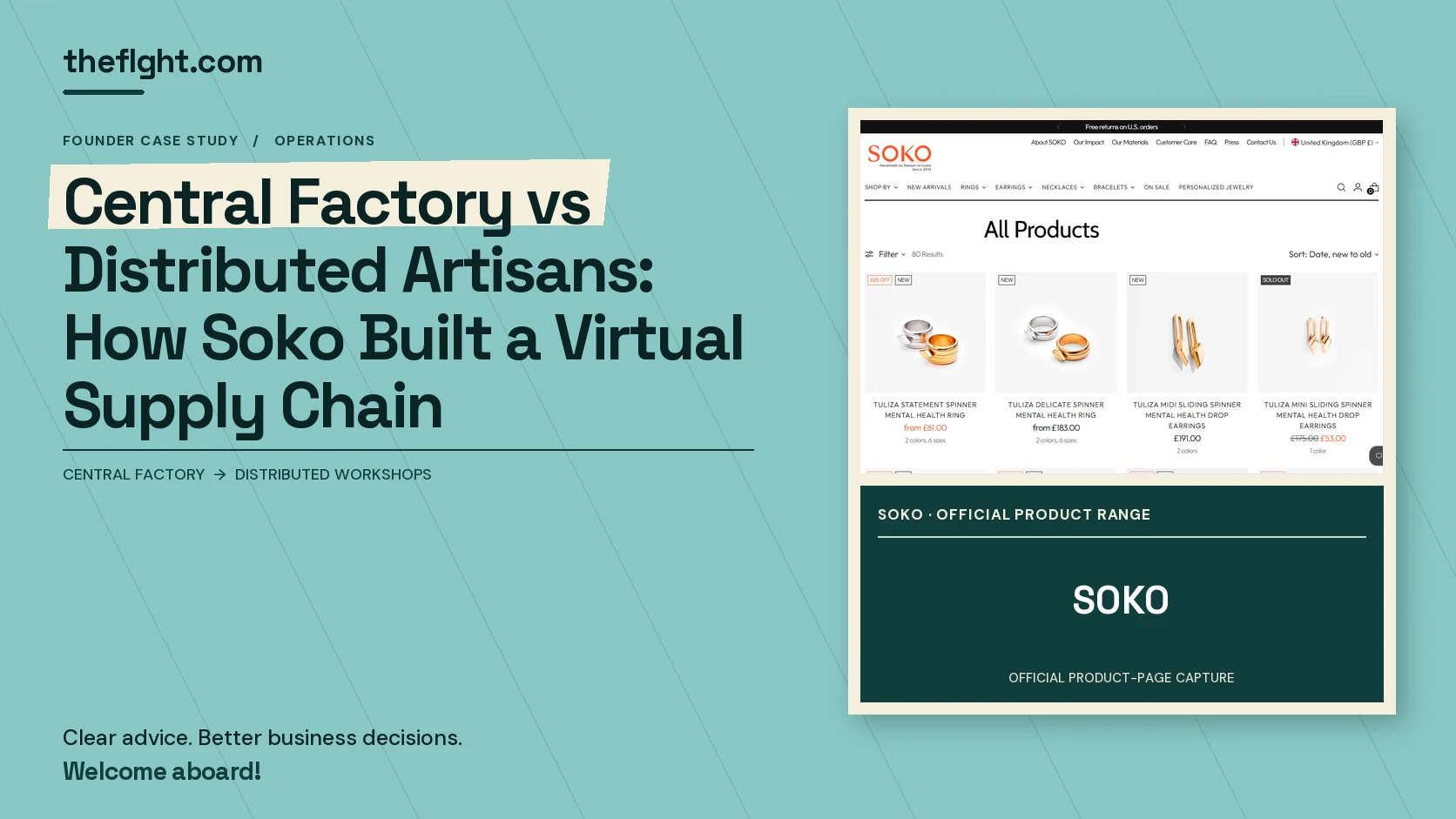
Central Factory vs Distributed Artisans: How Soko Built a Virtual Supply Chain
Short answer: Use distributed manufacturing when demand is uncertain, craft capability already exists and orders can be divided into standardised work packages. Use a central factory when process variation, equipment or throughput requires direct control. Start with confirmed orders across five approved producers, inspect every unit and centralise only the bottleneck that repeatedly causes delay or defects.
Soko connected global jewellery demand with independent Kenyan artisans, allocating work through ordinary mobile phones rather than building one central factory. Confirmed demand could flow to producers whose skills and capacity matched the order, reducing the need for speculative inventory and heavy facility investment.
Distributed production does not remove operations. It relocates them into specifications, allocation, quality assurance, materials, payment and communication. If those systems are weak, the network multiplies inconsistency.
Use the Distributed Capacity Grid
The Distributed Capacity Grid maps every product against the capability and reliability of every producer.
| Dimension | Product record | Producer record | Allocation rule |
|---|---|---|---|
| Skill | Process and finish required | Demonstrated approved skills | Assign only verified match |
| Capacity | Units and due date | Available units by period | Reserve with acceptance |
| Material | Type, quantity and source | Stock or collection ability | Confirm before start |
| Quality | Tolerance and inspection points | First-pass yield and defects | Limit volume until stable |
| Delivery | Handover location and date | On-time history | Add buffer from evidence |
The grid turns a community of suppliers into an operating network. A directory of artisan names is not a factory.
What Soko changed about production
Soko was founded by women with backgrounds in design, technology and international development. It created a jewellery supply chain connecting independent Kenyan artisans with global buyers. An MIT News profile of Soko describes its mobile-enabled system and the founders' aim to expand market access for producers.
The model has been described as a “virtual factory”. Orders could be assigned to artisans according to capability, with communication through mobile phones rather than requiring each workshop to own a computer or maintain a constant internet connection. An Unreasonable Group account explains the demand-responsive production idea.
A World Bank case study later referred to a network of about 2,500 artisans. That later scale does not describe Soko's first operating economics. Early margin and defect data are not public, so do not infer that distribution automatically reduced cost. The documented strategic choice is the use of existing workshops and confirmed demand instead of a central speculative factory.
My position is that founders romanticise artisan networks and industrial factories equally. The decision should follow process variance. Distributed craft is strong where skill is local and product can be specified. Centralisation is strong where one uncontrolled process can ruin the whole batch.
Separate what must be standard from what should vary
For each product, define the dimensions customers expect to remain consistent: size, material, safety, finish, packaging and delivery. Then define acceptable variation that expresses handmade production.
A specification should include reference images, measurements, tolerances, material source, inspection stages and a golden sample. Translate it into the producer's working context. A technically perfect document nobody can access or understand is not a control.
Approve capability through paid samples. Never ask suppliers to finance repeated speculative development. Record first-pass yield, rework and delivery by product and producer.
Allocate confirmed demand, then protect the bottleneck
Make to order reduces finished-stock risk but can extend customer lead time. Set a promise based on material availability, production, inspection, consolidation and export, not only making time.
| Production choice | Cash advantage | Operating risk |
|---|---|---|
| Confirmed-order allocation | Less unsold finished stock | Longer customer wait |
| Small standard component stock | Faster final assembly | Component obsolescence |
| Finished speculative stock | Immediate dispatch | Highest cash and demand risk |
Centralise only the constraint that benefits: material purchasing, final inspection, packaging or one specialist process. You do not need to own every workshop to control the customer promise.
Supplier status, product safety, employment, tax, customs and origin rules vary by country. Independent-producer language does not determine legal status. Obtain qualified local advice and verify the rules in production and customer markets.
Worked example: Coastline Brass Works
Coastline is a fictional UK jewellery brand deciding between a small central workshop and six independent makers. It has confirmed monthly demand for 300 bracelets at a £42 wholesale price.
The central workshop costs £5,800 a month for rent, equipment, supervision and fixed labour, plus £9 variable cost per bracelet. Monthly production cost is:
£5,800 + (300 × £9) = £8,500
Gross production contribution is 300 × £42 - £8,500 = £4,100.
Distributed makers charge £20 per approved bracelet. Central inspection and coordination cost £1,600 a month. Initial first-pass yield is 88%, so Coastline must commission 300 ÷ 88% = 341 units, rounded up. Cost is:
341 × £20 + £1,600 = £8,420
Contribution is £4,180, only £80 above the factory option. After three months of paid training, first-pass yield reaches 95%. Required production falls to 316 units and cost becomes 316 × £20 + £1,600 = £7,920, producing £4,680 contribution.
The distributed model wins only after quality improves. If demand drops to 150, it wins decisively because the £5,800 factory cost remains. Coastline keeps final inspection central and allocates confirmed batches, rather than claiming that decentralisation removes control cost.
Build supplier resilience without spreading orders blindly
Qualify at least two producers for each critical product or process, but give enough repeat work for skills and income to develop. Splitting every order equally ignores performance and creates excessive coordination.
Use a transparent allocation rule based on capability, available capacity, quality and delivery. Explain how rework, rejects and material loss are handled. Pay on agreed milestones and avoid transferring all demand risk to small producers through last-minute cancellations.
When one producer improves a process, decide how knowledge can be shared and compensated. A resilient network grows capability rather than treating workshops as interchangeable capacity.
What to do over the next 30 days
During week one, choose one product and write its specification, tolerance and inspection points. Identify five producers with relevant existing skill and verify identity, conditions and references.
In week two, commission paid samples and record quality, time and communication. During week three, allocate a small confirmed batch across the best matches and inspect every unit at an early stage and completion.
In week four, calculate cost per approved unit, rework, coordination and lead time. Centralise only the repeated bottleneck. Expand volume after two successful batches from at least two producers, not after an attractive sample from one.
Related guides
Frequently asked questions
Is distributed manufacturing always cheaper than a factory?
No. It avoids some fixed property and equipment cost, but adds coordination, transport, quality and supplier-margin costs. At stable high volume, a factory can produce more cheaply and consistently. Model cost per approved unit at low, expected and high demand. Include rejects and management time. Distributed production is strongest when demand varies and existing specialist capacity would otherwise be idle. Choose it for economic and capability reasons, not because “community” language makes cost disappear from the accounts. Retest the comparison as volume changes.
How many producers should I start with?
Start with about five candidates and approve at least two for the first critical process. That gives comparison and backup without overwhelming quality control. Commission paid samples before customer batches. The right number depends on complexity and volume. One producer creates dependency, while 20 untested producers create coordination risk. Expand only after the specification, allocation and inspection process works repeatedly. A smaller reliable network is more useful than a large directory that has never delivered an approved batch on time.
Who should buy the raw materials?
Central purchasing can improve consistency, traceability and price, while producer purchasing can use local knowledge and reduce your working capital. Decide material by material. Centralise inputs where variation affects safety or finish, and allow local sourcing where substitutes are clearly specified and approved. Define ownership, waste, transport and price changes. Customs, origin and product rules may depend on sourcing, so obtain qualified trade and legal advice for each production and customer market. Audit critical sources periodically and retain traceability records.
How do I maintain quality across independent workshops?
Use a golden sample, measurable tolerances, in-process checks and performance records by product and producer. Train through paid test work and show defects with specific evidence. Inspect early enough to prevent a whole batch failing. Do not rely on a final photograph for dimensions or material composition. Reward consistent first-pass yield and honest early reporting. If one stage remains unstable across workshops, centralise that stage rather than adding more inspection at the end of every batch. Reapprove after material changes.
Does make-to-order eliminate inventory risk?
It reduces finished-goods risk but does not remove material, component, packaging or work-in-progress exposure. It can also create cancellation risk after production starts. Take an appropriate deposit where lawful, define cancellation terms and buy only the material justified by confirmed orders plus a small evidence-based buffer. Long customer lead times can reduce conversion. Compare the cost of holding standard components with the contribution lost from slow delivery. Consumer rules and deposit treatment vary by jurisdiction and sales channel. Explain lead times before payment.
Are independent artisans contractors or employees?
The answer depends on the real relationship, including control, substitution, integration, economic dependence and local law, not the wording in a contract. A platform that sets hours, methods and exclusivity may create obligations it did not intend. Tax and employment status differ across countries. Obtain qualified local advice, use fair written terms and avoid shifting unsafe or uncompensated risk. Ethical sourcing claims also need evidence from actual working conditions, payment practices and producer testimony. Reassess status when the relationship changes.
When should I build a central facility?
Build when demand is stable enough to utilise it, a recurring bottleneck requires shared equipment or direct control, and the contribution improvement exceeds fixed cost under a downturn. Require several months of product-level volume and a stress test at 70% of expected demand. You can centralise inspection, material preparation or packaging before full production. A facility should solve a measured constraint. It should not be an expensive symbol that the business has become established or permanent. Price closure and underuse before signing.
Comments (0)