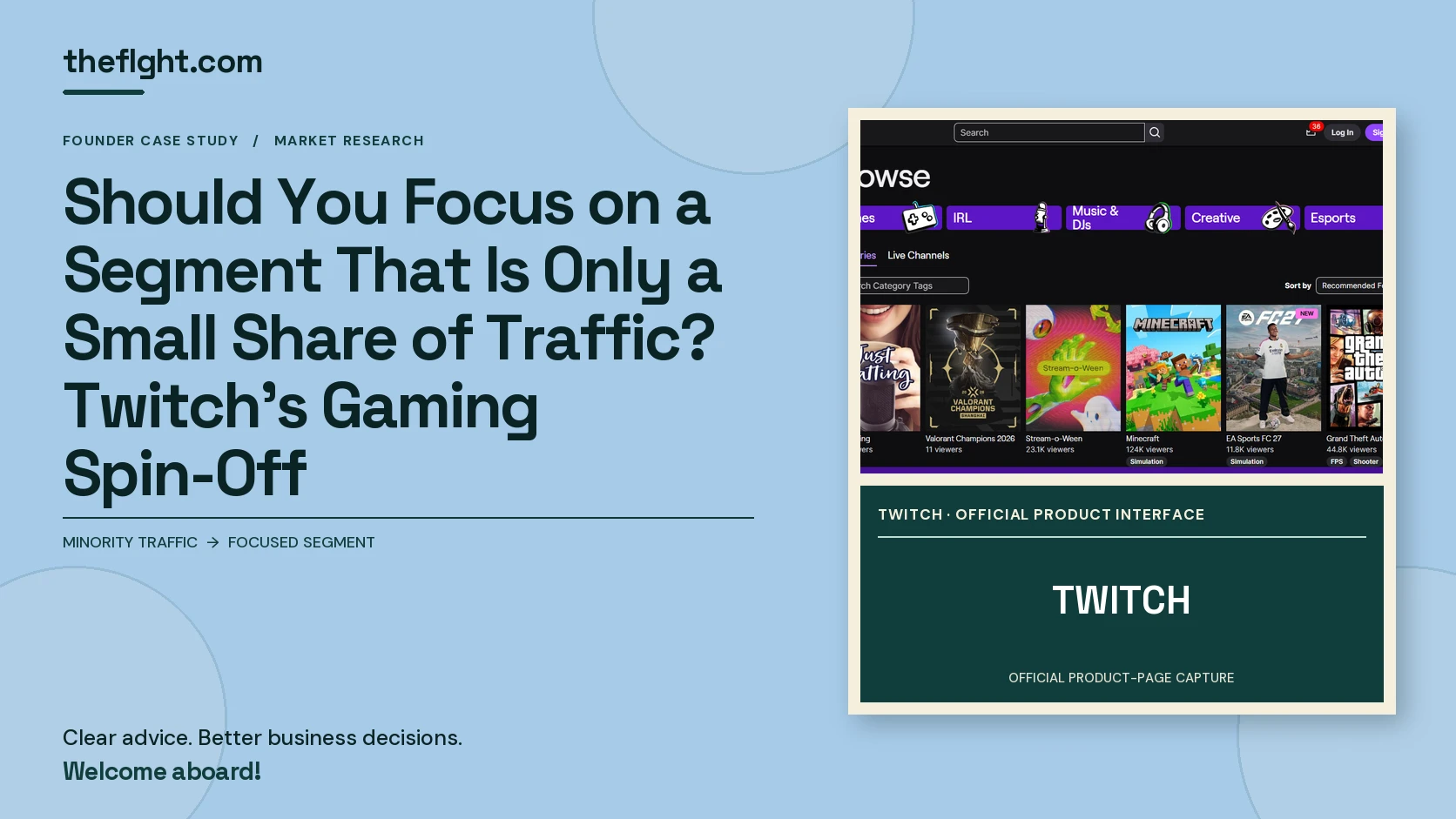
Should You Focus on a Segment That Is Only a Small Share of Traffic? Twitch's Gaming Spin-Off
Short answer: Focus on a small segment when it is growing faster, returns more often, has distinct unmet needs and produces better contribution or strategic learning than the larger audience. Give it a separate 8 to 12-week product and acquisition test before abandoning the broad market. Do not choose it because the community is vocal, and do not reject it because it represents less than 10% of current traffic.
Founders usually rank segments by present size. That feels objective, but present size often reflects where an unfocused product already happens to attract attention. It says little about which group has the strongest pull.
A minority segment can contain the future business. It can also be a noisy subculture that consumes resources and never pays. The decision requires behaviour, not enthusiasm.
Twitch separated a small but different use case
Justin.tv began as a broad live-video platform. Co-founder Justin Kan later explained in a Scale interview that overall growth had flattened. Emmett Shear identified gaming as the content he actually liked watching, and the team began asking broadcasters what would make them stream on the service more often.
Shear has said gaming represented less than 3% of Justin.tv viewership at the time. In a long-form interview transcript, he described reflecting on the video content he enjoyed and noticing video games despite that small share. A contemporary Justin Kan interview said the team had seen gaming growing rapidly as a category on its own.
The response was not an immediate shutdown of everything else. A small team focused on gaming, spoke directly with broadcasters and built around their specific needs. TwitchTV launched in 2011 as a separate gaming destination.
Later success does not mean every fast-growing minority deserves a spin-off. Twitch benefited from wider changes in broadband, games and online creator behaviour. The useful decision pattern is narrower: the team treated share as a lagging measure and investigated momentum plus distinctive behaviour.
My view is that a segment with 5% of traffic and three times the retention deserves more attention than one with 50% of traffic and no repeated job. Reach without intensity is often an audience, not a market.
Use the Minority Momentum Split
The Minority Momentum Split compares a candidate segment with the rest of the customer base across six measures.
| Measure | Candidate question | Strong focus signal | False positive | |---|---|---|---| | Growth | Is qualified use rising cohort by cohort? | Repeated growth without one-off promotion | Temporary event spike | | Intensity | How often is the core job completed? | Higher frequency and longer meaningful use | Passive viewing or idle time | | Retention | Do comparable users return after the natural cycle? | Clearly stronger retained use | A small founding clique | | Distinct need | Does the group need different product choices? | Several shared, urgent failures | Cosmetic feature requests | | Economics | Does use lead to payment or valuable supply? | Better contribution or credible path | Expensive engagement with no buyer | | Reachability | Can you find more of the same people? | Concentrated communities and language | Segment identifiable only after joining |
Do not combine these into an arbitrary score too early. First compare the raw measures and sample sizes. A segment of eight users can show an interesting pattern, but it cannot carry a confident revenue forecast.
Focus is justified when the evidence tells one coherent story: the group arrives for a shared job, behaves differently, stays and can be reached again.
Define the segment by behaviour
Demographic labels are convenient and often weak. “Small businesses” or “young professionals” can contain incompatible jobs. Twitch's useful distinction was not merely that gamers were a recognisable population. They were broadcasting and watching a specific kind of live content with particular quality, discovery, community and monetisation needs.
Start with an observed behaviour:
- completes the same core action at least twice in the natural cycle;
- uses a recognisable workaround;
- seeks the same outcome under similar constraints;
- brings another side of the network with them;
- pays, supplies or creates in a measurably different way.
Then interview 15 to 20 people displaying it, including some who stopped. Ask about the last real occasion, not what features they might like someday. Look for shared causes behind the behaviour.
Compare momentum, not one month's share
Measure the segment across at least three comparable periods or cohorts. Small numbers can produce dramatic percentage changes. Show counts next to rates.
Suppose a segment rises from 20 to 40 active users. It grew 100%, but one partnership may explain all 20 additions. If it grows from several unrelated sources and new cohorts retain, the signal is stronger.
Use the natural denominator. Traffic share may fall while active paying customers rise if broad, low-intent visitors increase faster. For a marketplace, measure both supply and completed transactions. For content, distinguish viewers from creators. For software, separate accounts from users reaching the core outcome.
The rest of the business is the control. Ask whether the segment improves because you served it, or merely because the broad product improved for everyone.
Worked example: LiveWorkshop finds specialist craft teachers
LiveWorkshop is a hypothetical UK live-video platform for any instructor. It receives 20,000 qualified monthly visits. Only 1,200, or 6%, relate to specialist craft teaching. The remaining 18,800 cover fitness, tutoring and general events.
The founder compares a monthly cohort after the normal eight-week retention window.
| Measure | Craft segment | Rest of platform | |---|---:|---:| | Qualified visits | 1,200 | 18,800 | | First successful broadcast | 18%, or 216 | 3%, or 564 | | Retained broadcasters | 42%, or 91 | 12%, or 68 | | Average monthly revenue per retained broadcaster | £18 | £12 | | Direct monthly service cost per retained broadcaster | £5 | £5 | | Monthly contribution | 91 x (£18 - £5) = £1,183 | 68 x (£12 - £5) = £476 |
The 6% traffic segment produces more than twice the contribution of the other 94% in this cohort. Craft teachers also run recurring paid workshops and complain about the same three issues: close-up camera switching, materials lists and capped class sizes.
That does not justify closing the broad platform tomorrow. LiveWorkshop assigns two people to an eight-week craft experience and keeps the existing service stable. The test budget is £14,400: two people at £4,800 a month for 1.5 months, plus £0 for a new advertising experiment because the goal is product evidence from existing channels.
The pass rule is 130 retained craft broadcasters producing at least £1,690 monthly contribution, with no more than 20% needing founder-assisted setup. If the segment reaches the user number but support consumes 90 minutes per broadcaster, it has not passed operationally.
Run a separated test before a company-wide pivot
Give the segment a distinct page, onboarding path, product priorities and acquisition message. Keep the core infrastructure shared where sensible. This lets you learn whether focus causes improvement rather than merely relabelling existing users.
Do not overbuild a separate brand on day one. A new name, domain and community can make attribution harder. First prove that the group responds to a sharper offer and that the product can serve its distinct job.
Interview the supply side if the segment is a network. Twitch needed broadcasters, not only viewers. A viewer spike without committed creators might have disappeared with the next game. Identify which participant creates lasting value and what makes them stay.
Protect the option you are giving up
Focus has an opportunity cost. Record the contribution, contracts and learning from the broad product that would be lost or neglected. Keep maintenance commitments explicit during the test.
If the segment passes, choose among three moves:
| Move | Use when | Main risk | |---|---|---| | Dedicated positioning | Product is mostly the same | Broad buyers feel excluded | | Separate product line | Needs and acquisition differ materially | Duplicate operations | | Full pivot | Segment clearly dominates future economics | Abandoning cash-generating legacy too early |
Twitch initially separated gaming rather than relying only on a category inside the broad site. Separation made the experience and identity clearer. Your business may need only a focused offer, not a second company.
Make the decision within 12 weeks
Weeks one and two: define the segment from behaviour and reconstruct at least three cohorts. Weeks three and four: interview active, lost and adjacent users and identify the common job.
Weeks five to ten: run a separate experience with one accountable team, fixed budget and unchanged pass measures. Track activation, retained core action, contribution, support and supply quality.
Weeks eleven and twelve: compare the segment with the rest of the business and price the opportunity cost. Focus only if better behaviour survives the test and you can reach more suitable customers. Otherwise preserve it as a supported category and test the next diagnosis.
Related guides
Frequently asked questions
How small is too small for a segment?
Small is not defined by a universal traffic percentage. The segment must contain enough reachable buyers to support the business you intend to build and enough observed users to distinguish a pattern from a handful of enthusiasts. Estimate the addressable customers you can name, realistic annual contribution and acquisition capacity from the bottom up. A niche of 500 organisations can support a specialist service at £5,000 a year, but not a mass advertising model. Validate both present behaviour and the number of similar prospects you can actually reach.
Should I focus on the fastest-growing segment?
Only after checking the source, retention and economics of that growth. A fast rise caused by one influencer, event or temporary price may reverse. Reconstruct several cohorts and remove the exceptional source. Then compare repeated core use, contribution, support and reachability with other segments. Growth is a reason to investigate, not an instruction to pivot. A slower segment with strong payment and low service cost may be the better business, particularly when the fast segment requires features or rights you cannot afford.
What if the minority segment asks for many features?
Translate each request into the job and outcome behind it. High request volume can signal strong need, or it can signal that the product is fundamentally wrong for the group. Build only the smallest change that tests a repeated, valuable outcome. Ask how many segment users share the failure, what workaround they use and what behaviour would change. If every customer requires different functionality, you may have a consultancy opportunity rather than a scalable segment. Measure support and complexity alongside adoption.
Do I need a separate brand for the focused segment?
Not at first. Use a dedicated page, message, onboarding path or product area to test whether sharper focus improves behaviour. A separate brand creates design, communication, search and trust work before the segment is proven. Introduce one when the audience, promise or reputation would conflict with the parent offer, or when separation materially improves discovery and community identity. Keep attribution intact so you know whether the brand changed behaviour. Legal naming and trademark questions vary by jurisdiction, so obtain local advice when committing.
How do I avoid alienating existing customers?
State what will remain supported, for how long and by whom. Do not announce a grand pivot while the focused test is still uncertain. Separate new development from existing service commitments and monitor failures in the legacy group. If current customers generate essential cash, price the cost of maintaining them and avoid promises the smaller team cannot meet. When focus becomes permanent, give clear migration, continuity or exit choices. Silence is more damaging than a candid explanation that future development is narrowing.
When should I abandon the niche test?
Stop when the segment's apparent momentum disappears after removing one acquisition spike, retained core use does not exceed the broad group, service complexity destroys contribution or you cannot identify enough similar prospects. Use the pass rule written before the test. Do not extend it because community feedback feels energetic. Preserve any generally useful product improvements, but return resources to the stronger opportunity. A failed niche test does not prove the segment has no need; it proves your current route, product or economics did not justify focus.
Comments (0)