Short answer. Use interviews to explore why a problem occurs, surveys to estimate how common a defined pattern may be with a defensible sample, and behavioural records to test what people actually did. Combine methods when the decision needs all three.
Founders often collect the evidence that is easiest to obtain, then ask it to answer a question it cannot answer. Ten rich interviews become a claim about market prevalence. A social-media poll becomes a sales forecast. A conversion report says what happened but not why. The error is not using a weak method; it is using a method outside its proper job.
The cost of choosing badly is larger than the research bill. A founder can build for an unusual interviewee, quote an unrepresentative percentage to an investor, or read a click as evidence that a buyer will pay. The remedy is to write the decision and evidence requirement before choosing a tool.
Start with the decision, not the method
The GOV.UK Service Manual's research-planning guidance recommends turning assumptions into research questions, identifying the relevant user groups and choosing activities that answer the question with proportionate time and cost. That sequence transfers well to a commercial test.
Write one sentence in this form:
We must decide [action] by [date]. The most uncertain claim is [claim]. We would change course if we learned [threshold or disconfirming fact].
"Do people like the idea?" is not an actionable research question. "Before paying a £3,000 deposit, do we have evidence that independent dental practices experience at least four hours of this task each week, control a budget for it and will take a paid next step?" is.
Different parts of that question need different evidence:
| Question you need to answer | Best starting evidence | What it can establish | What it cannot establish alone |
|---|---|---|---|
| Why does the problem occur? | Interviews or contextual observation | Process, triggers, constraints, language and workarounds | How common the pattern is |
| How many defined people report the pattern? | A properly designed survey | Prevalence in the sampled population, with stated uncertainty | What people will do or pay |
| What did people actually do? | Transactions, usage, support or operational records | Observed action within the measured system | Motivation, unmet demand outside the system or causation |
| Can the offer produce a commercial commitment? | A bounded behavioural test | Whether qualified people take a costly next step | The size of the whole market |
The Defra research-method hub similarly advises choosing methods around the goal, user need and constraints, and combining methods where necessary.
Interviews find mechanisms, not percentages
An interview is strongest when the founder does not yet understand the work, decision or failure. The government guide to in-depth interviews recommends current or likely users, open and neutral questions, and stories about real examples rather than generalities about what should happen.
Use interviews to learn:
- what happened before the problem;
- what the person did next;
- which tools, colleagues or suppliers were involved;
- what was delayed, lost or paid for;
- who had authority to change the process; and
- which apparently attractive solution would not fit the real constraints.
An interview sample is selected for learning, not for estimating a population percentage. A repeated theme across six well-chosen participants may justify a more precise test, but "five of six would buy" does not mean 83% of the market will buy.
The distinction also changes recruitment. If the research question concerns buying approval, speaking only to end users may reveal pain but miss the budget route. If it concerns a failure during onboarding, speaking only to successful customers hides the people who left. Recruitment should cover the meaningful variation in the decision, not just whoever replies first.
Government guidance says that service teams will often use four to eight participants in a qualitative round, then run another round as questions change. That is a planning convention for learning, not a universal proof threshold and not a substitute for a representative survey.
For help moving from compliments to evidence, use Theflght's guide to why people say they want an idea but refuse to pay.
Surveys estimate only what their design permits
A survey becomes useful after the founder can define the behaviour or condition clearly enough that different respondents understand the same question. The Government Analysis Function's questionnaire guidance treats questionnaire design as a cycle: establish the data need, understand respondents, test wording qualitatively and then test the revised instrument quantitatively.
Before treating a survey result as a market estimate, record five things:
1 Target population: exactly whom the result is meant to describe.
2 Sampling frame: the list or route from which people could be selected.
3 Selection method: whether recruitment was random, stratified, convenience-based or self-selected.
4 Question and response options: the exact wording, order and definitions.
5 Response and uncertainty: who did not answer, the achieved sample and any defensible interval around the estimate.
The ONS explanation of survey uncertainty distinguishes sampling error from non-sampling errors such as non-response, inaccurate answers and processing mistakes. A large sample can reduce sampling error while still producing a biased result if the wrong people were invited or a leading question pushed them towards an answer.
This is why an email survey sent to existing customers can answer "what do our current customers report?" but not automatically "what do all UK buyers want?" A poll shared by the founder's followers can be useful for generating hypotheses, but its self-selected sample does not become representative merely because it attracts hundreds of responses.
Do not begin with a fashionable sample-size number. Begin with the precision the decision needs, the expected proportion, the sampling design and the cost of being wrong. If the business cannot create a credible frame, present the survey as feedback from respondents, not a population estimate.
Behavioural data tests action inside a defined system
Behavioural evidence includes orders, deposits, renewals, cancellations, product use, support contacts, search logs and observed workarounds. GOV.UK discovery guidance explicitly combines interviews and observation with analytics, back-office workflow and support records.
Behaviour is often stronger than stated intention because it contains a real constraint: time, money, access, effort or reputational risk. But the record still needs interpretation.
Suppose 40% of visitors abandon a booking form. That tells you where people stopped in the measured journey. It does not tell you whether the form was confusing, the price was unacceptable, the appointment times were wrong or the visitor was merely browsing. An interview with recent abandoners may explain mechanisms; an A/B or process change may test one mechanism; transaction data then shows whether the change altered completion.
Define the event before using it as evidence. "Interested lead" might mean a page view, an email address or a booked call. Those actions impose very different costs. For demand research, move towards the most decision-relevant action the business can ethically ask for: a completed eligibility form, scheduled assessment, refundable deposit, paid pilot or signed order with clear conditions.
If the offer is still uncertain, test the business idea before spending heavily. When a service can be delivered safely in a small scope, a paid pilot can test more than another opinion survey.
Triangulate in a deliberate order
Triangulation does not mean collecting three datasets and choosing the one you like. It means giving each method a defined job and investigating disagreement.
A practical sequence is:
1 Explore: interview and observe enough varied participants to map events, workarounds and decision roles.
2 Define: turn the strongest pattern into a precise claim with inclusions, exclusions and a failure threshold.
3 Estimate: if prevalence matters, survey a defensible sample using tested wording.
4 Test action: offer a bounded next step and measure qualified conversion, cost, fulfilment and drop-off.
5 Reconcile: explain where speech, survey response and action disagree before committing more money.
Disagreement is useful. If interviewees describe a painful problem but few accept a paid test, the problem may lack budget, urgency or decision authority. If transactions are strong but interviews express dissatisfaction, switching costs or lack of alternatives may be holding customers temporarily. Neither result should be flattened into a single "validation score".
Practical asset: the research-question-to-method matrix
Complete one row for each consequential assumption.
| Decision claim | Evidence needed | Method | Recruitment or data source | Pass rule | Known limitation | Next method if unclear |
|---|---|---|---|---|---|---|
| Example: practice managers lose material time to manual recall reminders | Recent frequency, workflow and time cost | Six to eight varied interviews plus observation of the task | Practices using at least two current systems | Repeated recent events with records or visible workarounds | Qualitative sample cannot estimate prevalence | Survey a defined practice list |
| Example: enough qualified practices will trial a new service | Costly commercial action | Paid, time-bounded pilot offer | Eligible practices from the researched segment | Pre-agreed number accept at viable terms | Small test does not size the national market | Repeat in a second acquisition channel |
| Your claim |
Illustrative 14-day plan
This is an example, not a universal sample prescription.
- Days 1-2: write the decision, failure threshold and recruitment criteria.
- Days 3-8: run two rounds of four interviews, changing the guide only after documenting why.
- Days 9-10: code events, costs, workarounds and buyer roles; separate observations from interpretation.
- Days 11-12: check relevant operational or transaction records.
- Days 13-14: choose either a survey to estimate a well-defined pattern or a behavioural test to measure commitment.
If the founder still cannot name the target group or observable behaviour, another broad survey is unlikely to solve the problem. Return to discovery. Theflght's guide to knowing whether demand exists can help connect research evidence to a commercial decision.
Make the next decision explicit
Before collecting anything, produce a one-page brief with the decision, research question, target group, method, pass rule, privacy approach, analysis owner and date. After the round, record which assumption changed and what the business will do differently.
Reconsider the method when the segment changes, results conflict, the question moves from exploration to estimation, or the cost of the next commitment rises. Research is complete enough for the present decision when the remaining uncertainty is smaller than the risk of delaying - not when every possible question has been answered.
Sources
- GOV.UK Service Manual: Plan user research for your service - accessed 9 November 2026.
- GOV.UK Service Manual: Using in-depth interviews - accessed 9 November 2026.
- GOV.UK Service Manual: User research in discovery - accessed 9 November 2026.
- Defra Digital Service Manual: Research methods - accessed 9 November 2026.
- Government Analysis Function: Questionnaire design guidance - accessed 9 November 2026.
- Office for National Statistics: Uncertainty and how we measure it for our surveys - accessed 9 November 2026.
- UK Statistics Authority: Ethical considerations associated with qualitative research methods - accessed 9 November 2026.
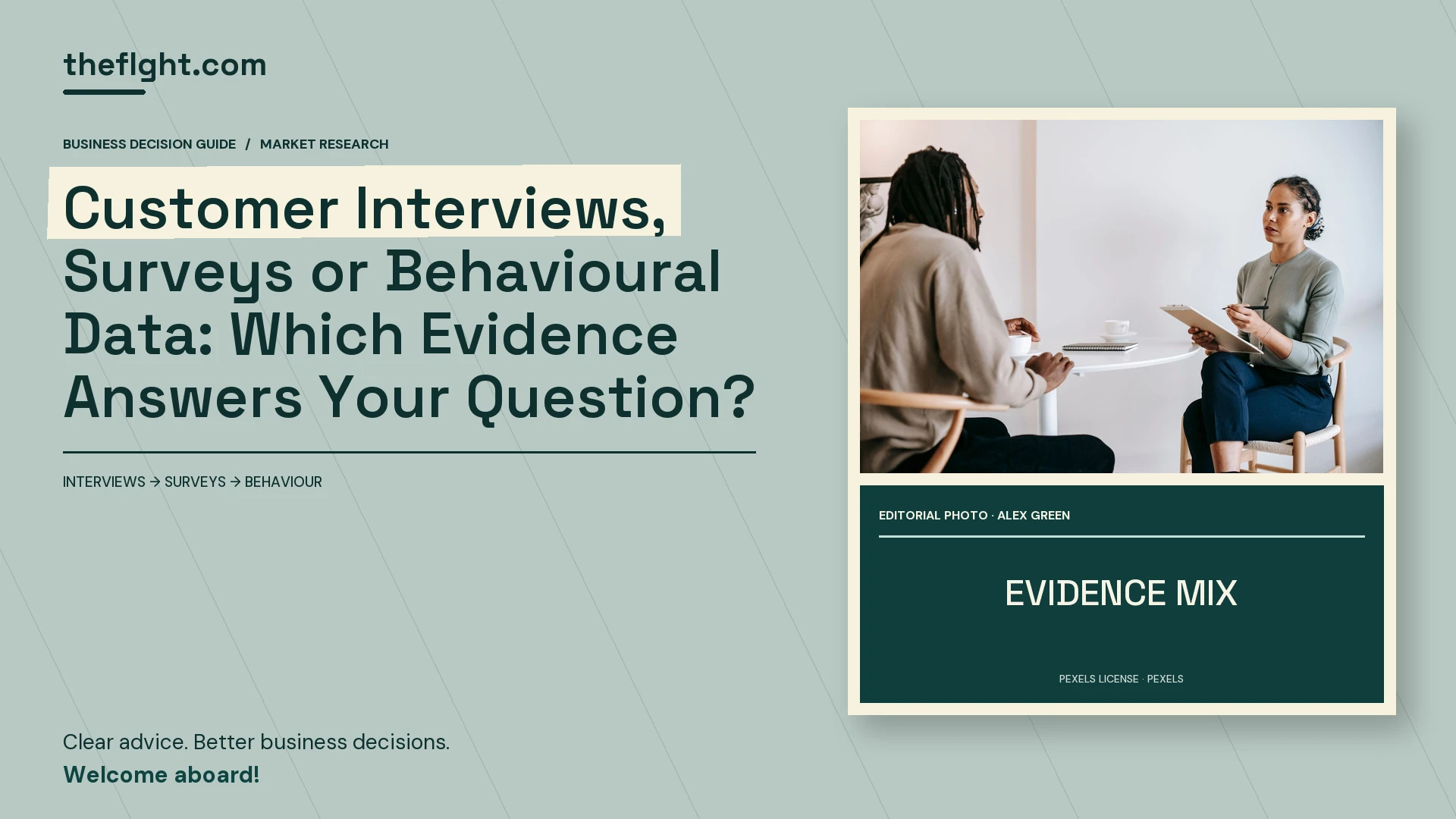
Cover photograph: Professional customer interview by Alex Green. Pexels License. Adapted with an editorial headline and The FLGHT branding.
Related guides
Comments (0)