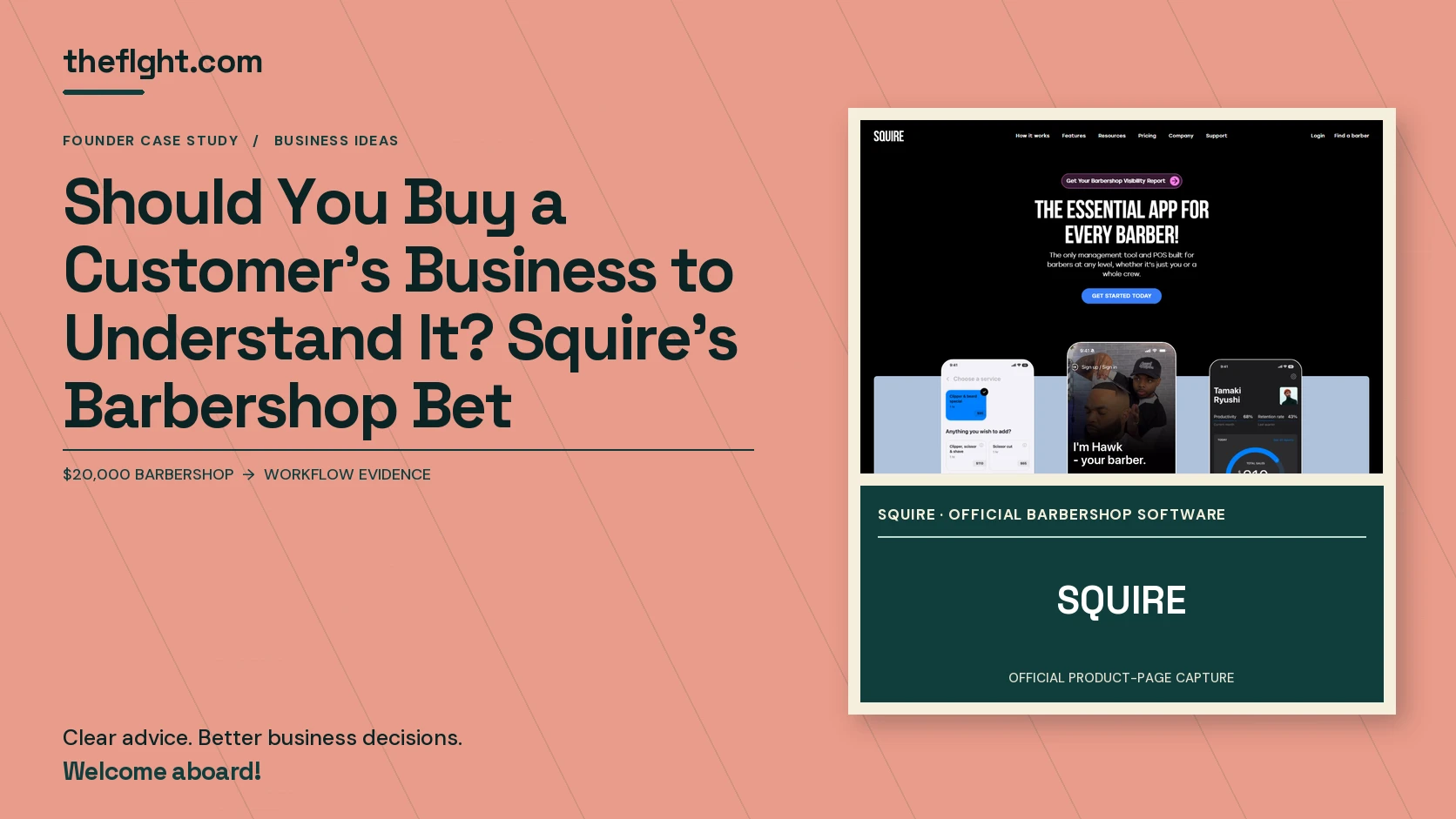
Should You Buy a Customer's Business to Understand It? Squire's Barbershop Bet
Short answer: Almost never buy a business merely to conduct customer research. First shadow five operators, perform the work yourself for at least three shifts and sell a manual version of the proposed outcome. Consider ownership only when access to the full cash flow and back-office workflow is essential, the acquisition costs less than a failed product cycle and you can cap the experiment without risking the company.
Squire's founders made the exceptional case look compelling. After struggling with a consumer booking idea, they bought a New York barbershop and learned the operating problems from inside. That decision helped them rebuild around barbershop management rather than consumer discovery.
The wrong lesson is that buying a customer creates commitment. It can create rent, payroll, regulation and a second company. The useful lesson is that founders need access to the decisions customers cannot explain in an interview.
Use the Embedded Customer Test
The Embedded Customer Test moves through four levels of access. Buy nothing until cheaper levels fail to answer a decision that could change the product.
| Level | Method | What it reveals | Commitment | |---|---|---|---| | Observe | Shadow five working days across several businesses | Sequence, interruptions and workarounds | Low | | Assist | Perform defined tasks under supervision | Skill, timing and error consequences | Low to medium | | Operate | Run a manual service or temporary concession | Full transaction and customer response | Medium | | Own | Buy or establish the operating business | Cash flow, staffing, compliance and incentives | Very high |
Advance only when you can state the unanswered question. “We need deeper insight” is not enough. “We cannot see whether walk-ins, chair availability or payment reconciliation causes the lost revenue” is specific and testable.
What Squire learned by becoming the customer
Squire began as an app intended to help customers find and book barbers. The founders found it hard to persuade shops to adopt the marketplace. Songe LaRon has described buying a barbershop with co-founder Dave Salvant so they could experience the business and rebuild the product around actual operations. A Y Combinator interview with LaRon describes the shift from consumer booking towards the operating system for barbershops.
An Albany alumni profile reports that the founders used $20,000 of their $60,000 starting capital for the shop. Other retrospective accounts give different purchase figures, so treat $20,000 as the figure in that source rather than an uncontested accounting record.
Ownership exposed the whole journey: customers arriving, barbers managing chairs, payments moving, appointments changing and managers trying to reconcile the day. That evidence is difficult to obtain from a scheduled interview because operators normalise workarounds and omit tasks they no longer notice.
Squire's decision was still unusually risky. It committed roughly a third of the reported starting capital and added a physical operation to a software company. You should copy the depth of access, not automatically the acquisition.
Define the learning asset before the operating asset
Write down the information you need and why ordinary access has failed. There are only a few defensible reasons to operate the customer's business:
- The workflow spans cash, staff and customers, and no single employee can show it end to end.
- Existing businesses will not provide access to commercially sensitive records.
- The product changes behaviour during live service, so a demonstration cannot expose adoption friction.
- You need repeated decisions across weeks, not opinions collected in an hour.
Then define what you will not learn. One shop cannot represent every shop. A founder-operated site may behave differently because you tolerate errors, work longer hours or explain the software personally. Ownership improves depth and weakens breadth. Counter that bias by comparing the findings with at least five unaffiliated businesses.
Put a stop-loss around immersion
Cap three resources before you begin: cash, founder time and operational liability. The test ends when any cap is reached, even if the experience remains interesting.
| Cap | Question | Sensible evidence gate | |---|---|---| | Cash | What can you lose without ending the product company? | Written maximum including closure costs | | Time | How many founder-weeks can operations consume? | Fixed shifts and a named end date | | Liability | What obligations survive the experiment? | Lease, staff, licences and refunds mapped | | Learning | What decision will the evidence change? | Product scope, customer or price chosen |
Buying a solvent business does not make the experiment reversible. Leases, employees, consumer obligations, tax and licences vary by jurisdiction and sector. Take qualified local legal and accounting advice before acquiring or operating one.
Worked example: QueueCraft and a salon concession
QueueCraft is a fictional UK start-up building scheduling software for independent salons. The founders consider buying a small salon for £45,000. Instead, they negotiate a 12-week concession inside an existing salon.
Their experiment costs £4,800 in concession rent, £7,200 for a part-time manager, £1,400 for insurance and setup, and £3,600 of founder time valued at £300 a day for 12 days. Total exposure is:
£4,800 + £7,200 + £1,400 + £3,600 = £17,000
The concession processes 540 appointments. Manual measurement shows that 81 customers request changes, and 49 of those changes happen within four hours of the appointment. The original product was designed mainly to attract new bookings. Yet only 18 booking slots remain empty because of weak discovery, while late changes create 37 unrecoverable gaps.
At an average £34 contribution per completed appointment, the late-change problem costs:
37 gaps × £34 = £1,258 over 12 weeks
Annualised for one comparable site, that is approximately £1,258 ÷ 12 × 52 = £5,451. QueueCraft changes its first product to deposits, wait-list filling and change handling. It spends £17,000 to redirect the build without assuming the £45,000 purchase price or a continuing lease. The result shows why operating access can be valuable and ownership unnecessary.
Turn lived experience into transferable evidence
Keep an event log, not a diary. Record the trigger, action, delay, person affected and financial consequence. Code each incident under a stable category such as scheduling, staffing, payment, stock or customer recovery. After 30 operating days, rank categories by frequency and contribution lost.
Next, take the top three problems to five outside operators. Ask them to show their last occurrence using records, not recall. If the same sequence appears elsewhere, you may have a market problem. If it exists only in your operation, you may have created a local management problem.
Finally, charge for the manual outcome before building the full system. A salon agreeing that cancellations hurt is weak evidence. A salon paying for wait-list management is stronger.
What to do over the next 20 working days
In the first two days, name the exact workflow decision you cannot make. Arrange five observation sessions and obtain appropriate permission for access to staff, customer and financial information.
During days three to 10, shadow the process and perform one task under supervision where lawful. Record 30 real events. By day 12, compare the pattern across five businesses.
Only if a crucial question remains should you design a time-limited operating test. Price closure, insurance, tax, employment and licensing obligations before signing anything. On day 20, choose among stopping, running a concession or operating a business. Buying is the last rung, not the badge of serious research.
Related guides
Frequently asked questions
How many customer interviews should I do before shadowing work?
Interview at least ten people across five businesses, then shadow when their descriptions conflict or omit the sequence you need. The number is a working guide, not statistical proof. Your aim is to find repeated events and different operating contexts, not reach a round total. Ask interviewees to reconstruct the last real occurrence using calendars, receipts or system records. If ten conversations reveal the same measurable problem and customers will pay for a manual outcome, ownership is unlikely to add enough evidence to justify its risk.
Can I work inside a customer's business without buying it?
Yes, and that is usually the better route. You can shadow staff, take a temporary operational role, run a paid pilot or operate a concession with clearly defined responsibilities. Agree confidentiality, data access, insurance, customer communication and who bears loss before starting. Employment, health and safety, data protection and sector rules vary by country and activity. Obtain qualified local advice where the arrangement creates legal duties. The purpose is legitimate access to workflow evidence, not disguising unpaid labour or bypassing regulation.
What if customers will not let me observe sensitive operations?
Reduce the request before increasing the incentive. Ask to observe one narrow process, anonymise records, sign appropriate confidentiality terms and explain exactly what will be captured. You can also reconstruct events from audit logs, screen recordings controlled by the customer or staff walkthroughs using completed cases. Refusal is itself information about trust and product adoption. Do not buy a business solely to defeat normal privacy boundaries. Sensitive industries may prohibit access regardless of consent, so check current rules and use a qualified professional.
Should I acquire a failing business because it is cheaper?
Usually not. A low purchase price can conceal lease arrears, staff claims, tax liabilities, damaged demand and unusual workflows caused by distress. Those conditions may teach you how a failing operator behaves rather than how your intended customer works. If the asset still fits, investigate liabilities, recurring revenue, owner dependence and closure cost with legal and financial advisers. An asset purchase may differ from buying the company, but neither is automatically clean. Treat due diligence cost as part of the learning budget.
How do I stop operating work taking over the start-up?
Allocate fixed shifts, appoint one operating owner and forbid routine issues from consuming the product team's protected build time. Track founder hours as a real cost. Set a dated end to the immersion and a list of evidence that must be collected by then. If the operation requires continuing founder rescue, that may be the most important insight, but it does not justify endless involvement. Close, sell or hand back the test when the learning question is answered, subject to your contractual and legal obligations.
What evidence should change my original product idea?
Change it when observed behaviour shows that the original problem is infrequent, low-cost or owned by a different buyer, while another repeated problem carries measurable loss and a clear budget. Require evidence from your operated environment and at least five independent businesses. A vivid incident in your own shop is not enough. The replacement problem should also support a paid manual test. Squire's useful move was not simply discovering more features. It was changing from consumer discovery to the shop's operating system.
Is buying a customer ever the fastest route?
It can be when the acquisition is small, reversible enough, legally manageable and cheaper than prolonged product error. It is still the fastest route only if you can continue product work while operating and if the business represents the intended segment. Compare the fully loaded purchase, working capital and exit cost against a concession, secondment or paid pilot. Speed to access is irrelevant if the transaction traps your cash for years. Most founders should exhaust observation, assistance and temporary operation first.
Comments (0)