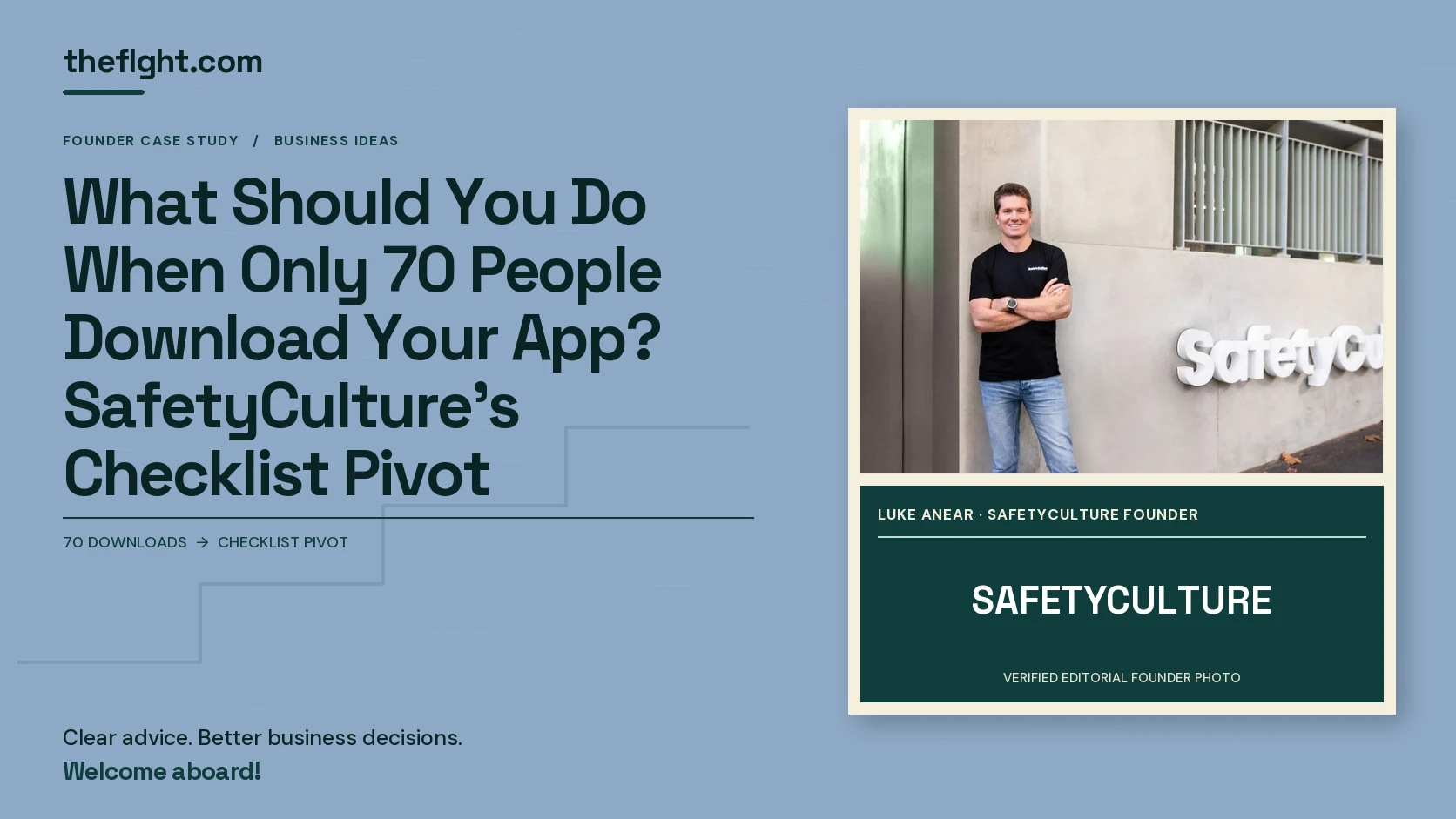
What Should You Do When Only 70 People Download Your App? SafetyCulture's Checklist Pivot
Short answer: Do not add features or buy traffic until you know whether the failure is reach, activation, repeated use or problem scope. Interview 15 intended users, watch five attempt the core task and rebuild only the smallest element that removes the dominant failure. If fewer than three of ten suitable users complete the task twice without founder prompting, change the problem or customer before spending on growth.
SafetyCulture's first app reportedly gained only about 70 downloads. Customer observation showed that the initial job-safety framing was too restrictive. The company broadened the product into a configurable inspection and checklist app, and founder Luke Anear says it passed a 10,000-download annual goal within weeks.
Low traction is not a verdict by itself. Seventy downloads can mean nobody saw the product, the store page failed, users could not activate or the use case was too narrow. You need evidence that identifies which one.
Use the Narrowness Diagnosis
The Narrowness Diagnosis tests four layers in order. Do not call the idea bad until you have isolated where the chain breaks.
| Layer | Evidence | Failure meaning | Next test | |---|---|---|---| | Reach | Suitable people view the offer | Distribution may be weak | Directly recruit 20 target users | | Activation | Users complete the first valuable task | Setup or promise may be weak | Observe five first sessions | | Repetition | Users return without reminders | Problem may be infrequent or minor | Track second and third use | | Transfer | Adjacent users adopt the same mechanism | Original scope may be too narrow | Test one broader use case |
The order matters. Buying downloads before activation only purchases a larger sample of confusion. Expanding the product before observing repeat use can replace one unproven idea with five.
What SafetyCulture changed
SafetyCulture grew from Anear's concern with workplace safety and an early app focused on job safety analysis. In a founder interview about finding traction, he describes the first product receiving roughly 70 downloads and the shift that followed.
The turning point was not a clever store listing. Customer visits exposed binders of inspection paperwork and a wider need for configurable checks. SafetyCulture rebuilt the app around general inspections and checklists under the iAuditor name. An Australian Investment Council profile records the company's path from workplace safety into a broader inspection platform.
Anear has said the new product exceeded a target of 10,000 downloads for the year within about six weeks. Treat that as a founder-reported outcome, not a benchmark. Downloads still did not equal a business, but the sharp change after broadening the use case supplied evidence that scope, rather than the underlying checklist mechanism, had constrained adoption.
My position is that founders pivot too quickly on audience and too slowly on problem framing. If the same mechanism solves a more frequent, expensive job for adjacent users, broadening can be disciplined. If you simply rename the app for everyone, it is avoidance.
Recruit users directly before testing distribution
Find 20 people who definitely experience the intended problem. Do not rely on store traffic. Ask them to perform the task with the app while you observe silently. Record where they stop, what they expected and whether they reach the first valuable result.
Then watch what happens without reminders. A user completing one checklist beside you proves usability under assistance. A user creating another checklist next week proves more. Ask for a real artefact, such as an inspection record, shared report or avoided hour, rather than a satisfaction score.
If suitable users activate and repeat but downloads remain low, work on distribution. If they fail in person, marketing is not the first problem.
Broaden the job, not the feature list
Look for the invariant mechanism under the first use case. SafetyCulture's useful mechanism was not one particular safety form. It was turning paper checks into configurable mobile inspections and records.
List three adjacent jobs using the same sequence, data and buyer. Test one at a time.
| Expansion | Good sign | Warning sign | |---|---|---| | Same user, more frequent job | Existing users create it themselves | Founder suggests it without evidence | | Adjacent user, same mechanism | Minimal product change needed | Entire workflow must be rebuilt | | Broader label, same outcome | Users understand it faster | Message becomes vague |
Do not broaden into different buyers, workflows and economics at once. That is a new business, not a scope correction.
Worked example: CloseCheck
CloseCheck is a fictional UK app for end-of-day restaurant fire-safety checks. It attracts 80 downloads after three months. The founder considers spending £4,000 on app advertising.
She recruits 20 restaurant managers directly. Twelve complete a fire checklist once, but only two return within seven days. Interviews show that a formal fire check is monthly at many sites, while closing checks for fridges, doors, cash and cleaning happen daily.
She spends £1,800 building a configurable daily checklist and £600 recruiting a second 20-manager cohort. Fifteen activate and nine complete at least five checklists in two weeks. The evidence cost is £2,400.
Had she bought downloads at an indicative £5 each, £4,000 would have produced 800 installs. At the original observed repeat rate of 2 ÷ 20 = 10%, only about 80 might repeat. Under the new observed rate of 9 ÷ 20 = 45%, the same 800 suitable installs could yield 360 repeat users, though paid traffic quality may differ.
The arithmetic does not prove scale. It proves that spending £2,400 to repair scope was more informative than spending £4,000 to amplify the old behaviour.
Decide whether to preserve, narrow or pivot
Preserve when target users activate, repeat and can name the value, but too few suitable people see the offer. Narrow when one segment repeats materially more than the rest. Broaden when users repurpose the mechanism for a nearby, more frequent job. Stop when repeated observation reveals no urgent job, no responsible buyer or no plausible path to contribution.
Set the decision before the test. For 20 recruited users, you might preserve at eight repeat users, revise at three to seven and stop or change the problem below three. Those are experiment thresholds, not market benchmarks. Choose numbers that make the next investment rational for your economics.
What to do over the next 14 days
On day one, export the funnel from view to download, activation and second use. During days two to five, recruit 20 people who meet the original target criteria.
Observe five first sessions and interview all 20 using real recent tasks. By day seven, identify the single dominant break. Build only the change needed to test it.
Run the revised task from days eight to 13. On day 14, compare activation and repetition between cohorts. Spend on distribution only if suitable users now repeat. Otherwise narrow, broaden or stop according to the written thresholds.
Related guides
Frequently asked questions
How many downloads are enough to judge an app idea?
Downloads alone are never enough because they do not confirm that suitable users reached value. Recruit at least 20 target users directly and track activation plus second use. That cohort is not statistical proof, but it can expose a dominant failure before you spend heavily. If the app serves a rare enterprise task, fewer users with repeated, high-value use may be meaningful. A consumer app may require a larger cohort. Set the evidence threshold from frequency, value and acquisition cost, not a universal download count.
Should I change the app-store description first?
Change it first only if direct observation shows that suitable users misunderstand the promise before downloading. A clearer listing can repair reach-to-install conversion, but it cannot make a weak problem frequent or fix a failed first session. Test two descriptions with the same audience and measure activated users, not taps. If users you recruit personally still fail to complete or repeat the task, work on product and problem scope. Store optimisation belongs after you can recognise value in real behaviour.
When is low traction just a marketing problem?
It is mainly a marketing problem when suitable users who are brought in directly activate, repeat and would be disappointed to lose the product, while organic reach remains low. Verify this with behaviour and at least some payment or costly commitment. Praise from friends does not qualify. Also check that the acquisition cost the channel implies can fit expected contribution. A product can be useful and still lack an affordable route to customers. In that case distribution economics, rather than product utility, blocks the business.
How broad should the pivot be?
Change one dimension at a time where possible: the job, customer, mechanism or revenue model. SafetyCulture kept the mobile checklist mechanism while broadening the jobs it could serve. That made the new evidence interpretable. Changing customer, problem and product simultaneously may be necessary, but it resets most of what you know. Prefer an adjacent use case that existing users already improvise. Require five observed examples before adding it, then compare repeated use against the original cohort under the same observation period.
Should I ask users what features they want?
Ask what they were trying to accomplish, what happened last time and what consequence followed. Feature requests can reveal friction, but users are not responsible for designing a coherent product. Watch the workaround and measure its cost. If five users ask for reminders because they forget an infrequent task, the deeper issue may be frequency rather than notifications. Build a feature only when it removes a repeated obstacle to the core result. Track whether behaviour changes after release, including whether the same users return again without prompting.
When should I shut the app down?
Stop when multiple cohorts of suitable users do not reach or repeat the core value after you have repaired the clearest usability problem, or when the resulting acquisition and service cost cannot support the price. Write this threshold before the next build cycle. Closing does not require proving nobody will ever want the app. It requires recognising that the next pound is unlikely to produce decision-changing evidence. Preserve the customer learning, honour data and consumer obligations, and communicate clearly with any active users.
Does a fast download spike prove product-market fit?
No. It proves that distribution and the immediate promise generated installs. SafetyCulture's reported spike was meaningful because it contrasted strongly with the earlier app, but downloads still needed to become useful repeated behaviour and revenue. Track activation, weekly or task-based retention, user-created content, referrals and payment. The right interval follows the task: daily checks should repeat quickly, while an annual compliance event will not. Define fit through the customer's operating rhythm rather than an attractive chart, and wait for several cycles before declaring the pattern durable.
Comments (0)