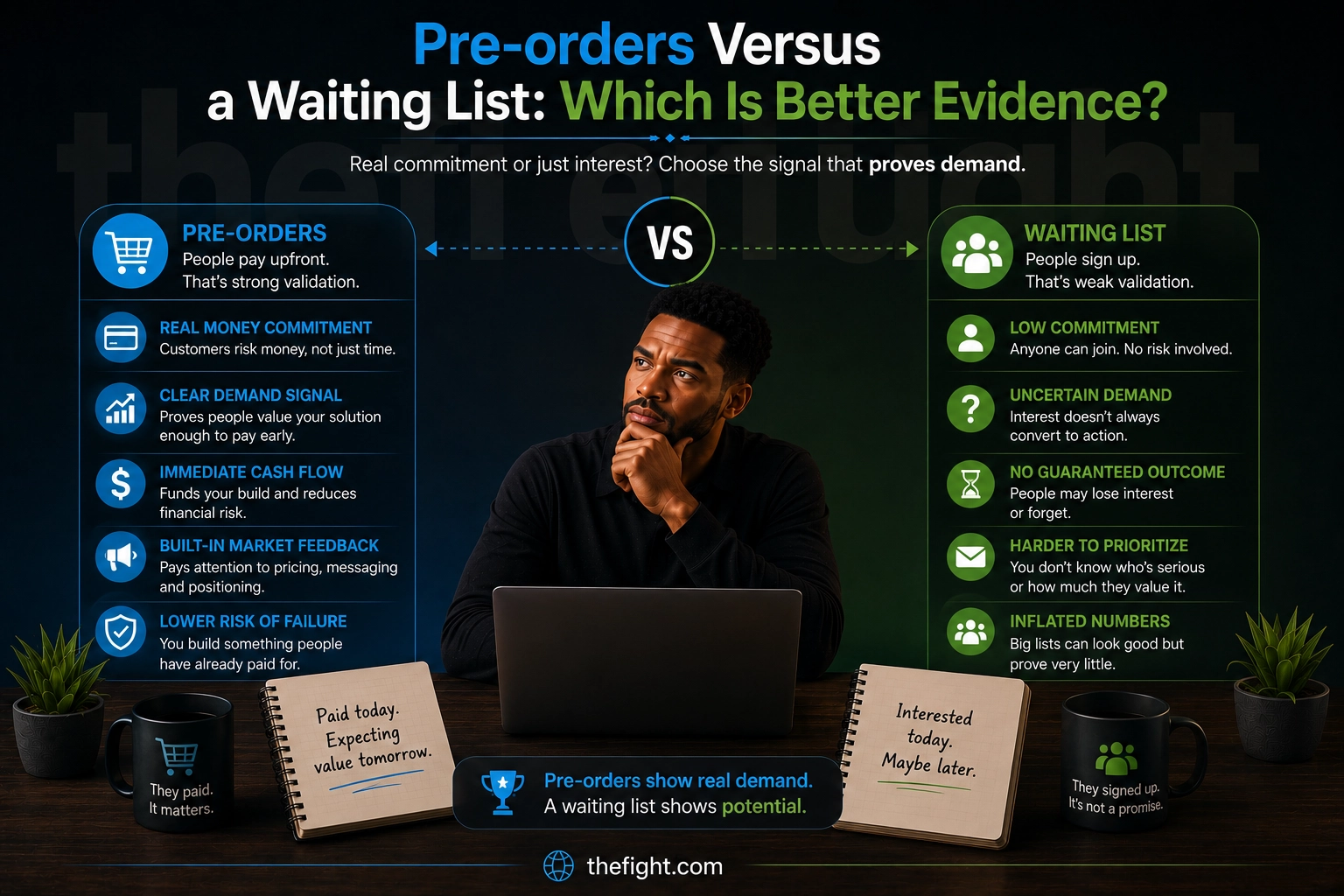
Pre-orders Versus a Waiting List: Which Is Better Evidence?
Short answer: A genuine pre-order is stronger evidence because the customer accepts a real price, delivery condition and payment sacrifice.
It also creates refund, communication and fulfilment obligations, so use a waiting list when cost, timing or safety is still too uncertain to take money responsibly. Compare both signals among the same qualified audience. Do not proceed to production until commitments cover your minimum viable batch or you can fund the shortfall without using refundable money.
A waiting list can contain curiosity, support and people who have forgotten what they joined. A pre-order filters more of that noise, but payment does not make the business viable if eight customers commit and the supplier requires 500 units.
The right evidence depends on what you are ready to promise. Stronger customer sacrifice creates stronger founder responsibility.
Use the Commitment-Obligation Grid
The Commitment-Obligation Grid compares each demand signal on two axes: what the customer gives up and what you become responsible for.
| Signal | Customer sacrifice | Founder obligation | What it can show |
| Email waiting list | Contact detail and small attention | Honest communication and appropriate data handling | Message relevance and a pool for follow-up |
| Qualified waiting step | Price acknowledgement, delivery preference or booked conversation | Stronger fit and timing evidence | |
| Refundable deposit | Money unavailable until refund or delivery | Clear terms, cash protection and prompt remedy | Price acceptance under stated conditions |
| Full pre-order | Full payment and purchase decision | Lawful fulfilment, updates, cancellation and refund handling | Strong buying intent and order value |
Move down the grid only when your operational readiness can carry the corresponding obligation. A full pre-order is not a research response you can ignore if production becomes inconvenient.
Make a waiting list difficult enough to be informative
A name and email collected after a broad social post is weak. State the intended buyer, result, price range or exact price, likely timing and important limitation before someone joins.
Then request one relevant action. Ask which use case applies, whether the stated price remains acceptable or whether the person will book a short buying conversation. Do not add friction purely to reduce numbers. Each field should test an assumption.
Measure response from qualified exposure:
Waiting-list conversion = qualified signups divided by qualified visitors or approaches
Raw list size hides how people arrived. A prize, unrelated audience or friend sharing can generate signups without intended buyers. Record source and qualification separately.
My view is that a waiting list should have an expiry date. If you cannot make a real offer within a defined period, re-confirm interest rather than presenting an old count as current demand.
Accept pre-orders only against a deliverable promise
Before taking money, know the proposed specification, price, delivery window, minimum condition, cancellation process and what happens if the threshold is not reached. State uncertainties plainly.
Keep refundable money available unless qualified advice and the agreed terms permit another treatment. Do not use deposits to discover whether manufacturing is possible and then hope future sales fund refunds.
Consumer, contract, tax, payment and data rules vary by country and product. Safety, labelling and product-specific regulation may apply before sale. Use qualified local legal, accounting and sector advice when structuring pre-orders, especially for a product with unverified performance or a long delivery period.
Some founders avoid early payment because they fear disappointing customers. That concern is reasonable. The answer is not to call a waiting list a sale. Either reduce uncertainty enough to offer protected commercial terms or admit that demand remains untested.
Compare rates, not incomparable totals
One hundred waiting-list names and ten pre-orders cannot be compared unless the audiences, offers and exposure are known. Use the same buyer definition, traffic source, message and time period where possible.
Track at least four figures:
| Figure | Why it matters |
| Qualified exposures | Denominator for the signal |
| Commitments | |
| Commitment value | Cash and order value at risk |
| Fulfilment threshold | Orders and cash required to deliver responsibly |
A lower pre-order conversion can be more valuable because the action is harder. But neither rate has meaning without unit economics. Calculate contribution per delivered order and the cash required before final customer payment clears.
Worked example: Maya's insulated cycling lunch bag
Maya is testing an insulated lunch bag for cycle commuters. She first shows a clear description, intended price of £68 and proposed delivery period to 180 qualified visitors. Thirty-six join the waiting list.
Waiting-list conversion is:
36 divided by 180 = 20 per cent.
Maya follows up, asking people to confirm that £68 remains acceptable and select the stated delivery period.
Nine respond. That deeper signal is 9 divided by 180 = 5 per cent of qualified exposure.
After clarifying production, she runs a refundable-deposit pre-order test with 120 comparable qualified visitors.
Eight people pay £15 each.
Deposit conversion is:
8 divided by 120 = 6.67 per cent.
Deposits total 8 × £15 = £120. The supplier's minimum is 200 units at £29 each, so manufacturing alone requires 200 × £29 = £5,800. Maya still faces a £5,680 manufacturing gap before other costs, calculated as £5,800 minus £120, and the deposits may need to remain refundable.
At a £68 selling price, packaging, delivery, payment and sale-specific support are estimated at £11. Contribution per delivered unit would be:
£68 minus £29 minus £11 = £28.
Eight completed orders would produce only 8 × £28 = £224 contribution. The pre-orders are stronger evidence than the waiting list, but they do not justify a 200-unit batch. Maya should seek a lower production minimum, run a broader qualified pre-order test or stop. She must not multiply 6.67 per cent by a huge theoretical audience and treat forecast orders as cash.
Set the threshold before seeing results
Define the number of orders and cleared, usable cash required for fulfilment, plus a safety allowance for cancellations, failed payments and replacements. The threshold should come from supplier terms and your cash cycle, not a satisfying round number.
Also set a deadline. If the threshold is missed, follow the stated refund or expiry process promptly. Extending repeatedly changes the offer and tests customer patience rather than demand.
Where a small first batch costs more per unit, compare its lower commitment with reduced contribution. Paying more per unit may be the rational price of better evidence. Do not chase the lowest unit cost by accepting inventory risk unsupported by orders.
Interpret cancellations and silence
A cancelled pre-order can reveal delivery timing, changing need, trust or simple buyer regret. Ask for a reason without making refund difficult. Preserve cancellation data as part of demand evidence.
Waiting-list silence is less diagnostic because the original commitment was weak. Re-confirm with the intended price and date once. People who do not respond should leave your active forecast, even if you may lawfully retain details under the stated permission.
Do not report gross pre-orders while hiding refunds. Net active commitments are the relevant figure. Likewise, separate friends, employees and discounted buyers from customers purchasing on intended terms.
Run the two-stage test in 14 days
Start with a qualified waiting step if specification, cost or delivery remains uncertain. State price and timing, then use responses to resolve the assumption blocking a responsible sale.
Proceed in this order:
- Calculate unit contribution, supplier minimum and fulfilment cash.
- Define qualified exposure and the commitment threshold before launch.
- Present the same clear offer to a waiting-list group.
- Move to protected pre-order terms only when you can state and carry the obligation.
- Produce, revise or refund according to the pre-set threshold and deadline.
Choose the stronger evidence you can honour. A weaker honest signal is better than money accepted against a promise you are not ready to keep.
Frequently asked questions
How many pre-orders are enough to prove demand?
Enough to meet the minimum responsible fulfilment threshold under your actual supplier, cash and cancellation terms. There is no universal count. Calculate manufacturing, packaging, delivery, tax, payment, replacement and support cash, then identify what customer payments can lawfully and safely fund. Also require a qualified source of buyers rather than friends alone.
Ten pre-orders may be compelling for a made-to-order service and useless against a 1,000-unit minimum. The exception is a test whose objective is price acceptance rather than production, but state that limitation and do not present the result as proof the complete business can fulfil.
Should I take full payment or a refundable deposit?
Take the smallest payment that creates meaningful commitment while matching your delivery certainty and legal obligations. A full payment is stronger evidence but creates greater customer exposure and founder responsibility. A refundable deposit can test price seriousness while leaving a later balance, provided terms, refund triggers and cash handling are clear.
Do not call a token amount a sale if customers do not understand the final price. The correct arrangement varies by country, product and payment method, so obtain qualified local advice. High-risk or unverified products may require further testing before either form is appropriate.
Does a large waiting list make investors or suppliers take the idea seriously?
It may start a conversation, but a competent counterparty will ask how names were acquired, what offer they saw, how current they are and how many accepted commercial terms. Present qualified exposures, signup rate, follow-up action and net pre-orders rather than one headline total.
Do not imply that list members are customers. A supplier may still require cash or a binding order regardless of interest. The exception is a tightly qualified list created through a high-effort action, which carries more evidence than casual signups, but fulfilment economics and conversion remain unproven until tested.
Are pre-orders from friends and family valid evidence?
They are valid evidence of your ability to take and fulfil an order, but weaker evidence of market demand. Friends may buy to support you, tolerate delays or accept a price because of the relationship.
Record them separately and seek buyers who experience the target problem without a personal incentive. Do not exclude their cash from operational records or treat their rights differently. The exception is a business genuinely serving a community in which your relationships are the normal route to customers. Even then, repeat sales and referrals beyond the closest circle provide stronger proof.
How long should I keep people on a waiting list?
Set an expected offer or update date when they join and re-confirm interest if that date passes. Do not treat old, silent names as current demand. Provide updates only within the permission given and make leaving straightforward. The commercially useful period depends on purchase frequency and development time, but the list should have a decision purpose.
If you are still unable to state price or delivery after the planned period, explain the uncertainty and ask whether the person wants to remain. Privacy and marketing-consent requirements vary, so check current local rules and obtain advice where necessary.
What if pre-orders do not reach the minimum batch?
Follow the terms you stated: refund promptly, extend only with explicit customer agreement, or offer a lawful alternative without pressure. Then examine whether the failure came from weak demand, poor access, price, timing or an unrealistic supplier minimum. A smaller higher-cost batch may preserve evidence if contribution remains viable.
Do not keep customer money while searching indefinitely for new buyers. The exception is a clearly disclosed rolling made-to-order arrangement with no batch dependency, where each order can be fulfilled independently. Confirm that the operating model and customer terms genuinely support that exception.
Comments (0)