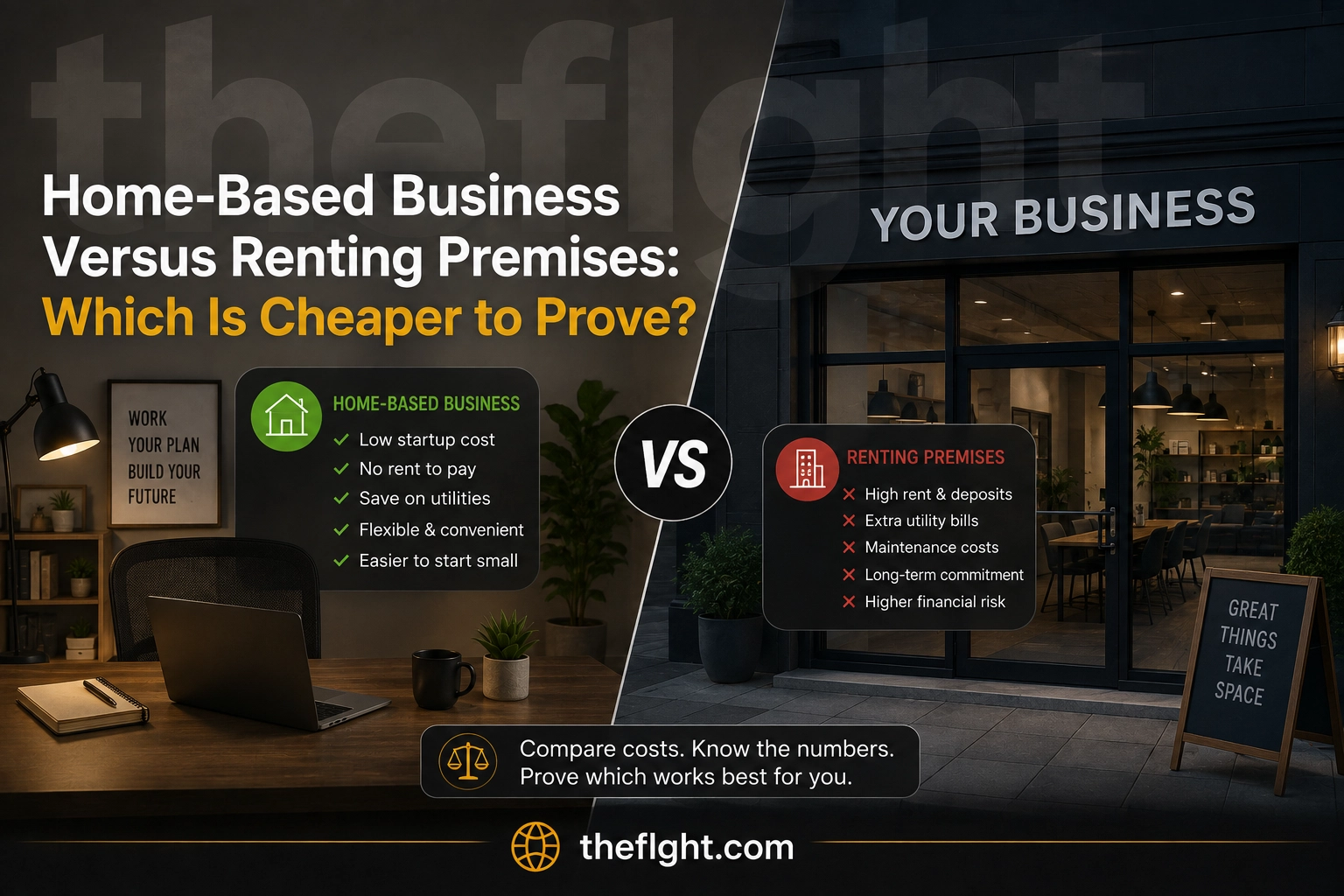
Home-Based Business Versus Renting Premises: Which Is Cheaper to Prove?
Short answer: Prove the business from home, at customers' premises or in space hired by the hour unless a temporary test shows that dedicated premises create enough extra contribution to cover every new occupancy cost by at least 1.5 times.
Before signing a lease, keep cash for the deposit, setup and six months of fixed occupancy costs. Rent because lack of space is causing measured lost sales or unsafe delivery, not because premises make the idea feel established.
Home is cheaper only when it can support lawful, credible delivery. A spare room is not free if customers cannot visit, stock takes over the house or planning and insurance restrictions prevent the activity.
Premises can improve visibility, capacity and trust. They can also convert an uncertain idea into a fixed monthly obligation before you know whether customers will travel to the location. The comparison must measure what the space changes, not merely compare rent with zero.
Use the Space Proof Threshold
The Space Proof Threshold tests four conditions in order. Dedicated premises are justified only when the business passes all four.
| Threshold | Question | Evidence required |
| Permission | Can you operate safely and lawfully in each space? | Written checks covering lease, planning, insurance and sector rules |
| Necessity | Recorded refusals, capacity losses or required facilities | |
| Increment | How much extra monthly contribution will the premises create? | Results from temporary space, not optimistic footfall |
| Exposure | Can you survive if that increment arrives late? | Deposit, setup and six months of occupancy cash after other commitments |
The 1.5 coverage level and six-month reserve are conservative working guides, not universal benchmarks. A short, flexible agreement may justify less cash. A specialised fit-out or seasonal business may require more. Use the actual terms and your own demand evidence.
Count the full cost of each space
For home working, include additional utilities, storage, insurance changes, cleaning, noise control, delivery restrictions and the value of any room you can no longer use personally. If customer visits are necessary, include privacy, accessibility and household disruption.
For rented premises, include more than headline rent:
| Cost type | Examples | Cash timing |
| Entry | Deposit, advance rent, legal review and initial fit-out | Before opening |
| Cost type | Examples | Cash timing |
| Fixed occupancy | Rent, service charges, business rates where applicable and minimum utilities | Monthly regardless of sales |
| Operating | Monthly or usage-based | |
| Exit | Repairs, reinstatement, notice-period rent and disposal | When leaving or changing the space |
Obtain written quotes and read the lease. A low monthly rent paired with a long term, repair obligation or personal guarantee can create the larger risk.
Property, planning, tax, business-rate, accessibility, fire-safety and insurance requirements vary by jurisdiction and use. Check with the landlord, local authority, insurer and appropriately qualified legal or property professionals before committing.
Identify what customers are actually buying from the space
Premises can provide convenience, privacy, equipment, storage, visibility or reassurance. Name the benefit precisely. “Customers will take me seriously” is not evidence.
Ask prospects whether the location changes their buying decision, but do not stop at their answer.
Test behaviour. Offer appointments in hired space for a limited period, run a short residency where permitted or compare conversion between home delivery and a professional room hired by the hour.
Count only additional contribution, not additional revenue. If a shop creates £3,000 of new sales but products, staffing and transaction costs consume £2,200, the space has added £800 towards its fixed costs.
My view is that appearance alone is a poor reason to sign a lease. If customers require privacy or specialist facilities, premises may be essential. If you mainly want the psychological commitment of having an address, use a cheaper commitment to your sales routine.
Test capacity before buying capacity
Home businesses often outgrow a constraint gradually. Storage fills, appointments collide or household tolerance falls. Record the constraint for four weeks:
- Enquiries refused because the space was unsuitable
- Paid work delayed by lack of capacity
- Extra hours lost moving or setting up equipment
- Orders limited by storage or collection rules
Then calculate the contribution lost. A rented unit is financially justified only if it removes a valuable constraint.
General busyness does not count if the diary could be improved through price, scheduling or a narrower offer.
Temporary space is particularly useful because it tests both customer behaviour and operating reality. You learn whether buyers attend, what equipment is missing and how much opening and closing time consumes without accepting a long property obligation.
Worked example: Mara's clothing alterations business
Mara runs clothing alterations from a permitted room at home. Her additional home occupancy costs are £140 a month. A small high-street unit would cost £800 rent plus £440 for service charges, utilities, insurance differences and other fixed occupancy costs, making £1,240 a month.
Her average job is £55. Thread, fastenings and payment costs average £7, so contribution is:
£55 minus £7 = £48 per job.
The rented unit adds £1,240 minus £140 = £1,100 of monthly fixed cost. Mara needs:
£1,100 divided by £48 = 22.92, rounded up to 23 additional jobs a month just to break even on the move.
Using the Space Proof Threshold's 1.5 coverage guide, she would want £1,650 of extra contribution. That requires £1,650 divided by £48 = 34.38, rounded up to 35 additional jobs each month.
The landlord also requires a £2,400 refundable deposit. Fit-out and professional costs are quoted at £2,750, so entry cash is £5,150. Six months of fixed occupancy costs add 6 × £1,240 = £7,440. Mara's prudent cash requirement is therefore £12,590 before allowing for personal living costs.
She hires a suitable room and collection point for eight weeks. The test produces an average of 14 extra jobs a month, worth 14 × £48 = £672 contribution. That does not cover the £1,100 cost increase. She should remain home-based and investigate pricing, collection arrangements and further temporary tests rather than sign the lease.
Compare reversibility, not just monthly cost
A home arrangement can often be changed within weeks. A lease, fit-out and public opening hours create dependencies that are slower to unwind. Give each option a reversal cost: the cash and months required to leave it without breaching a promise.
Some landlords offer licences, shared units or shorter terms. These may reduce exposure, but check what rights, notice and liabilities actually apply. A flexible label in an advertisement does not replace the written agreement.
If a location is essential to the customer experience, consider whether a market stall, pop-up, concession or room hired by the session can test the specific premise. Match the test to the claim. A weekend pop-up can test destination demand, but it cannot prove weekday repeat trade without further evidence.
Make the premises decision over four weeks
During week one, calculate the complete home and rented-space costs and check permission for both. In week two, record every sale constrained by your current space and the contribution attached to it.
Use weeks three and four to act:
- Hire the closest temporary equivalent to the proposed premises for defined sessions.
- Track extra enquiries, conversion, contribution, setup time and customer travel behaviour.
- Calculate how many additional monthly sales the permanent space must create.
- Stress-test the cash position if sales reach only half that level for six months.
- Sign nothing unless necessity, increment and exposure all pass the Space Proof Threshold.
If the test fails, keep the business flexible. Your next move is to improve demand or redesign delivery, not negotiate a slightly cheaper version of an unnecessary lease.
Frequently asked questions
Can customers visit my home-based business?
Possibly, but permission and suitability depend on the property, activity and location. Check your tenancy or mortgage terms, planning rules, insurance, lease restrictions and local requirements. Consider access, parking, neighbours, privacy, security and whether household members are exposed to business visitors.
A customer agreeing to visit does not make the arrangement compliant or safe. If occasional meetings are the only need, a room hired by the hour may be cleaner. Businesses involving food, beauty, childcare, health, machinery or hazardous materials can carry additional rules. Confirm specific decisions with the relevant authority and qualified local professionals.
How do I know whether premises will bring more customers?
Test the exact customer behaviour before assuming it. Use suitable temporary space, record passing enquiries separately from purchases and compare contribution with your existing model. Ask every buyer how they found you and whether the location affected the decision.
A busy street is not evidence that your intended customer will enter at your price. Run the test across representative days and times, not one promotional event. The exception is a location whose value depends on a long pattern, such as habitual weekday trade. In that case, negotiate the shortest credible trial and use conservative assumptions for unobserved months.
What percentage of revenue should rent be?
There is no safe universal percentage. Rent affordability depends on gross margin, staffing, seasonality, payment timing and the other fixed costs needed to operate the space. Calculate contribution after costs caused by each sale, then divide total monthly occupancy cost by contribution per sale to find the required sales volume.
Add a safety margin and compare it with tested demand and capacity. A high-margin appointment business can tolerate a different ratio from low-margin retail. Treat published sector ranges as indicative only and verify them against your market, lease and accounts with an appropriately qualified adviser.
Is a short lease always safer than a long lease?
No. A short commitment usually reduces duration risk, but it may carry higher rent, limited renewal rights or setup costs that cannot be recovered before the term ends. A licence may also provide fewer rights than a lease. Compare total entry, monthly and exit cash under the written terms.
Check break clauses, notice dates, repair obligations, permitted use, rent reviews and personal guarantees. Do not rely on a verbal promise that leaving will be easy. Property law varies, and commercial agreements can create substantial liabilities, so obtain independent advice from a qualified local property professional or solicitor before signing.
Should I rent premises to separate work from home life?
Only after comparing that benefit with cheaper boundaries. Fixed working hours, external storage, a lockable room or hired workspace may create separation without a full commercial lease. Put a value on the time or wellbeing improvement, but do not pretend it guarantees extra revenue.
If home working is harming health or household relationships, moving can be justified even when it does not maximise profit. Name that as a personal operating decision and make sure the business can fund it. The caveat is that replacing household strain with financial strain may not improve the situation, especially before demand is stable.
Should I rent storage before customer-facing premises?
Often, yes, when stock or equipment is the only constraint and customers do not need to visit. Compare secure storage, handling, extra journeys and insurance with the occupancy cost of a customer-facing unit. Then test whether retrieving items slows fulfilment enough to remove the saving.
Storage will not solve noise, production safety, accessibility or the need for private appointments. Use a short commitment first and track the exact home constraint it removes. Planning, lease, insurance and product-storage requirements vary by location and activity, so confirm them with the relevant authority, provider and qualified local adviser before moving business property.
Comments (0)